
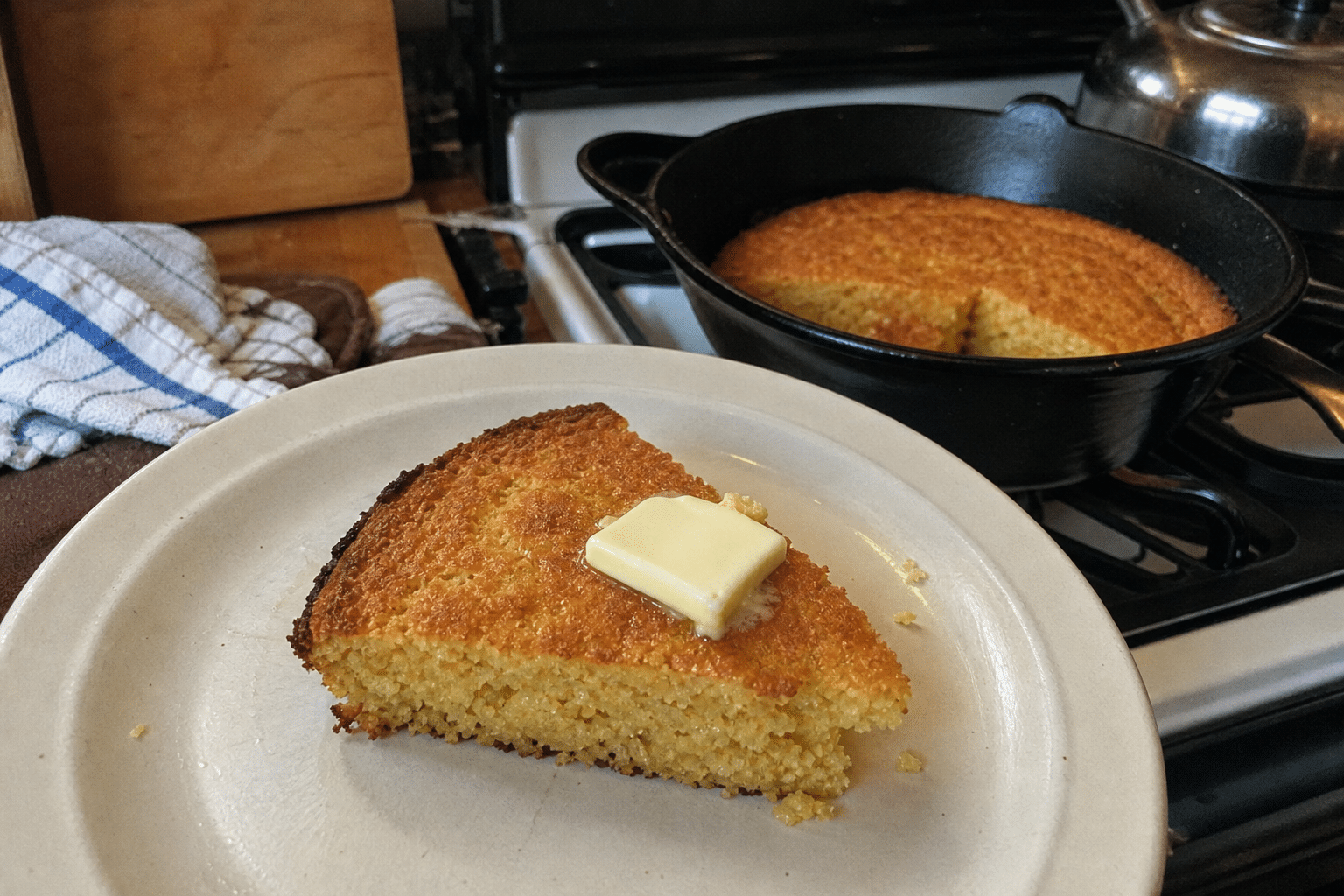

A proper cast-iron cornbread has two things a baking dish version never delivers: a base crust that crackles when you cut into it, and deeply browned sides that peel cleanly from the pan. Both come from the same move – a preheated skillet – and once you understand the science behind it, you will use this technique every time.
This recipe takes the Southern approach: no sugar, a mix of fine and coarse-ground cornmeal for crumb and texture, and full-fat buttermilk that reacts with the baking soda to give the bread its lift and tang. It is on the table in about 50 minutes, most of which is hands-off oven time.
Why this recipe works
The crackly bottom crust is all about heat transfer. When batter hits a room-temperature pan, the bottom layer heats slowly alongside the rest of the bread and bakes at roughly the same rate as the interior. When batter hits a cast iron skillet preheated to 425°F (220°C), the bottom 1-2 mm of batter jumps to roughly 350°F within seconds. Three things happen at once: the starches gel immediately to form a sealed bottom layer, the fat in the pan lightly fries the cornmeal granules into a structurally distinct crust, and the Maillard reaction starts, building the brown, toasty flavor compounds that make this worth making in cast iron specifically.
Buttermilk does two jobs: its acidity reacts with the baking soda to produce CO2 that lifts the crumb, and that same acid delivers the bread’s characteristic tang. Regular whole milk can substitute but requires adjusting the leavening chemistry and loses the flavor.
Read more: Pico de gallo from scratch: the fresh tomato salsa with 15 minutes of prep
The mix of fine and coarse cornmeal handles texture. Fine-ground alone gives a cakey, uniform crumb without much corn character. Coarse-ground alone can be dense and gritty. Together, the fine cornmeal carries the crumb and the coarse adds real bite and nuttier corn flavor.
Southern or Northern?
The main question cornbread asks you to answer is sugar. Southern-style uses none – or at most one teaspoon, which you will barely taste. Northern-style typically adds 2-4 tablespoons and leans on more flour, moving toward something closer to corn cake. This recipe is Southern by default: a savory, slightly coarse bread built to sit alongside chili, braised greens, or the Thanksgiving table. If you want a touch of sweetness, one tablespoon is the ceiling before you are making something categorically different.
The choice of fat for the skillet also matters. Butter gives the bottom crust rich browning and clean flavor. Bacon grease, the traditional Southern option, produces a slightly deeper brown and a faint savory note. Both work; use what you have.
Read more: The holiday appetizer that always goes first: warm brie with cranberry and honey
Ingredients
Serves 8
- 1 cup (145 g) fine-ground yellow cornmeal
- 1/2 cup (75 g) coarse-ground (stone-ground) yellow cornmeal
- 1/2 cup (65 g) all-purpose flour
- 1 tsp baking powder
- 1/2 tsp baking soda
- 1 tsp fine salt
- 2 large eggs
- 1 1/4 cups (300 ml) full-fat buttermilk
- 2 tbsp (28 g) unsalted butter, melted, for the batter
- 2 tbsp (28 g) unsalted butter, for the skillet (or bacon grease)
- Optional: 1 tbsp granulated sugar
Instructions
- Place a 10-inch (25 cm) cast iron skillet on the middle rack of a cold oven. Heat the oven to 425°F (220°C) and let the skillet continue to preheat for at least 10 minutes once the oven reaches temperature. Total preheat time from a cold oven is roughly 20-25 minutes.
- While the skillet heats, whisk together both cornmeals, the flour, baking powder, baking soda, salt, and sugar (if using) in a large bowl.
- In a separate bowl or large measuring cup, whisk together the eggs, buttermilk, and 2 tablespoons of melted butter until combined.
- Pour the wet ingredients into the dry and stir just until no dry streaks of flour remain. A few lumps are fine. Stop here – overmixing makes the crumb tough.
- Using oven mitts, carefully pull the hot skillet from the oven. Add the remaining 2 tablespoons of butter directly to the pan. It should sizzle and melt within about 20 seconds. Swirl quickly to coat the bottom and sides.
- Pour the batter into the hot skillet. It should sizzle audibly on contact. Return the skillet to the oven immediately – every second the pan loses heat is crust you lose.
- Bake for 20-23 minutes, until the top is deep golden brown and the edges have pulled away slightly from the sides of the pan. The center should spring back when pressed lightly with a finger.
- Cool in the skillet for 5 minutes, then cut into wedges and serve.
Tips and variations
Don’t skip the sizzle test. If the butter does not sizzle when it hits the skillet, the pan is not hot enough. Return it to the oven for another five minutes and test again before adding the batter.
Keep the oven door closed after returning the skillet. Every time you open it, the ambient temperature drops and the crust-forming window narrows. Resist checking for the first 18 minutes.
Overmixing is the most common mistake. Cornbread batter is thin and very easy to overwork. Once the wet and dry ingredients come together, stop. Dense, rubbery cornbread is almost always overmixed cornbread.
Read more: From sugar cookies to rugelach: 15 Christmas cookies ranked by tradition and crowd appeal
For a richer crumb. Swap 1/4 cup (60 ml) of the buttermilk for sour cream. The higher fat content makes the interior more tender and moist.
Storage. Leftovers keep at room temperature, loosely wrapped, for up to two days. To restore some crunch to leftover slices, place them cut-side down in a dry skillet over medium heat for two minutes, or warm them in a 350°F (175°C) oven for 8-10 minutes.
Fall pairings. Cast-iron cornbread pairs naturally with the season’s harvest table: roasted sweet potatoes, pumpkin soup, braised collard greens with smoked ham hock, or a pot of turkey chili. Bake it the day of – it’s fastest when it comes straight from the oven to the table.