
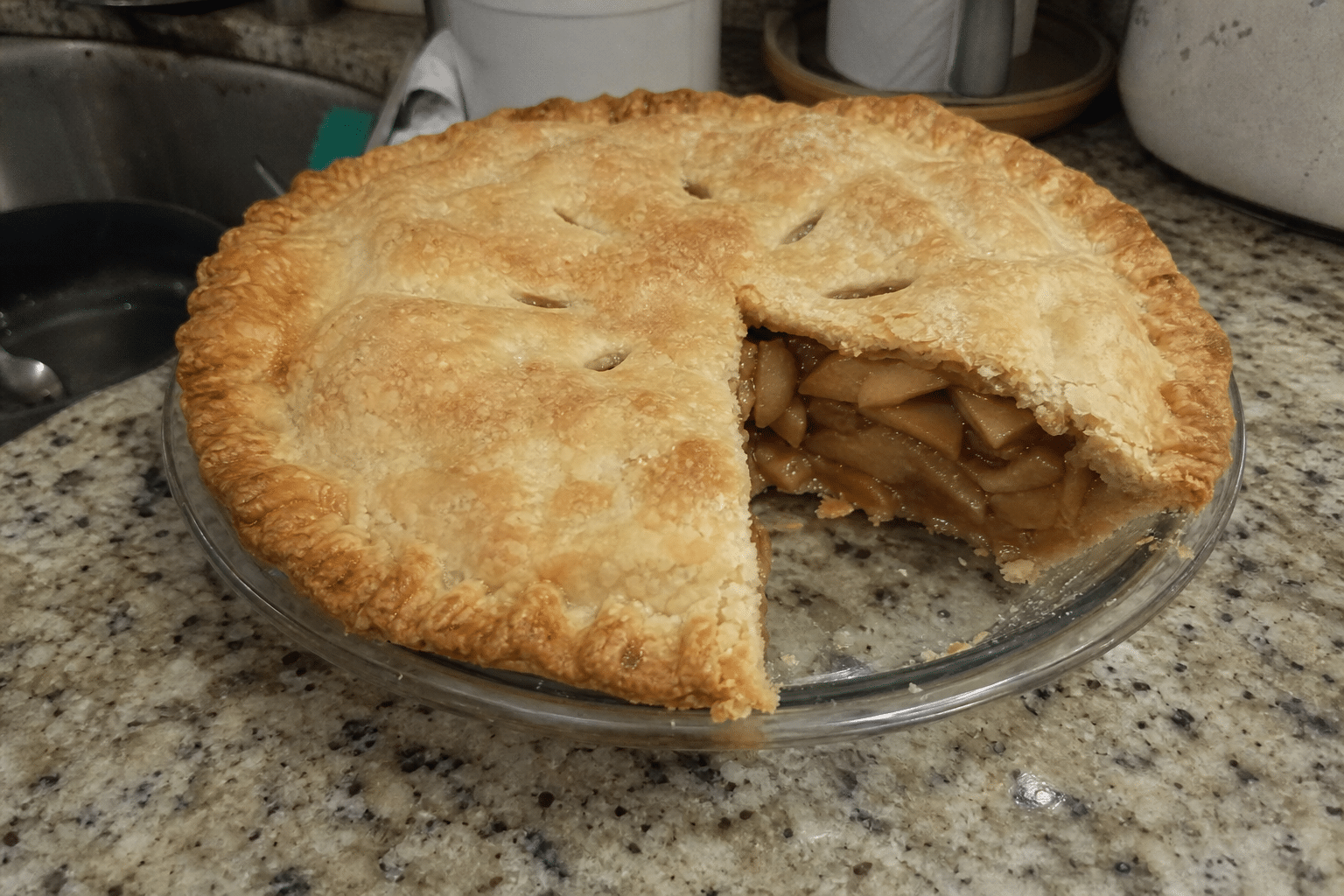

A scratch-made apple pie has two parts that fail independently: a crust that turns tough or soggy, and a filling that collapses into a watery puddle the moment you cut it. Both are avoidable. The techniques that prevent them are not complicated – just specific.
Apples are a fall and winter seasonal staple right now. USDA SNAP-Ed’s seasonal produce guide lists them as fall and winter seasonal produce, which makes this the right pie for the season and for the holiday table.
Why this recipe works
Three decisions carry most of the weight.
Macerate and drain the filling first. Raw apples mixed with sugar and cornstarch and loaded straight into a shell will make the bottom crust wet. Apples release a lot of juice when they sit with sugar. If that liquid does not get managed before baking, it soaks the bottom and makes the filling runny. The fix: let the sliced apples sit in sugar for 45 minutes to an hour, drain off the juice, reduce it in a small saucepan until it thickens slightly, and add it back. You keep all the flavor and lose the wateriness.
Cold butter, minimal handling. Flakiness comes from intact pieces of cold butter distributed through the dough. Those pieces create steam pockets as they melt, lifting the layers apart. Work butter into flour quickly, stop when chunks the size of peas remain, and add ice water one tablespoon at a time. Overworked dough is mealy dough.
Partially blind-bake the bottom crust. A short prebake before the filling goes in sets the bottom crust before it has a chance to absorb liquid from above. It is the single most reliable fix for a soggy base.
Ingredients
For the crust (double crust, 9-inch pie)
- 2 1/2 cups (315 g) all-purpose flour
- 1 tbsp granulated sugar
- 1 tsp fine salt
- 1 cup (225 g) cold unsalted butter, cut into 1/2-inch cubes
- 6-8 tbsp ice-cold water
For the filling
- 3 lbs (1.35 kg) apples, about 6 medium – half Granny Smith, half Honeycrisp or Braeburn
- 3/4 cup (150 g) granulated sugar
- 2 tbsp fresh lemon juice
- 1 tsp ground cinnamon
- 1/4 tsp ground nutmeg
- 1/8 tsp ground allspice
- 1/4 tsp fine salt
- 3 tbsp cornstarch
To finish
- 1 tbsp cold unsalted butter, cut into small pieces
- 1 large egg beaten with 1 tbsp water
- 1 tbsp coarse sugar, for sprinkling
Instructions
Make the crust
1. Whisk flour, sugar, and salt together in a large bowl. Add the cold butter cubes and work them into the flour with a pastry cutter or your fingertips until the mixture looks like rough crumbs with scattered pea-sized butter chunks remaining. Those intact pieces are what make the crust flaky.
2. Drizzle in ice water one tablespoon at a time, stirring briefly with a fork after each. Stop when the dough holds together when you pinch a bit between your fingers – not sticky, not crumbly. You will likely need 6-7 tablespoons.
Read more: Buche de Noel from scratch: the Christmas Yule log that looks harder than it is
3. Turn the dough out, divide it into two equal pieces, and press each into a flat disk about 1 inch (2.5 cm) thick. Wrap each disk tightly in plastic and refrigerate for at least 1 hour and up to 2 days.
Macerate and prepare the filling
4. Peel, core, and slice the apples into 1/4-inch-thick (6 mm) slices. Toss in a large bowl with the sugar and lemon juice. Leave at room temperature for 45-60 minutes. The apples will release a significant amount of liquid.
5. Drain the apples thoroughly through a colander set over a bowl. Pour the collected juice into a small saucepan and simmer over medium heat for 5-7 minutes, until reduced to about 3-4 tablespoons and slightly syrupy. Set aside to cool for 10 minutes.
6. Return the drained apple slices to the bowl. Add cinnamon, nutmeg, allspice, salt, and cornstarch, and toss until every slice is coated. Pour in the cooled reduced syrup and toss again.
Assemble and bake
7. Set a rack in the lower third of the oven and place a rimmed baking sheet on the rack below to catch drips. Preheat the oven to 400°F (205°C).
8. On a lightly floured surface, roll one dough disk into a 12-inch (30 cm) circle. Transfer it to a 9-inch (23 cm) pie dish, pressing gently into the bottom and sides. Leave the overhang hanging over the edge. Refrigerate the shell while you proceed.
9. Blind-bake the bottom crust: line the shell with parchment paper and fill with pie weights or dried beans. Bake for 15 minutes. Remove the parchment and weights and bake 5-6 more minutes, until the surface looks dry and just barely starting to color. Remove from the oven and let cool 15 minutes.
10. Scrape the apple filling into the cooled shell, spreading it evenly and mounding it slightly toward the center. Scatter the tablespoon of butter pieces over the top of the filling.
11. Roll out the second dough disk to a 12-inch (30 cm) circle and lay it over the filling. Trim both layers of overhang to about 3/4 inch (2 cm), fold the overhang under itself, and crimp the edges firmly together to seal.
12. Cut 5-6 slits in the top crust for steam to escape. Brush the surface with egg wash and sprinkle with coarse sugar.
13. Bake at 400°F (205°C) for 20 minutes, then reduce the oven to 375°F (190°C) and bake for another 25-30 minutes, until the crust is deep golden brown and the filling is visibly bubbling through the vents. Total time: 45-50 minutes.
14. Transfer to a wire rack and cool for a minimum of 2 hours before slicing. The cornstarch needs this time to fully set the filling. Cut it warm and the filling will run; cut it after two hours and it holds a clean edge.
Read more: Why slightly pink pork is safe to eat
Tips and variations
Butter vs. butter-shortening: All-butter crust has the best flavor and plenty of flakiness. For a more shatteringly crisp texture, replace 1/4 cup (55 g) of the butter with an equal weight of cold vegetable shortening.
Choosing your apple mix: Granny Smith is the backbone – tart, firm, holds its shape through a long bake. Honeycrisp adds sweetness and stays juicy. Braeburn has a natural spiced note that works well here. Golden Delicious softens more and lends honeyed sweetness. Avoid Red Delicious, which turns mealy in the oven.
Keep the dough cold: If your kitchen is warm, chill the flour-butter mixture in the freezer for 10 minutes before adding water, and work with a bowl set over ice. Warm butter melts into the flour instead of staying in separate pieces.
Skip blind-baking if needed: If you are short on time, skip step 9 and bake with a raw shell. Add 10-15 extra minutes to the second phase of baking and check that the bottom looks golden through the pie dish before pulling it from the oven.
Make-ahead: Dough disks freeze for up to 3 months; thaw overnight in the refrigerator. The assembled unbaked pie also freezes well – bake directly from frozen, adding about 20 minutes to the total time, and cover the edges with foil if they brown too fast.
Storage: Keep at room temperature, loosely covered, for up to 2 days or refrigerate for up to 5 days. Reheat slices in a 325°F (165°C) oven for 15 minutes to restore crust crispness.
Allergens: Contains gluten (flour) and dairy (butter). For a dairy-free version, use an equal weight of cold solid-stick vegan butter.