
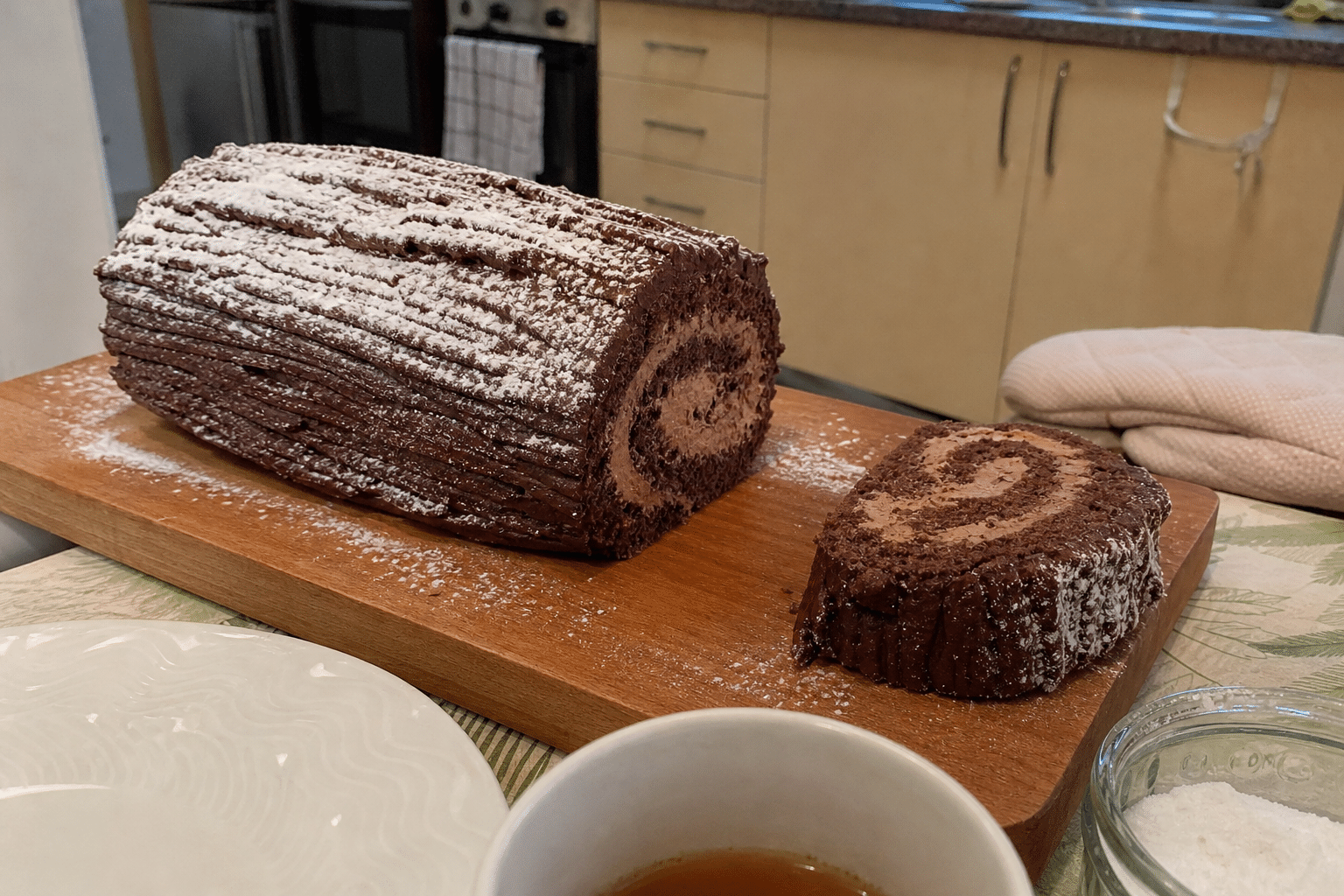

The Buche de Noel looks like it arrived from a professional pastry kitchen: bark-textured chocolate buttercream running the full length of the log, a cluster of meringue mushrooms at the base, a dusting of powdered sugar snow. It draws gasps. It is also, once you understand the two or three techniques that actually matter, a completely manageable home bake.
The sponge spends 12 minutes in the oven. Rolling it without cracking is a matter of timing, not skill. The rest is assembly and decoration, and decoration is forgiving by nature.
This recipe covers the whole thing: a chocolate genoise with real flexibility, a whipped ganache or creme chantilly filling, chocolate bark buttercream, and Italian meringue mushrooms. Christmas is 40 days away. There is time to make this once before the holidays and serve it with complete confidence.
Contains: dairy, eggs, gluten.
Why this recipe works
The sponge is high in eggs and low in flour. A genoise uses a larger proportion of eggs to flour than a standard sponge cake, and that matters: the egg proteins give the crumb elasticity, not density. Rolled thin across a half-sheet pan, this sponge bends rather than breaks.
You roll it hot. The moment the sponge comes out of the oven it goes onto a damp cocoa-dusted towel and gets rolled up tightly while still steaming. The heat keeps the gluten relaxed and pliable. The towel holds the curl while it cools into shape. A cold sponge tears; a warm one bends without protest.
Cocoa powder on the towel, not flour. Flour shows as pale streaks and powdered sugar can get sticky; cocoa adds color, prevents sticking, and adds another layer of chocolate.
Whipped ganache is more stable than plain cream. Because the cream is emulsified with chocolate before whipping, the filling holds its shape at room temperature for longer. It is the better choice if the finished log needs to sit out for an hour or more. Creme chantilly is a faster, lighter option when you are serving straight from the refrigerator.
Read more: Why slightly pink pork is safe to eat
Italian meringue mushrooms carry lower risk than French meringue. The 240°F (116°C) sugar syrup raises the egg white temperature considerably during beating. Food scientists note, however, that the foam mass typically reaches only around 130-135°F, below the 160°F threshold for instant bacterial kill and below the 140°F threshold for timed pasteurisation. For healthy adults, the Italian method is widely used without incident; for anyone in an at-risk group (pregnant, elderly, or immunocompromised), pasteurized shell eggs are the safest choice for Italian meringue as well. French meringue, which uses cold unheated egg whites, requires pasteurized shell eggs per FDA egg safety guidance.
Ingredients
Chocolate genoise sponge
- 5 large eggs, room temperature
- 3/4 cup (150 g) granulated sugar
- 1/3 cup (40 g) all-purpose flour
- 1/4 cup (25 g) unsweetened cocoa powder, plus extra for dusting the towel
- 1/4 teaspoon fine salt
- 2 tablespoons (30 g) unsalted butter, melted and cooled to room temperature
- 1 teaspoon vanilla extract
Whipped ganache filling
- 8 oz (225 g) semi-sweet chocolate (60-70% cacao), finely chopped
- 1 cup (240 ml) heavy cream
- Pinch of fine salt
Chocolate bark buttercream
- 1 cup (225 g) unsalted butter, softened
- 2 cups (250 g) powdered sugar, sifted
- 1/2 cup (50 g) unsweetened cocoa powder, sifted
- 3-4 tablespoons (45-60 ml) heavy cream
- 1 teaspoon vanilla extract
- Pinch of fine salt
Italian meringue mushrooms
- 3 large egg whites, room temperature
- 3/4 cup (150 g) granulated sugar
- 1/4 cup (60 ml) water
- 1/4 teaspoon cream of tartar
- 2 tablespoons unsweetened cocoa powder, for dusting
- 2 oz (55 g) semi-sweet chocolate, melted, for assembly
To finish
- Powdered sugar, for dusting
- A few sprigs of fresh rosemary (optional, reads as evergreen)
Instructions
Make the ganache first (it needs 2 hours to chill)
- Put chopped chocolate and salt in a heatproof bowl. Heat cream in a small saucepan over medium until it just reaches a simmer, small bubbles forming around the edges. Pour over the chocolate. Let sit 2 minutes, then stir from the center outward until completely smooth and glossy.
- Press plastic wrap directly against the surface and refrigerate until firm enough to hold a shape but not fully set, about 2 hours. If it over-firms, let it sit at room temperature for 15 minutes before the next step.
Make the meringue mushrooms
- Preheat oven to 200°F (95°C). Line two baking sheets with parchment paper.
- Combine the 3/4 cup (150 g) sugar and water in a small saucepan. Heat over medium without stirring until a candy thermometer reads 240°F (116°C).
- While the syrup heats, beat egg whites with cream of tartar in a clean stand mixer bowl on medium speed until soft peaks form.
- With the mixer running on medium-high, pour the hot syrup in a thin, steady stream down the inside of the bowl, avoiding the whisk. Increase to high speed and beat until the meringue is stiff, glossy, and the bottom of the bowl feels cool, about 5 minutes.
- Transfer to a piping bag fitted with a 1/2-inch (12 mm) plain tip. For the caps, pipe 1-inch (2.5 cm) round domes by holding the bag straight down, applying steady pressure, and lifting cleanly. For the stems, pipe 1-inch (2.5 cm) tall narrow points. Aim for about 20 of each. Dust the caps lightly with cocoa powder.
- Bake for 1 hour and 30 minutes until completely dry and hollow-sounding when tapped. Turn off the oven and leave the mushrooms inside for 30 more minutes. Cool completely on the pans.
Make the sponge
- Preheat oven to 375°F (190°C). Butter a 13×18-inch (33×46 cm) half-sheet pan, line with parchment, then butter and lightly flour the parchment.
- Put eggs and granulated sugar in the bowl of a stand mixer. Set over a saucepan of barely simmering water and whisk continuously until the mixture is warm and the sugar is fully dissolved, about 3-4 minutes. It should reach 110°F (43°C) on an instant-read thermometer.
- Remove from heat. Beat on high speed until the batter is pale ivory, tripled in volume, and falls from the beater in thick ribbons that hold for 3 seconds before dissolving back in, about 5-7 minutes.
- Sift together the 1/3 cup flour, 1/4 cup cocoa, and salt. Fold into the egg mixture in three additions using a large flexible spatula, cutting down through the center and sweeping around the bowl. Stop the moment no dry streaks remain.
- Drizzle in the melted butter and vanilla around the edges of the batter. Fold in with two or three strokes.
- Pour into the prepared pan. Spread level to the corners with an offset spatula. The layer will be thin, about 1/4 inch (6 mm).
- Bake 10-12 minutes until the top springs back when pressed in the center and the edges just begin to pull from the pan.
Roll the sponge immediately
- Before the sponge goes in the oven, lay a clean kitchen towel flat on the counter. Dampen it barely, just enough that your palm comes away slightly cool, and dust it generously with cocoa powder.
- The moment the sponge comes out of the oven, run a thin knife around the edges. Invert onto the prepared towel. Peel off the parchment paper slowly.
- Starting from one short end, roll the sponge tightly inside the towel. Set the roll seam-side down on a wire rack. Cool completely, about 1 hour.
Assemble the log
- When the ganache is properly chilled and firm, beat it with a hand mixer on medium-high until it lightens in color and turns fluffy and spreadable, about 2-3 minutes. It should hold soft peaks. If it looks grainy, it has broken; warm the bowl briefly over hot water, stir to smooth, re-chill, and try again.
- Unroll the cooled sponge gently onto the towel. Spread whipped ganache evenly over the surface, leaving a 1-inch (2.5 cm) bare border on the far short end.
- Roll the sponge back up tightly from the near short end, this time without the towel. Wrap in plastic and refrigerate at least 30 minutes.
Frost and decorate
- Unwrap the roll and place seam-side down on a serving board. Using a serrated knife, cut a diagonal slice about 3 inches (8 cm) from one end. Press this piece against the side of the main log to create a branch stub. A small smear of buttercream holds it in place.
- Beat the softened butter for the buttercream in a stand mixer on medium-high until very pale and fluffy, about 4 minutes. Add the sifted powdered sugar, cocoa, and salt; mix on low to combine, then beat on medium-high for 2 minutes. Add vanilla and cream one tablespoon at a time until the buttercream is smooth and spreadable, slightly stiffer than a typical layer-cake frosting.
- Spread a thick, uneven layer of buttercream over the entire log and branch, including the cut ends. Use the tines of a fork to drag long, irregular lines from one end to the other, following the length of the log. Vary pressure and direction slightly. Leave the circular cross-section ends free of fork marks so they read as a sawn log face. Refrigerate 20 minutes to set the texture.
- To assemble the mushrooms: use a small knife or skewer to press a shallow hole in the flat underside of each cap. Dip the tip of a stem in melted chocolate and press into the hole. Let set at room temperature, about 10 minutes.
- Arrange mushrooms on and around the log. Dust the board and log lightly with powdered sugar. Tuck in rosemary sprigs if using.
Tips and variations
Creme chantilly instead of ganache: Whip 1 1/2 cups (360 ml) cold heavy cream with 3 tablespoons (25 g) powdered sugar and 1 teaspoon vanilla to soft-stiff peaks. Use immediately after whipping. It is lighter and faster, but it softens more quickly at room temperature. Keep the finished log refrigerated and slice within 2-3 hours.
French meringue mushrooms: French meringue, made by beating raw egg whites with plain sugar without a hot syrup, is quicker to make. Because the whites are never heated to any significant temperature, the FDA recommends using pasteurized shell eggs in any preparation where eggs remain raw or undercooked in the finished dish. Pasteurized shell eggs are sold next to regular shell eggs at most grocery stores. The Italian method in this recipe is the lower-risk default; using pasteurized eggs in either method is the safest approach.
Read more: The best homemade meatloaf, with a tangy glaze and a texture that actually holds together
If the sponge cracked: A thin crack in the rolled sponge almost always means it was left to cool before rolling, or was rolled at too gentle a pace. The buttercream conceals cracks entirely; the texture and flavor of the finished log are unaffected.
Make-ahead: The sponge can sit rolled in its towel (unfilled) at room temperature for up to 8 hours or refrigerated overnight. The fully assembled and frosted log keeps well, covered, in the refrigerator for up to 2 days. Add meringue mushrooms the day of serving; they soften in the refrigerator.
Scaling: This recipe serves 10-12. For a smaller log, halve all quantities and bake in a 9×13-inch (23×33 cm) quarter-sheet pan; reduce bake time to 8-10 minutes.