
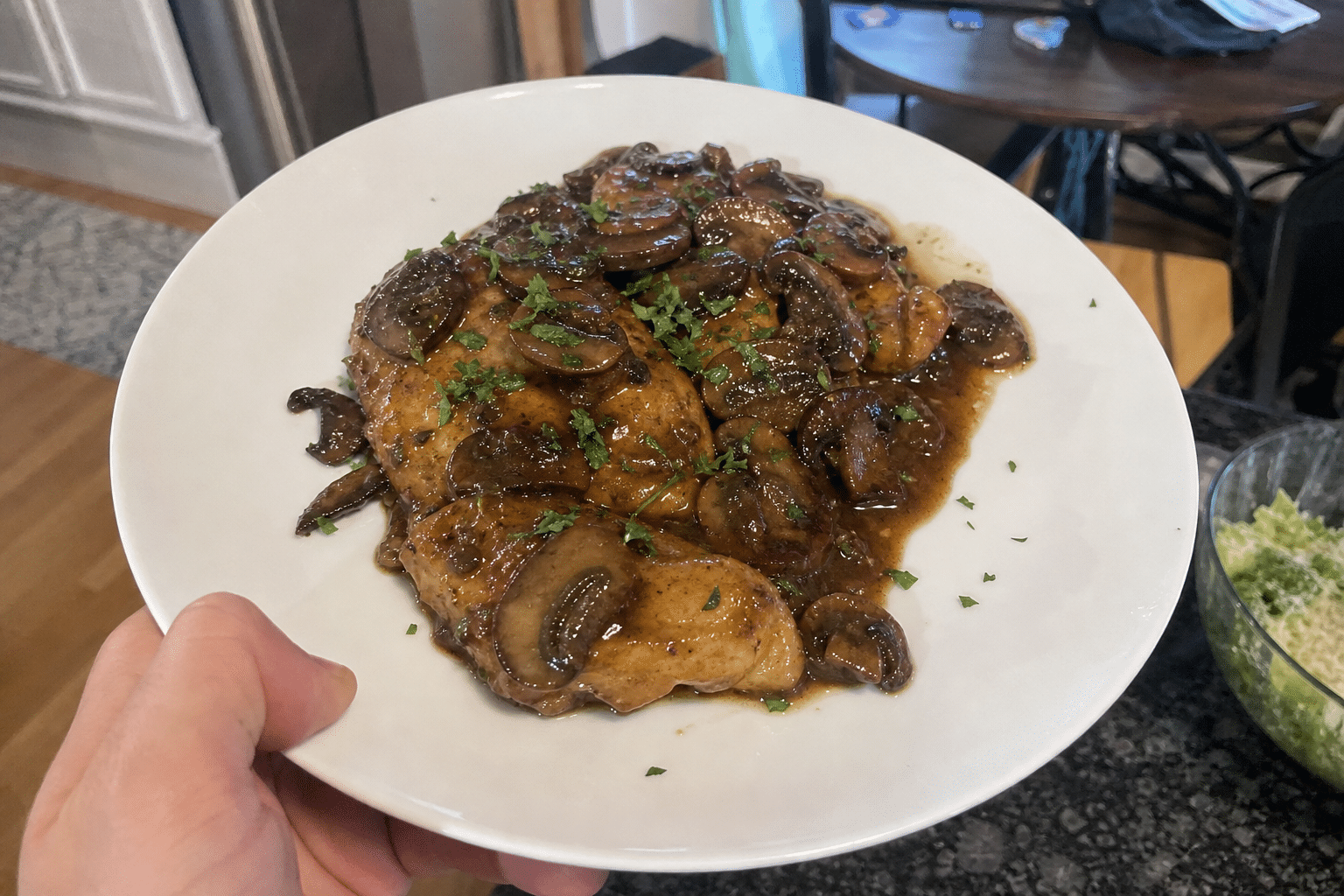

Chicken Marsala is one of those Italian-American weeknight standards that sounds impressive but asks almost nothing of you: one skillet, a bottle of dry Marsala from the wine shop, and about half an hour. The dish leans on a pan-sauce technique Italian immigrants carried into American kitchens, using the fortified wines of Sicily as the base.
What makes it so reliable midweek is the cutlet format. Thin-pounded chicken breasts cook through in under five minutes per side and leave behind exactly the sticky, golden fond a great pan sauce needs. The flour dredge thickens the sauce as it cooks, so there is no need for a starch slurry.
The choice of Marsala matters more than most recipes admit. Dry Marsala, labeled “secco,” belongs in a savory pan sauce. The sweet version, labeled “dolce,” is for tiramisu and dessert work. In a hot pan over meat, sweet Marsala turns cloying. Dry keeps the sauce nutty, slightly caramelized, and wine-forward.
Why this recipe works
Pounding each cutlet to about ¼ inch (6 mm) solves two problems at once: the chicken cooks fast enough to stay juicy, and every part of the cutlet hits the pan evenly, so there are no dry edges from an uneven thick end.
Flour dredging does double duty. A light coat builds a thin golden crust and, once those flour particles dissolve into the sauce liquid, the sauce thickens naturally without any extra starch.
The sauce builds entirely from the pan. Mushrooms go in after the chicken comes out, shallots and garlic soften next, then the Marsala hits the hot fond. Reduce the wine by half before the stock goes in so you are concentrating flavor rather than diluting it. A cold pat of butter swirled in off-heat finishes the sauce to a glossy, restaurant-smooth texture.
Ingredients
Serves 4 | Total time: about 30 minutes
For the chicken:
- 2 large boneless, skinless chicken breasts (about 1½ lb / 680 g total)
- ½ cup (60 g) all-purpose flour
- 1 teaspoon kosher salt
- ½ teaspoon black pepper
- 2 tablespoons olive oil
- 1 tablespoon unsalted butter
For the sauce:
- 1 tablespoon olive oil
- 10 oz (280 g) cremini mushrooms, thinly sliced
- 2 medium shallots, finely diced
- 3 garlic cloves, minced
- ¾ cup (180 ml) dry Marsala wine (look for “secco” on the label)
- ¾ cup (180 ml) low-sodium chicken stock
- 1 teaspoon fresh thyme leaves (or ½ teaspoon dried)
- 1 tablespoon cold unsalted butter
To finish:
- 2 tablespoons fresh flat-leaf parsley, roughly chopped
Instructions
1. Halve each chicken breast lengthwise to get 4 pieces. Place one piece between two sheets of plastic wrap and pound with a meat mallet or rolling pin to an even ¼-inch (6 mm) thickness. Repeat with the remaining pieces.
Read more: Why slightly pink pork is safe to eat
2. Mix the flour, salt, and pepper together on a large plate. Dredge each cutlet, pressing lightly so the flour adheres, then shake off any excess.
3. Heat 2 tablespoons olive oil and 1 tablespoon butter in a 12-inch (30 cm) skillet over medium-high heat until the butter foams and the foam subsides. Add the cutlets in a single layer, working in two batches if the pan looks crowded. Sear until deep golden brown on the first side, about 3 to 4 minutes. Flip and cook until the second side is golden, 2 to 3 minutes more. Transfer to a plate and tent loosely with foil.
4. Reduce the heat to medium and add the remaining 1 tablespoon olive oil to the same pan. Spread the mushrooms in a single layer and leave them alone for 2 to 3 minutes to pick up color. Stir and continue cooking until they are golden all over, about 3 minutes more. Season lightly with salt.
5. Push the mushrooms to one side. Add the shallots and garlic to the cleared space and cook, stirring, until softened and fragrant, 1 to 2 minutes.
6. Pour in the dry Marsala. Use a wooden spoon to scrape up all the browned bits from the pan bottom. Raise the heat to medium-high and simmer until the wine reduces by half, about 3 to 4 minutes.
Read more: The best homemade meatloaf, with a tangy glaze and a texture that actually holds together
7. Pour in the chicken stock and add the thyme. Simmer, stirring occasionally, until the sauce is thick enough to coat the back of a spoon lightly, about 3 to 4 minutes.
8. Remove the pan from the heat. Add the cold tablespoon of butter and swirl the pan until it melts into the sauce.
9. Return the chicken and any accumulated resting juices to the pan. Place over low heat and spoon the sauce over the cutlets, cooking just until the chicken registers 165°F (74°C) at the thickest point on an instant-read thermometer, 1 to 2 minutes.
10. Scatter the parsley over the top and serve straight from the pan.
Tips and variations
Dry versus sweet Marsala: Dry Marsala (secco) is a fortified Sicilian wine with a nutty, lightly oxidized flavor that holds up under heat and reduces well. The sweet (dolce) version overpowers the mushrooms and makes the sauce taste closer to a dessert syrup. If you cannot find Marsala, a dry Madeira is a workable substitute.
Read more: The perfect roast chicken with crispy skin and herb butter, done in under 90 minutes
Pan size: A 12-inch (30 cm) skillet is the right size. A smaller pan will force the chicken to overlap, which creates steam instead of a sear, and you will lose the fond the sauce depends on.
Do not skip pounding: Even thin-cut chicken breasts from the store are often uneven from one end to the other. A quick pound to a uniform thickness ensures the cutlet cooks at the same rate throughout.
Sauce split: If the sauce looks greasy or broken after adding the butter, take the pan fully off the heat and whisk in a splash of stock. Heat and over-reduction are the usual causes.
Make-ahead: Store the sauce and cooked chicken separately in the refrigerator for up to two days. Reheat the sauce in the skillet, then return the chicken and warm through over low heat for 2 minutes.
What to serve alongside: Egg noodles or creamy mashed potatoes soak up the sauce well. Polenta, sauteed spinach, and roasted asparagus all work. A simple green salad dressed with lemon is enough to round out the plate.
Allergen note: This recipe contains gluten (flour dredge) and dairy (butter). For a gluten-free version, substitute a 1:1 gluten-free flour blend. Replacing the butter finish with an extra drizzle of olive oil makes the sauce dairy-free, though the texture will be slightly thinner.