
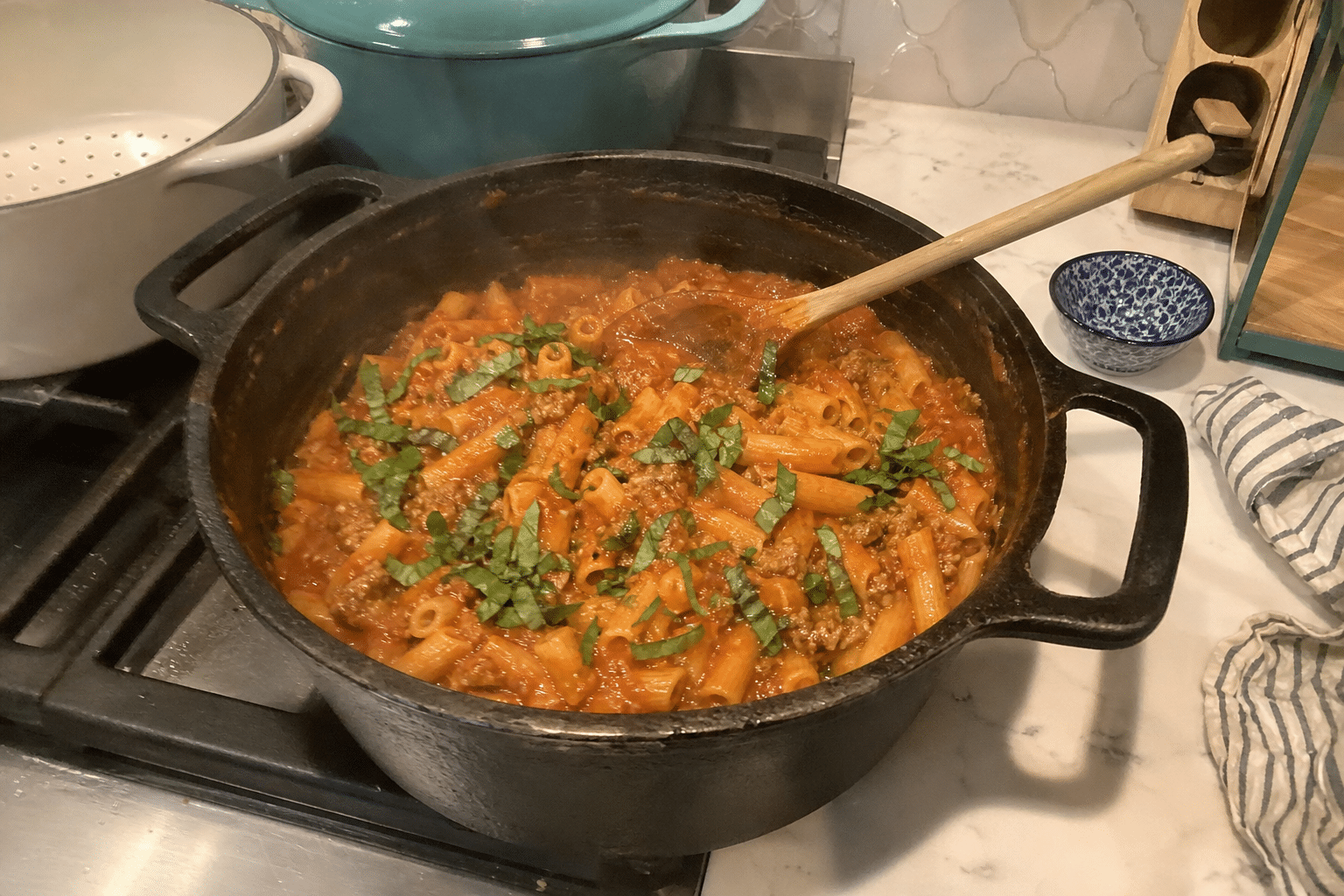

Pasta e fagioli (pasta and beans) is a thick Italian soup built on a soffritto base, slow-simmered beans, and small pasta that absorbs everything it cooks in. It has fed Italian families for centuries because it costs next to nothing and delivers a depth of flavor most restaurant pasta cannot match.
The dish comes from cucina povera, the cooking of the poor – a tradition the Accademia Italiana della Cucina calls “a ‘poor’ cuisine which is nevertheless rich in ingenuity and creativity.” That ingenuity is exactly what makes pasta e fagioli work: three techniques that turn the cheapest pantry staples into something that tastes deeply considered.
Why this recipe works
The bean mash. About a third of the beans get mashed or briefly blended before going back into the pot. This paste dissolves into the broth and turns it thick and creamy without flour, cream, or any thickener. The texture is what separates a great pasta e fagioli from a forgettable bean soup.
Pasta in the pot. Ditalini cooks directly in the soup, not in a separate pot of water. As it cooks, it releases starch into the broth and absorbs the flavor of the beans, the soffritto, and the Parmesan rind. The pasta and the broth become something neither could manage alone.
The Parmesan rind. A leftover rind simmered in the broth for 20 minutes adds a deep, savory depth you would otherwise spend a long time building with stock. Keep your Parmesan rinds in a bag in the freezer. This is exactly what they are for.
Read more: The classic key lime pie from scratch: tart, creamy, and easier than you think
Two styles worth knowing
Pasta e fagioli varies by region, and the two main versions call for slightly different choices.
The Venetian version from northern Italy is thick, almost porridge-like. Borlotti beans (sold as cranberry beans in US stores) are traditional. There is no tomato. The soffritto is kept simple, and the finished soup is dense enough that a wooden spoon stands up in it.
The Neapolitan version from the south is brothier and lighter, often with a splash of crushed tomato that gives the broth a reddish color and a little acidity. Pasta mista – mixed broken pasta shapes – is traditional here. When Italian immigrants brought this version to the United States, the name became “pasta fazool,” echoing the Neapolitan dialect word for beans.
Read more: Danish Christmas trifle with spiced apple compote, cinnamon cream, and ginger cookies
The recipe below leans Venetian. The Neapolitan variation is noted in the tips.
Ingredients
Serves 4 to 6
- 3 tablespoons (45 ml) extra-virgin olive oil, plus more to finish
- 2 oz (55 g) pancetta (Italian cured pork belly), finely diced; substitute regular bacon, or skip for a vegetarian version
- 1 medium onion, finely diced
- 2 medium carrots, finely diced
- 2 celery ribs, finely diced
- 4 garlic cloves, minced
- 1 sprig fresh rosemary
- 2 cans (15 oz / 425 g each) borlotti or cannellini beans, drained and rinsed
- 4 cups (960 ml) low-sodium chicken or vegetable broth
- 1 Parmesan rind, about 2 to 3 inches (5 to 8 cm) long
- 1 cup (90 g) ditalini
- Kosher salt and freshly ground black pepper
- Freshly grated Parmesan, to serve
Instructions
- Set a large pot over medium heat and add the olive oil. Add the pancetta and cook until it has turned lightly golden and rendered its fat, about 3 minutes. Remove with a slotted spoon and set aside, leaving the fat in the pot. (Skip this step if making the vegetarian version.)
- Add the onion, carrot, and celery. Cook, stirring occasionally, until everything has softened and the edges are just beginning to color, 8 to 10 minutes. Add the garlic and rosemary and cook 1 more minute, until fragrant.
- Add the drained beans, broth, Parmesan rind, and the reserved pancetta. Bring to a simmer and cook uncovered for 10 minutes to let the flavors develop.
- Scoop out about 1 1/2 cups (360 ml) of beans and a ladleful of broth. Mash them to a rough paste with a fork, or briefly blitz with an immersion blender, then stir the paste back into the pot. The broth should look noticeably thicker.
- Bring the soup to a gentle boil. Add the ditalini and cook, stirring frequently to prevent sticking, until just tender, 8 to 9 minutes. The soup thickens further as the pasta releases starch. If it becomes too thick, stir in a splash of hot water or broth to loosen it.
- Remove the rosemary sprig and Parmesan rind. Taste and season generously with salt and pepper. Ladle into bowls, drizzle each with olive oil, and add a generous amount of grated Parmesan.
Tips and variations
Don’t overcook the pasta. Ditalini keeps absorbing liquid even after the heat is off. Pull the pot as soon as the pasta is barely tender. If you are making this ahead or expect leftovers, cook the pasta separately and stir a portion into each bowl at serving – otherwise it turns soft and bloated overnight.
Neapolitan variation. Add 1/2 cup (120 ml) of crushed tomatoes along with the beans in step 3. Swap the ditalini for pasta mista or broken spaghetti.
Read more: No-bake coffee and orange oat truffles: the Danish Christmas candy that takes 20 minutes and no oven
Dried beans. If you have time, start with 8 oz (225 g) of dried borlotti or cannellini beans, soaked overnight and simmered in fresh water until tender before adding to the soffritto. Save the cooking liquid to use in place of broth – it makes a richer, more bean-forward base.
Make it vegetarian. Skip the pancetta and use vegetable broth. For the Parmesan rind, substitute a rind from a vegetarian hard cheese, or add a teaspoon of white miso to the broth in step 3 for savory depth.
Allergens. This recipe contains gluten (pasta) and dairy (Parmesan rind and cheese). For a gluten-free version, use certified gluten-free ditalini or a short rice pasta; gluten-free pasta turns soft fast, so check it a few minutes early and pull it off the heat the moment it is barely tender.
Storage. Leftovers keep in the fridge for up to 3 days. The pasta will absorb most of the remaining liquid overnight. Reheat over low heat with a splash of broth or water, and check the seasoning again before serving.