
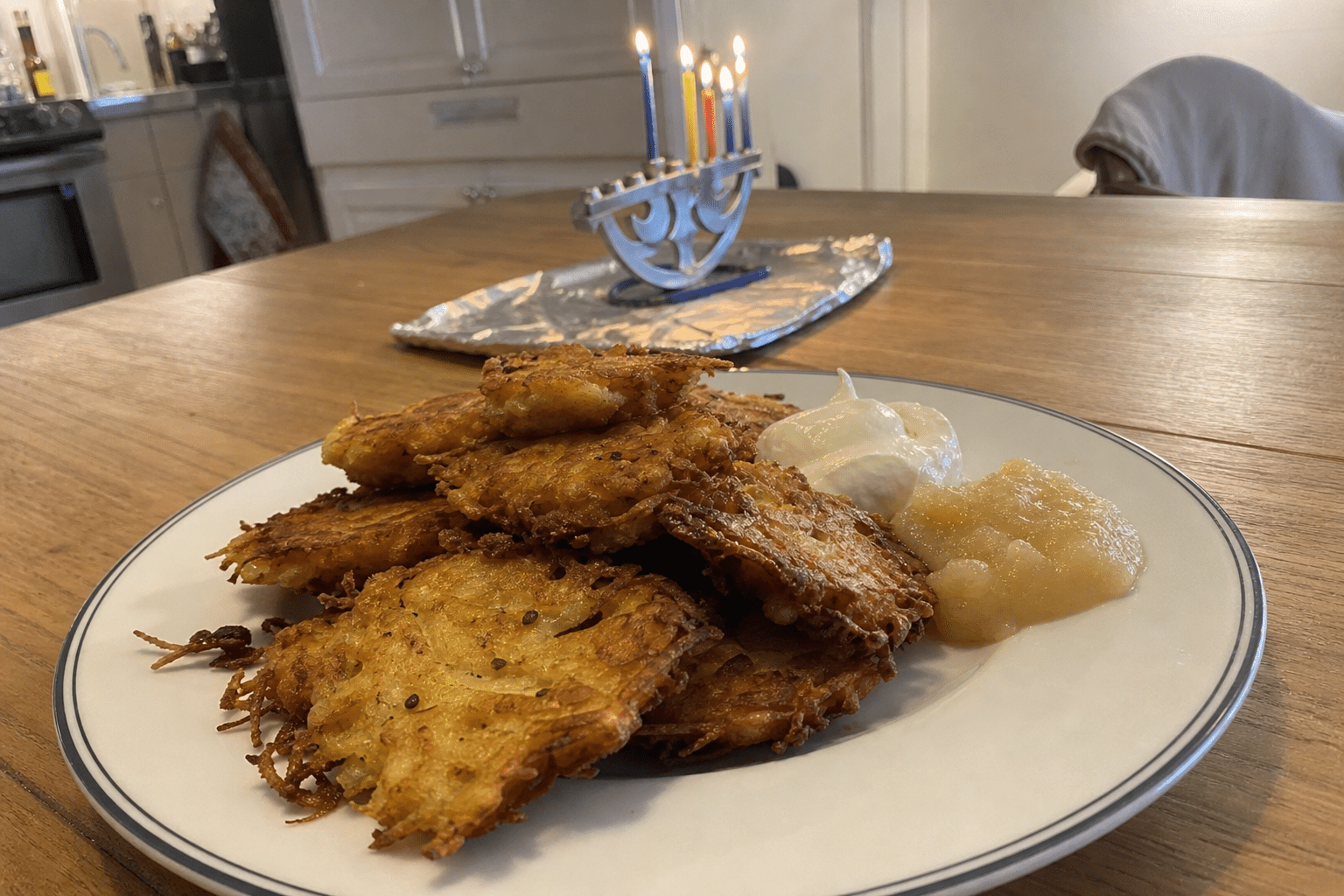

Latkes are fried potato pancakes eaten during Hanukkah, the eight-night Jewish festival of lights that begins at nightfall on December 4, 2026. The dish is simple: grated potato, egg, a little binder, hot oil. Potatoes are in their natural fall and winter season right now, per the USDA SNAP-Ed Seasonal Produce Guide, which means freshly harvested, starchy spuds in every grocery store.
But skipping or rushing the moisture-removal step almost always ends in pale, soft results instead of the shattering crispness that makes a great latke worth eating. This recipe fixes that with one non-negotiable technique: wring the grated potatoes completely dry before you mix anything else in.
Why this recipe works
Potatoes are mostly water. When you grate them, you release a lot of it, and if that liquid goes into the pan with the latke, it steams instead of fries. The result is pale, soft, and disappointing.
Salting the grated potatoes and letting them sit for 10 minutes draws out even more moisture. Then you gather everything into a clean kitchen towel and wring hard, then wring again. This is not optional. The drier the potato mixture, the crispier the finished latke.
Starchy potatoes, specifically Russets, help too. High starch and low moisture is exactly what you want for frying. That starch is also what gives latkes their characteristic lacy, craggy edges.
One bonus move: drain the liquid into a bowl and let it sit for a couple of minutes. White potato starch sinks to the bottom. Pour off the cloudy water on top and scrape that white starch back into your potato mixture. It acts as an extra binder and deepens the crispness.
Ingredients
Serves 4 (makes about 14-16 latkes)
- 2 pounds (900 g) Russet potatoes (about 3 large), peeled
- 1 medium yellow onion
- 2 large eggs, beaten
- 3 tablespoons matzo meal (or all-purpose flour)
- 1 teaspoon kosher salt, divided, plus more for finishing
- 1/4 teaspoon black pepper
- About 1 cup (240 ml) neutral oil for frying (canola or vegetable)
To serve:
- Sour cream
- Applesauce
Instructions
1. Grate the potatoes and onion on the large holes of a box grater, or use the grating disk of a food processor. Combine them in a large bowl.
Read more: Rich homemade eggnog that is actually safe to make, with real eggs and no guesswork
2. Add 1/2 teaspoon of the salt, toss well, and let the mixture sit for 10 minutes. The salt pulls moisture to the surface.
3. Transfer the potato-onion mixture in batches to a clean, dry kitchen towel. Gather the corners and twist tightly, wringing out as much liquid as possible over the sink or a bowl. Wring more than you think is needed.
4. If you caught the liquid in a bowl: let it sit for 2 minutes. White potato starch settles to the bottom. Carefully pour off the watery liquid on top, then scrape the white starch at the bottom back into the potato mixture.
5. Add the beaten eggs, matzo meal, remaining 1/2 teaspoon salt, and pepper. Mix until evenly combined.
6. Pour oil into a large, heavy skillet (cast iron works well) to a depth of about 1/4 inch (6 mm). Heat over medium-high until the oil shimmers and a pinch of potato mixture dropped in sizzles immediately on contact.
Read more: Why your tomatoes lose their flavor in the refrigerator, according to food scientists
7. Working in batches of 3 or 4, drop heaping 2-tablespoon portions of the potato mixture into the hot oil, spacing them apart. Use the back of a spatula to press each one into a flat round about 3 inches (8 cm) across.
8. Fry undisturbed until the edges are deep golden and the underside is crispy, about 3-4 minutes. Flip and fry the second side until equally golden, another 3-4 minutes.
9. Transfer to a wire rack set over a baking sheet, or drain on paper towels. Season immediately with a pinch of salt. Keep warm in a 200°F (95°C) oven while you fry the remaining batches, adding more oil to the pan between rounds as needed.
10. Serve hot with sour cream and applesauce.
Tips and variations
Don’t crowd the pan. Frying too many latkes at once drops the oil temperature and leads to steaming instead of frying. Work in small batches and give each latke room.
Read more: Refrigerator, cold water, or microwave: how to safely thaw your Thanksgiving turkey
Watch the heat, not just the clock. If the oil starts smoking heavily, lower the heat slightly. If latkes take more than 4 minutes per side to turn golden, nudge it up. Deep amber color means the inside is fully cooked through.
Russets vs. Yukon Golds. Russets give the crispiest, laciest edges because of their high starch content. Yukon Golds produce a creamier interior but hold more moisture, so they need even more aggressive wringing.
Make ahead and reheat. Latkes reheat well. Spread them in a single layer on a baking sheet and warm in a 375°F (190°C) oven for 8-10 minutes until hot and crisped again. The microwave turns them soft; skip it.
Gluten-free option. Swap the matzo meal or flour for 2 tablespoons of potato starch for a fully gluten-free version.
Onion texture. Grating the onion produces an almost invisible result in the finished latke. For more onion bite and texture, finely chop it instead.