
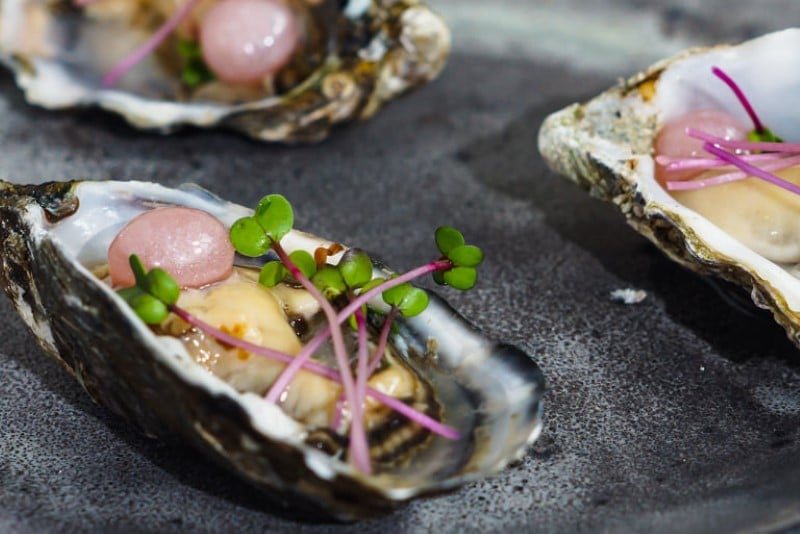

Many associate them with New Year’s Eve or as an extravagant dish, paired with caviar and champagne, but oysters offer much more than that. There is a vast variety of oysters, each with unique flavors and characteristics. Furthermore, they are a food item you can pick yourself in Denmark, just like berries, herbs, or flowers.
But when is the best time to pick your oysters? What should you be aware of? And are frozen oysters as good as fresh ones? You will have the opportunity to get answers to these questions and many more as we explore all the different types of oysters – both domestic and international.
Oyster Lifecycle
The oyster we know in Europe has historically been an important food source, with oyster remains found in archaeological excavations dating back to before the birth of Christ. One reason for this is that oysters often live very close to the coast, making them easy to collect. Additionally, there have often been plenty of them, and their size has made them attractive in terms of nutritional value.
In Denmark, there are mainly 2 types of oysters: the Pacific oyster, which is an invasive species mostly found in the Wadden Sea, and the European oyster found around the Limfjord. In fact, the Pacific oyster is so invasive that it threatens the populations of other oysters and blue mussels in the area, which is why people are encouraged to pick them as often as possible. You won’t have to be a beachgoer at the Wadden Sea for long before you realize that it’s easier to find an oyster in the seabed than sand and seaweed.
Besides that, there are several factors to consider when you venture into picking oysters yourself. Their lifecycle plays an important role in taste, texture, and food safety. Since an oyster lives by filtering seawater, the surrounding marine environment significantly influences oysters. An oyster can filter 100 liters of seawater in a day, absorbing everything from algae, plankton, and other foreign substances. The importance of this will be explained later.
Oysters are hermaphrodites, meaning they become females in seawater with a temperature above 18 degrees Celsius, while they become males in seawater below 18 degrees Celsius. Therefore, the temperature fluctuations throughout the year significantly affect oyster reproduction. For this reason, it is usually male oysters that are consumed. An oyster can live up to 20 years, but they become ready for harvesting when they are around 10 months old.
What is the difference between the various oysters?
The current conditions in the sea or fjords often determine how much nutrition an oyster receives, significantly affecting their taste. An oyster that has lived well and grown large and plump often has a more intense oyster flavor, while a more undernourished oyster resembles the infamous snot blob they are often described as. Therefore, there is also a significant difference in taste depending on where the oyster comes from. This difference is particularly evident when comparing, for instance, Perle Blanche with Papillon, where the latter is much saltier than the former. Thus, there are many different descriptions of flavor nuances when looking at various oysters. Some of the most common descriptions include salty, nutty, seaweed, or mineral.
Moreover, the texture descriptions can range widely from creamy and meaty to more slushy with a lack of bite. Fundamentally, it is about the water the oysters have grown up in. Since the North Sea and the Atlantic Ocean are often perceived as very salty, oysters will also take on that taste. Whereas in water that is less salty, oysters will have a less salty taste and more creamy and fresh flavor. This affects what is served with the oysters you use.
Generally, you can count on the fact that different oyster producers want to maintain a specific taste, meaning not all oysters from different producers are the same.
Is there a difference in quality?
When discussing quality, there are different parameters to measure against, as it all depends on taste preferences and the dish you want to make. If you want to create a very salty dish, oysters raised in the sea are preferable, but if you desire a more rounded and creamy taste, you can benefit greatly from choosing fjord oysters. As mentioned, there are primarily 2 different types of oysters in Denmark, namely the European oyster and the Pacific oyster. The first is a relatively flat oyster, primarily found in the Limfjord, which is why it is often referred to as ‘Limfjord oyster,’ while the latter is more knobby and found abundantly in the Wadden Sea. They can also be found in Isefjord and eastern Jutland fjords.
The taste of Limfjord oysters is described as being very mineral-like, with a round nutty and sweet flavor. This is due to the water circulation and salt content in the water, giving them their distinctive taste. Pacific oysters, on the other hand, have a softer texture and a much saltier taste, as they live in a much saltier water climate.
If you look beyond the country’s borders, there is a sea of different oysters to choose from, but here we have gathered the 5 that are often considered the most common.
Bretagne
This oyster originates from the French Atlantic coast and is considered a good mediocre oyster. The taste itself is very salty but still with a creamy and rich texture. They don’t have a wild aftertaste, and you can easily eat many of them without overwhelming your taste buds. It is ideal for making stuffed oysters, as the taste is not dominant. The price is typically around 12-15 kroner.
Ancelin
Ancelin is a French Pacific oyster found along France’s Atlantic coast and is often referred to as a “branded oyster.” This is partly because breeders send them to the Normandy coast during the maturation process, where there are excellent conditions for oysters. Here they absorb as much nutrition as possible, reflected in their taste, described as rich with a good firm texture. At the same time, it tastes very little of salt, having more sweetness than a Bretagne oyster, which also makes the price higher.
Perle blanche
This is another Pacific oyster found around the French Atlantic coast, bred in the same way as Ancelin oysters. They don’t taste particularly salty but rather more of the sea and are incredibly rich in flavor. As it has a relatively small size, it is also described as a good beginner’s oyster, yet still in the high-end brand category.
Gillardeau
It is probably the most famous oyster that exists, also bred along the French Atlantic coast, and is also described as a luxury oyster. Its taste resembles nuts, while the aftertaste is more reminiscent of the sea and seaweed. At the same time, it has a more firm and mussel-like texture.
Small and large Limfjord oysters
Denmark is certainly one of the best oyster suppliers on the market, and particularly the small and large Limfjord oysters are well-known abroad. They are in the expensive range as their population is threatened by the invasive Pacific oyster. Therefore, it is said that you should buy 2 Pacific oysters for every Limfjord oyster you purchase, if you don’t go on an oyster safari yourself.
Where to buy oysters? Frozen or fresh?
The best place is at a fishmonger, but they can still be hard to find as they are often seasonal. However, you can always find fresh oysters at a specialty store year-round. It is recommended to only eat fresh oysters raw, as the risk of food poisoning from frozen oysters can be high. Frozen oysters are best suited for cooking, which can also be delicious.
When is the best time to go on an oyster safari?
Since oysters live as filter feeders, you must be cautious about when you pick them. Therefore, you shouldn’t pick them in the summer, as the concentration of toxic algae in the water is high, which affects the oysters. You should also not pick oysters near sewage outlets or other pollution sources, as you risk ingesting toxic substances and bacteria.
The ideal oyster season typically extends from mid-October to mid-April. This is because the water temperature in the winter months is low enough to prevent the development of toxic algae in the water. You can always check for algal blooms on the Food Authority’s website. But once you have taken care of all the health aspects, you are more or less ready to go oyster hunting. All it requires is a bucket and a pair of good rubber boots – and of course, you need to know the good spots. It can be difficult to find the perfect spot unless you go to the Wadden Sea, where there are plenty of oysters. If you are searching for Limfjord oysters, it is a good idea to ask a local who can guide you to the best places. Otherwise, there are numerous opportunities to go on an oyster safari. Additionally, you should use common sense, as if an oyster shows no signs of life, you should not take it home, as it can cause severe food poisoning. An oyster should close its shell when touched, and once picked, it should remain closed. An open oyster is a dead oyster.
How to open oysters easily?
The easiest way to open an oyster is with an oyster knife, a small knife with a protective device. You can find a guide on how to open an oyster here. You can also use a regular small knife, although it requires a bit more finesse.
What tastes best with oysters?
Most associate oysters with champagne, but it’s not just because it seems extravagant. There is indeed research that has proven that these two things together create a special umami synergy. Without going into too much detail about the precise synergies, the pair can be compared a bit to cheese and ham or tomato and meat. The best taste experience is achieved when pairing Limfjord oysters with aged champagne. Beyond that, it is almost only your imagination that sets the limits for preparing or serving oysters. Many prefer them fresh and raw, mixed with acidic elements like balsamic vinegar and tart apples. The main thing to keep in mind is whether your oysters taste creamy and rich or more of salt.