
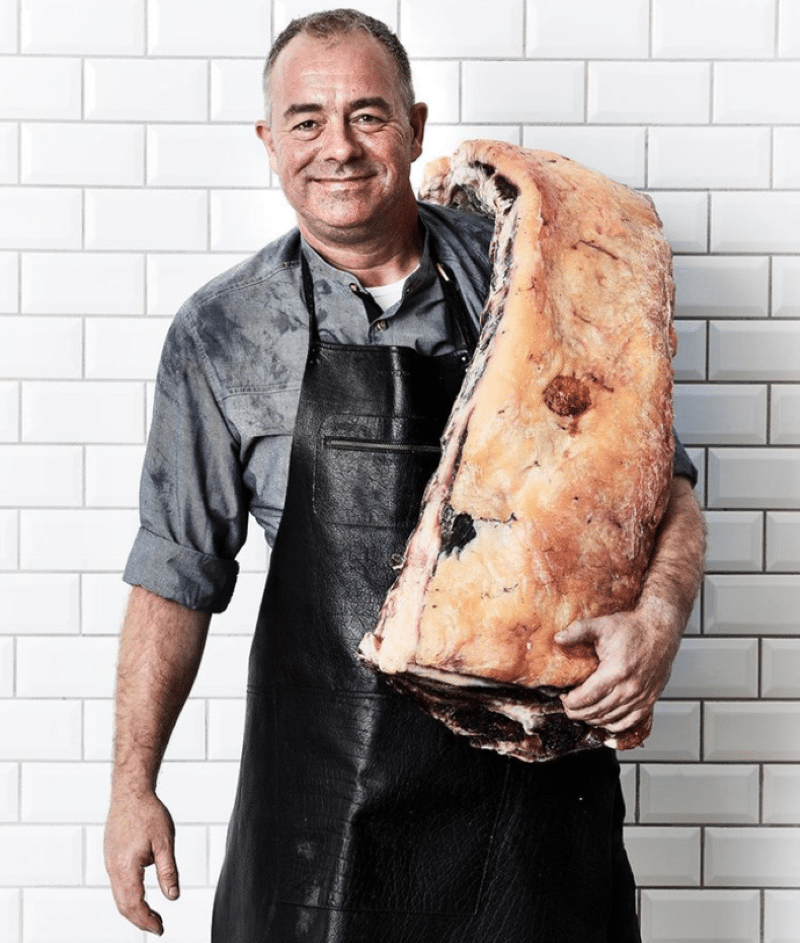

The Butcher from Funen Who Revolutionized the Danish Meat Market
If you’re into quality meat in all its forms and cuts, Rone is the man to know. He is the daily manager at the ‘Gold Room‘ under Danish Crown, which provides top-quality meat to most of Denmark’s top restaurants. Therefore, he would also describe himself as creative and good at building relationships, especially if the conversation turns to meat. And the creative part never stands still.
“I might get an idea – when we’re sitting on a Friday evening watching TV – and suddenly I go to the kitchen and fry some meat. It’s mostly to check the cooking method. But it depends on the inspiration, and I’ve also found out that I’m pretty good at coming up with new ways to fry potatoes. Being the big meat guy that I am, I can find vegetables a bit boring, so I focus a lot on ways to make vegetables taste good. I think a lot about how I can prepare them like meat. For example, carrot and tarragon pair really well together, and if cauliflower gets a crust, it becomes caramelized and nutty in flavor,” he says.
He graduated as a butcher in 1996 from Brugsen located in Søndersø, but before that, he attended the School of Economics, which he realized wasn’t for him. From there, the butcher trade took up more and more of his life.
“I actually attended business school because it was what you were supposed to do. Either high school or business school, and I just wasn’t interested. So I got an apprenticeship at Brugsen when I was about 17-18 years old. After I finished, I moved to Hadsten, where I worked as a journeyman butcher for half a year. Then I got a job as a journeyman butcher in a SuperBrugs in Strib near Middelfart, where I later became the master butcher. From there, I moved to Vejle and became the master butcher in another Brugsen,” he explains.
From there, coincidences played a part, leading him to become the uncrowned meat king of Denmark.
“At one point, FDB (now Coop) transformed some of the Brugsens into Faktas, leaving me suddenly without a job. I spoke with one of the drivers from Danish Crown, who mentioned they needed someone at the distribution center in Kolding, where the meat is packed and sent out to supermarkets. I thought it would be fine until I found something else. It was 2004, and after being there for about a year, I found out they needed someone in the ‘Gold Room.’ So I moved there, where someone else was in charge. After a year, she didn’t want to do it anymore, and it was natural for me to take over. And I’ve been there since 2006,” he says.
When he started in the ‘Gold Room‘, there were only two employees, but under Rone’s skilled leadership, there are now ten people working in both the ‘Gold Room’ and ‘Dyrbar‘, which today has become its own concept within Danish Crown.
Rone has always had a great interest in the culinary arts but quickly realized that the path of a chef was not for him.
“In elementary school, I interned as a chef, but I’m not sure if the places I interned just didn’t really capture me, or if it was the working hours. I’ve always enjoyed cooking, and I did back then too, but it just didn’t grab me at that time. One place let me fry fish fillets and peel some potatoes, so I wasn’t exactly thrilled. But I’ve always been a meat guy, and at the place I worked, there were some entertaining butchers. So I also got to work a bit with meat and help out, even though I was so young. I was only 15-16 years old. I primarily got to marinate some of the meat and cut meat cubes, but that way, I could get a taste of it. So it piqued my interest more at that time, instead of becoming a full-fledged chef. To start with, it was really just because I needed a part-time job. I wasn’t even thinking about becoming a butcher. So in a way, it’s a bit random that I ended up doing it, but on the other hand, that’s where my interest was sparked,” he explains.
If you get into a conversation with Rone about “meat,” you might as well set aside a good amount of time. It’s a treasure trove of knowledge you’re allowed to experience, but there are other interests that fill his spare time.
“I’m very into football and cycling, and I also play golf. If you’re not from Odense, then you can’t like OB, and it’s the same for me. In my younger days, I was invited to a national team selection, but when I found out I had to ride the bus with those from OB, I said ‘no thanks.’ Maybe, today, that might be a bit of a dumb decision,” he laughs.
We Ask – Rone Answers
Get to know Denmark’s most dedicated meat man better as we ask him a series of personal questions. You can read about how to best cook a steak and how to mature meat yourself.
What is the difference between ‘Gold Room’ and ‘Dyrbar’?
‘Gold Room’ is where it all starts, and it is the flagship. In the beginning, it was about building relationships and, of course, selling some meat to top restaurants. But if we, for example, stand at the ‘Food Festival‘ in Aarhus and show off all this delicious meat to the private individuals who come, they think everything looks fantastic. We are constantly asked where they can buy it, and we have to say they can’t. So 2-3 years ago, we created ‘Dyrbar’ so that private individuals could also buy the meat we have in the Gold Room. In that way, you can call ‘Dyrbar’ the little brother of the ‘Gold Room.’
Many of the things you find in ‘Dyrbar’ were product developments in the ‘Gold Room,’ where it may not have stuck. For example, we have made a large beautiful pork tomahawk made from dry-aged pork. It’s quite large (700g), and there aren’t many Michelin restaurants that can put it on their menu because it’s simply too big, even for retail. But it’s a super delicious piece of meat, and therefore, it’s great that there’s a universe for it. Dad at home by the grill might think it’s cool to have one.
What different products do you make?
Danish Crown has made a lot of standard pork in Horsens, where all pigs look alike. These are slaughter pigs also used for export. It’s super fine, but we’ve also worked with the slightly larger pigs, which we call “heavy pigs,” which are pieces of meat that develop wildly as the pig gets bigger. In fact, the more common cuts like the loin and neck become a bit harder and coarser in structure and require a completely different handling. It’s very interesting. The tenderloin from these pigs also becomes larger. Usually around one kilo, but we’ve had some up to 1.5 kilos, whereas a regular pork tenderloin weighs around 400g. They become more like a veal tenderloin. So these large pieces of meat need to be handled in a completely different way, as they become much coarser in the fibers, which means if you give it too much heat and overcook them, they tense up and become tough and chewy. Not like a shoe sole, because that means more that the meat hasn’t matured enough. So it means it should be served at least medium-rare, otherwise, it goes from being delicious, tender, and juicy to being hard and tough. I care a lot about such things, both frying and frying in the right way, because it’s a matter of split seconds, and you can “kill” a good piece of meat instead of having something that is amazing.
We also have something called pork tie, and it is so loose and porous in structure that in raw state it resembles the deli meat called ‘smoked filet,’ which you can almost rub between your fingers. It is because it is very fine in structure, and it doesn’t tense up the same way. It just becomes dry and sad if you overcook it because it’s very lean. So in my view, it should be cooked like a tuna steak, which you quickly put on a hot pan, so it gets some color, and then almost serve in a raw state. That’s the kind of thing I find exciting and interesting. To find new things on the pig that you can work with. You don’t use a pork tie from a standard pig, because the pieces are too small for that.
What is your best memory from the kitchen or your professional career?
I was involved from the beginning when MASH restaurants started up, where I was in Kolding frying steaks with Rasmus Oubæk. We went after dry-aged rib-eye, and it developed so much that we eventually couldn’t handle it in the ‘Gold Room.’ My employees in the ‘Gold Room’ ended up doing nothing but cutting beef rib-eye for MASH. That was, of course, fine enough, but it wasn’t the task of the ‘Gold Room.’ Our task was more to geek out with the small fine restaurants. When the work for MASH ended, we had to find something else for the employees to do, so we tried dry-aging pork. We didn’t invent the wheel, but we systematized it more. And that journey, in terms of what we’ve tried and come up with, is one of the wildest things I’ve been involved in.
What can dry-aged meat do that other meat cannot?
When you age meat, you can achieve 3 things. You can use it to make the meat more tender, and it’s the meat’s own enzymes that begin to break down the connective tissue through fermentation. Additionally, there is much moisture in meat, which you can get to evaporate through dry-aging, and when that happens, you get a more intense flavor of meat. It doesn’t change the actual taste of the meat, but it makes it taste much more like meat. It’s a bit like mixing squash, where instead of mixing the concentrate with water, you remove some of the water again. A beef rib-eye that has hung for one month has a much milder taste than one that has hung for 6 months. It’s a bit like the fermentation of cheese, where you start from the mild Danbo cheese and end with blue cheese.
In dry-aging, where you hang the meat in a dry room, all 3 factors are at play. If you instead vacuum-pack it, as known from the refrigerator section, only one of the factors is at play. The enzymes will work, but no moisture evaporates, so you don’t get the same intense meat flavor. And fermentation doesn’t happen the same way, as you need an oxygen supply for that.
Some people use these dry-age bags, but I haven’t worked with them myself. They give a similar effect to dry-aging, except that fermentation doesn’t happen in that environment either.
Do you have any good advice for people on how to view the aging of meat, and that it actually tastes better because of it?
What I think many people do wrong is that they buy a piece of vacuum-packed meat and then start aging it. It can be done, but it’s a bit risky, and you really have to be careful. Inside the muscles of animals are lactic acid bacteria, and they start working as soon as the animal is slaughtered. And in a vacuum bag, it has a minimum shelf life date because the lactic acid bacteria have worked so long by then that the meat turns sour. That process has started in the vacuum bag, and if you then take it out and begin to age it, there are already processes happening where it’s difficult to predict what will happen to the meat.
In my world, it should happen parallelly, so if you want to dry-age meat, it preferably shouldn’t have been packed first. It can succeed, but I would never do it myself. What you can do if you have some vacuum-packed meat is to look at when it was packed. If it’s been packed very recently, you can take it out of the vacuum packaging and let it lie in a tray uncovered for 1-2 days in the refrigerator. What you want to do here is to evaporate some of the moisture. Afterwards, you can vacuum-pack it again and continue to age it a bit, making it more tender. We’ve tried doing it with tenderloin, and the result you get by just letting it lie out for a few days and then vacuum-packing it again is amazing. My best advice – if you want to try aging yourself – is to experiment and see what happens. There is also a difference in aging cabinets, so everything can’t always be compared 1:1.
Do you have a show-off dish?
I always do because that’s how it ends up being when I bring something. It’s clear, with the meat I have access to. Both family and friends often think it’s fantastic, what I bring. Regarding a show-off dish, it often depends on what I get inspired by when I, for example, walk through the cold room. So it can be a good steak, a good tenderloin, or pork belly, which I braise first until it’s butter-tender, then cool down so it can be grilled. The spectrum is very broad and depends on inspiration.
Do you have a favorite side dish to the meat you eat yourself?
Homemade fries and Bearnaise sauce, but that’s the easiest to say because almost everyone loves it. The best thing I know is something people laugh about because when I test something, I dip my meat in ketchup (he laughs). I also work a lot with purees and make my own stocks from bones, which I use in sauces and glazes. I might boil my cauliflower in stock and then make a puree from it. That gives a really intense taste. I also make my own mayonnaise, which I put in the puree instead of butter. That gives a completely different smoothness to the puree. So for me, it’s about curiosity and making vegetables taste good. Otherwise, I don’t want to eat it.
Do you have a favorite cut?
If you ask me today about a favorite piece of meat, it’s a neck roast. I can’t think of anything I think tastes better. So a dry-aged free-range neck is definitely a favorite.
Where and when were you last impressed?
I’m just so fond of food that I almost get impressed every time I go out to eat. Not too long ago, one of my colleagues brought burratta (A mozzarella-like cheese, ed.). It was absolutely amazing! Another colleague brought olive oil from Italy, which I almost drank from the bottle, it tasted so good. And those two things were really good, and those were two ingredients I hadn’t tasted before.
Do you have a favorite restaurant?
Most of the top places I’ve only been to once, but they were really good experiences with good friends. The restaurants I probably frequent the most are those in Odense since I only live 30 kilometers from the city.
What type of knife and equipment do you use the most?
It might be a bit embarrassing, but I use a Fiskars chef’s knife for 100 kroner. Otherwise, I have a deboning knife from the slaughterhouse, which is from Victorinox and maybe costs 35 kroner. And I have a sharpening steel that I maintain them with. Otherwise, I, of course, have my own meat grinder and sausage stuffer, and they are just regular ones with a hand crank. I fairly often make sausages at home, which I hand knead, and then I make binding fars in a food processor. However, I’ve just gotten a spiralizer, which you can, for example, make spaghetti out of zucchini with. And, of course, I also have a deep fryer for fries. Otherwise, I don’t have a lot of sophisticated equipment, and much of what I have is very common. I believe that having exactly the right knives is more of a chef’s thing. For me, it just has to work, be sharp, and I focus mainly on the handle. It has to feel good in the hand, otherwise, I can’t work with it.
How to best cook meat?
If you want to pan-fry, I would recommend choosing a piece of meat with a good height so it can get a good crust. I always fry at extremely high heat in oil at the beginning, precisely to give it a crust. Once it has that, I actually take it off and let it rest a bit. Then I pour the oil from the pan, heat it up again and add a bit of oil and a lot of butter, along with herbs and garlic, where I then place the meat on, and turn down the heat. You should just let it get some crust in the butter, and then you basically bathe the meat in the butter with the herbs, so it gets the flavor from both. Then you have to feel your way to the meat to determine when it’s done. It’s better than going for a fixed time because it depends on so much, like the type of meat, height, the quality of the pan, and the hob.
Another good tip is to take the meat out half an hour before you need it, so it’s not fridge-cold when you put it on the pan. Conversely, I can also use meat from the freezer that isn’t fully thawed, which I lay directly on the pan. That way, you can really create a crust that says top-notch! You can really give it a beating with the heat, and it will still be red inside. But it shouldn’t be completely frozen, as that cools the pan too much, making it fry instead of sear. Therefore, you shouldn’t put too much on the pan.
Can you mention 3 cuts that give the best result at home in people’s own kitchens?
The meat must be of good quality because you can’t cook a bad steak well, and think about getting a good crust and how to achieve that. I think the meat should preferably be medium-rare, so you have to be really careful not to overdo it. The trick lies in getting the good crust without overcooking it.
If you find top-quality meat, many will say the tenderloin is the best, and it’s not for nothing that tenderloin steaks, rib-eye steaks, and rib-eyes are known for being good. They are, but often it’s mostly about quality because you can also get a bad rib-eye steak, and conversely, the “cheap” meat can be just as good. It’s the same with wine.
Is it easier to grill meat than cook it on the pan?
It’s easiest on the pan! Without competition. On a grill, it’s really, really hard, and I find it difficult to grill it properly. It comes from the fact that I work a lot with crusts, which can be hard to get on a grill. Again, the most important thing – to get the best result – is to get a crust quite quickly. So personally, I find it difficult on a grill, and if I have to grill something, it needs to have a good height, like a côte de boeuf. Here, you can almost keep making a crust.
Do you have any advice for those who want to start aging meat themselves?
You have to constantly monitor what’s happening and learn from it. It’s important to have an interest when you start, and you need to know something about what you’re doing and why you’re doing it. You have to have a plan for what you’re starting and keep an eye on whether what you expect to happen actually happens. Meat can be aged almost anywhere, but in the Danish climate, you shouldn’t hang it out in a shed. And then meat aging is a very broad topic, and there is a difference between aging beef rib-eye or a pork loin. One of the most important things to think about is creating ventilation, so an old fridge is not good because they close completely. The moisture needs to evaporate out of the meat, and the worst is if you create condensation around the meat. But the best advice is to have a clear plan for what you want, what you expect to happen, and monitor that it happens. The easiest to start with is rib-eye, pork loin or -bacon, and that’s also what I think is best suited.
Fact Box
Name: Rone Stokholm Kruse
Age: 47
Residence: Bogense
Job: Master in the Gold Room
Company: Danish Crown.
You can follow Rone and the work of the ‘Gold Room’ on Instagram under @guldrummet.
Photo: Torben Hjulmand, Moment Studio