
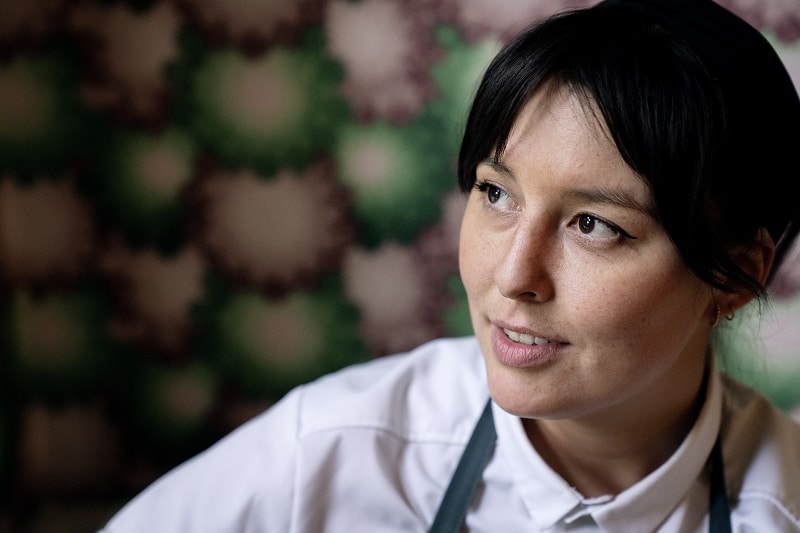

Relentless and Focused Work Has Driven the Dream and Passion
Anika is a born leader with boundless energy, and she loves the wild side, which is expressed through her creativity.
“I love being creative and creating new dishes. Preferably ones where I can push the boundaries a bit. I’m not much into making dainty food, but the dishes I make should still have some form of symbiosis,” she says.
She is always the one leading the way but simultaneously focuses on helping her colleagues where needed. She graduated as a chef from the ‘Hotel – and Restaurant School’ in 2014, but the dream of becoming a chef goes back to her childhood.
“I’ve always known I wanted to be a chef, and I quickly realized I wanted to pursue the education. It started with a dishwashing job I had at ‘Dragør Badehotel‘ back in 2006 when I was 13 years old. The interest came from the atmosphere in the kitchen and the tough tone around achieving the same goal. And when I occasionally got to plate a dish, it was huge. I stayed there until I left elementary school, and my main tasks were setting up for events, polishing silverware, and the like. Occasionally, I assisted with plating. So, I got a bit of the meticulous presentation part. But there was never any doubt that becoming a chef was the path for me,” she explains.
In fact, no one in Anika’s circle doubted that this was the path for her. It even said so in her yearbook when she graduated from elementary school.
“Everyone wrote that I would end up being a chef. At that time, I wasn’t very good at cooking yet, but the interest also came from my uncle having a lunch restaurant where I often helped out. So, I’ve almost always been in a kitchen, whether as a dishwasher or during summer holidays when I helped my uncle,” she recounts.
Although the ambition to become a chef was firm, almost from childhood, she still needed to explore what the world had to offer, where sports took precedence over cooking.
“I took a year in the USA, where I attended high school. Just like you see in the movies. I’m not very academic, so I was very involved in my own schooling and focused more on the athletic side, playing a lot of sports. The first half year I was there, I played volleyball, which I had also done here in Denmark. I was really good at it, which surprised them (she laughs, ed.). In the winter, I played basketball, which was new to me, but it went well. And the last half year, I played softball, which is a bit like baseball. During my time in the USA, cooking wasn’t a big part, but I knew I wanted to join the culinary education when I got back. So, I started when I was 17 and took the classic route with a basic course and then went to find an apprenticeship,” she explains.
Initially, she had the idea of first learning to cook real food and then later focusing on the finesse. Therefore, her first apprenticeship was at a brasserie called ‘The Tattooed Widow’ in Copenhagen.
“It was actually a Belgian beer bar, but on the first floor, they had an à la carte restaurant, and we had many guests throughout the day. I actually started on the ‘grill station,’ which is very unusual for a new apprentice. It requires being a skilled grill chef, so my boss was breathing down my neck the first half year. It was tough, but I somehow had a knack for it and thought it was amazing. Even if you messed up on Friday, you still had to show up on Saturday but with red ears. That’s also part of being an apprentice,” she says with a chuckle.
Today, she is the head chef at ‘Fasangården,’ which fits well with her dreams. Here, she also acts as a partner, where her opinions and views are valued concerning various concepts. Therefore, the menu is also influenced by her creative and hardworking mind.
“I would love to have a place with its own kitchen garden and herbs, where we make high-quality food but at bistro prices. The most important thing for me is that the guest feels my ideas about the food through what they’re served. I’m generally very inspired by the ingredients in the Nordic season, but I also love seeking inspiration, basic techniques, and flavors from all four corners of the world. On my menu, you’ll always find Asian ways of preparing something or Asian flavors. There’s a lot of strength in it, but I try to make it with Danish ingredients as much as possible,” she says.
Her journey to where she is today has been marked by relentless and focused work, and there is nothing she would change.
“For me, it was about really wanting this and not looking back to question if it was the right choice. If you just work hard and focused, things will come to you,” she says.
We Ask – Anika Answers
Get to know one of the biggest talents on the Danish culinary scene better as we ask her a series of personal questions. Read about her show-off dish, where and when she was last impressed, and her best tips and tricks.
Where does the nickname ‘Umami Queen’ come from?
It dates back to when I participated in ‘Sol over Gudhjem‘ in 2019. Svend Rasmussen, who is a commentator on the competition and a food critic for Berlingske, tasted my dish, which was pork with Nordic BBQ, and exclaimed that he simply had to call me the ‘Umami Queen.’ It’s a huge compliment, and I laugh a bit at the title, but I must say I’m proud of it.
How was it to win the Talent of the Year in 2018? And how did you get considered?
It was huge, and being a young head chef who deserved that title was pretty wild and a bit surreal. Before that, I had flown under the radar, and I was just little me, I thought. I was considered after I started as head chef at the new ‘Kadeau’ restaurant called ‘Roxie,’ where the guys behind it asked if I wanted to be co-owner, along with a partner, to which I said yes. They could see that I had a flair for cooking and lots of energy to develop new dishes. At that time, I was only 24 years old but helped mark a new footprint on the culinary scene, which echoed in the gastronomic world.
What is your best memory from the kitchen?
I think the best memories are the times when one of my apprentices graduates. It’s buzzing and indescribable, and the first one is my right hand today, who graduated a year ago. And that was very big, I can feel that. He’s had his entire apprenticeship with me, so when he finished, it was a big day for both of us.
What dish do you like to make the most? Why that one?
The dish that surprises the most when I have guests over is when I make meatloaf. A classic meatloaf. It’s not a dish you think chefs would like to make, but for me, it’s a dish I can always win with. Most people are often pleasantly surprised, so when we have guests and tell them we’re having meatloaf, they always say, “Yes! You almost never get that anymore” (she laughs, ed.).
What if you want to make a show-off dish?
Then I might make a dish like stuffed morels. Find the largest morels from France and then make stuffing. It could be fish stuffing, chicken liver stuffing, or whatever you have in the freezer, which you then inject into the morel.
Do you have a nemesis? Or flavors you struggle with?
Everyone has that, but I’m not very picky. However, there are some flavor components I’ve never understood, like dark chocolate with orange. The same goes for lemon or orange peel in pancake batter; I’ve never understood that either. It doesn’t belong anywhere (she says with a laugh, ed.).
What dish do you make most often in your own kitchen?
It’s probably a Thai dish called Pad Krapow, and the one we make is minced pork stir-fried in a pan with ginger, garlic, chili, coriander roots, a little bit of fish sauce, and oyster sauce. It’s a wildly fragrant dish, and at the end, you add fresh mint, coriander, and Thai basil. It sounds like a lot, but when you’re doing it, you literally toss it in the pan for 5 minutes on high heat, and then it’s done. It’s also a dish with lots of aromatic umami.
Do you have a favorite cuisine?
I’m very into Thai cuisine, but what I return to the most is French cuisine. I trained at ‘formel-B,’ so it lies very close to my heart.
What is your favorite ingredient?
I think it’s cabbage, which is something you can get almost all year round in the Danish seasons. For example, soon there will be cabbage flowers popping up around cabbage fields. In the summer, it’s the very tender pointed cabbage, which I love to use when they’re no bigger than a hand. And otherwise, pointed cabbage is always available in the fall and winter. So, it’s about finding out which cabbage is in season right now.
What is your favorite dish?
I have a real love for meatballs in curry, even though it’s a dish I don’t feel like making myself. I think it’s a boring dish to make yourself, where you first make the meatballs, which you then have to poach, and then you have to make a roux-based sauce. It’s not difficult to make, but I just find it boring to deal with. But if others make it for me, I get really happy. It’s the best. When you’re at work, making a lot of refined food, it’s great on the weekend to just get something as simple as meatballs in curry.
Where and when were you last impressed?
It must have been in Berlin last summer at a place called ‘Barra.’ Generally, the bistro-level is incredibly high in Berlin. They’re also some of the frontrunners in terms of using local and organic ingredients. I had a German version of aguachile, which is this South American cold appetizer. They made it with raspberries and salted fish. A bit of a strange combination, but wow, the flavors were just genius! Sometimes they’re way ahead in Berlin compared to us here in Denmark.
Do you have a favorite restaurant?
It must be ‘Septime‘ in Paris, which is French with neo-Nordic concepts, where they use French ingredients but have a Nordic mindset in the way they create dishes. They stand out a lot from the classic French cuisine.
Do you have a guilty pleasure?
I probably can’t get away from it being a ‘Jaggerburger’ (from Jaggerfastfood, ed.), preferably the one with chicken. So, a fried-chicken Jaggerburger. That’s a guilty pleasure for me.
What type of knife do you use the most?
It’s a small knife that looks like a utility knife but is just smaller in size, about 15cm. It’s not a chopping knife, but it can be used for everything from vegetables to filleting fish.
What brand are your knives?
I often find that the really cheap German knives are easy to source, so I often recommend them to my apprentices. But I personally like Japanese knives with wooden handles. I usually go down to ‘Foodgear‘ and try them out, depending on what feels good in the hand.
What machines and equipment are your favorites?
I can’t live without a dough scraper. I use it for everything. I can’t stand it when someone hasn’t used a dough scraper to, for instance, get the last bit out of a container. And then a sauté pan and a regular frying pan. Additionally, I must admit that I’ve become very fond of a bamboo steamer. It’s a good little steam oven, and it can be used for everything from Asian dishes to steaming fish and vegetables. It’s absolutely brilliant.
What kitchen appliance do you have a strained relationship with?
It’s probably a roner (A water bath, ed.), I’ve never been a fan of it. You need to learn how to fry from scratch when you start as an apprentice at my restaurant. It doesn’t make sense to me that you need to steam the meat that way if it’s because you can’t figure out how to fry. So, buy 10 pork chops and fry them, and try your way through (she says with a small laugh, ed.). It’s all about the hand, and you can certainly learn to fry meat properly. By using a roner, I don’t think you retain the juices and flavor, and it’s hard to impart flavor with, for instance, thyme, garlic, and butter.
Can you name the three most important techniques you use as a chef that others can benefit from?
It must be something as simple as frying vegetables but then using them cold. Many think that when you fry something, it should be eaten hot, but most things are actually better when they’re cold. For instance, in salads. You can also fry cabbage, which you then use in a cold or temperate salad. It tastes incredibly good! And then I recommend getting a steamer. It’s become trendy to get ovens with steaming functions, and it’s not necessary. A bamboo steamer can do it just as well. The trick is that you can place it on top of a pot with water, where it traps the steam inside. I also think people should do more curing (A preparation method, ed.). We’ve grown up with gravad laks, but there are many different things that can be cured and salted, and it’s the easiest preparation method. You follow a recipe that’s often one part salt, double the sugar, and then just put in your item. It could be duck breast that you have leftover. It could be white fish, which needs less than a day in the fridge. So, curing in general, that’s something people should do more of, and you can use your favorite spices. I recommend fennel seeds.
Is there something that many do wrong in the kitchen that you think can be done differently?
I think there’s too much fascination with minced beef. I think you can easily use minced chicken or pork instead. It can drive me a bit crazy how much we Danes love beef, and it’s just not very good for the climate. I can’t completely avoid using it now and then, but I try to educate people to use something other than beef. For example, at the restaurant, we make our tartare from game meat, which could be venison, and people are wildly excited about it. And many don’t even notice that it’s not beef.
Fact Box
Name: Anika Madsen
Age: 28
Residence: Frederiksberg
Job: Chef and Head Chef
Company: Fasangården.
You can follow Anika and her work on Instagram under @ani.kamadsen and @fasangaarden_frb.
/Photo:/ Walter Bølge