
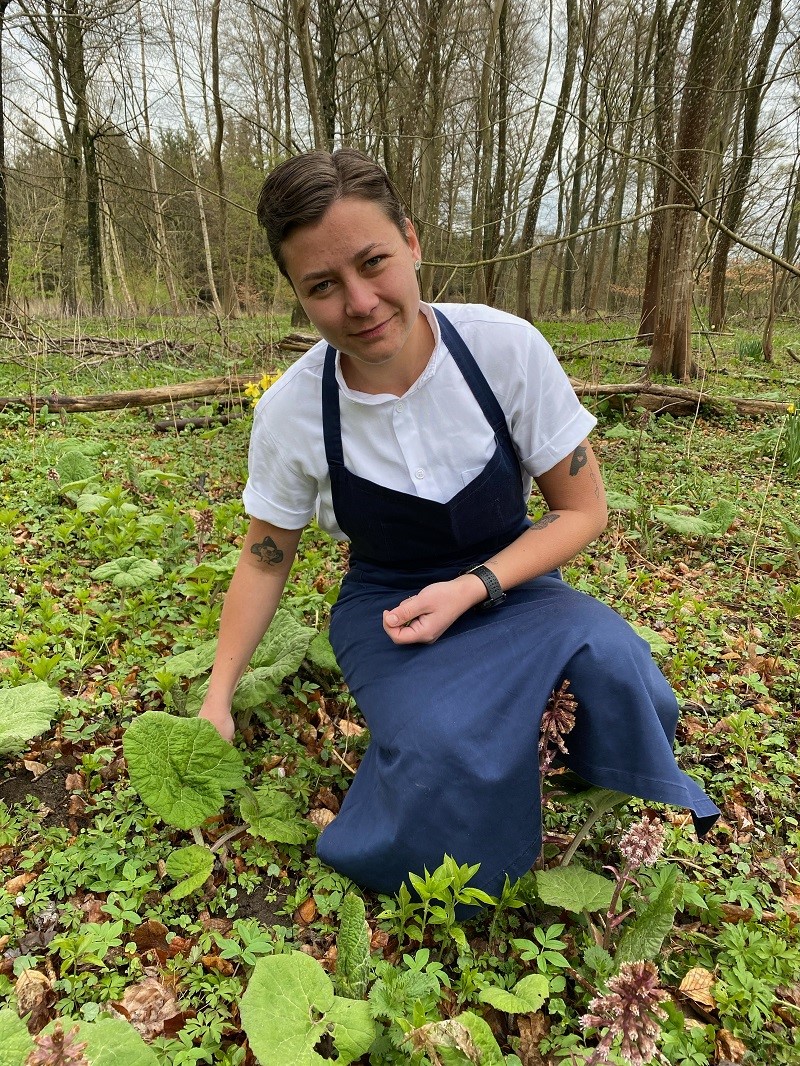

Passion for food can drive you far
On March 28, 2021, Amanda was crowned the first winner of the new talent competition ‘Rising Star’, held by ‘Sol over Gudhjem‘.
“The competition was really well executed, and it was a super good event with a really good setup. It was cozy, and the judges, journalists, and Mikkel (Mikkel Marschall, ed.) were really good at creating a nice framework to compete in,” she says.
She herself graduated as a chef in 2016, where she apprenticed at ‘Stammershalle Hotel‘ on Bornholm and ‘Alberto K‘ in Copenhagen. She has always had an interest in food, but it wasn’t initially in the cards for her to become a trained chef.
“The year I took a gap year, a basic course started at the ‘Hotel and Restaurant School’. So I started there, and everything just clicked for me. It suddenly made sense to me, and it was the chef’s path I should take. I’ve always enjoyed cooking, and it’s always been a big part of my life,” she says.
She believes that during that time there was a huge development for her, even though the contrast from STX to vocational training was significant. She therefore had to get used to going from reading and studying to suddenly working 14 hours a day.
“It was really great for me because the apprenticeship quickly became a form of ‘adult work’, as it’s vocational training. So you’re thrown into it quite quickly, and the chefs at ‘Stammershalle Hotel’ were pretty quick to give you a lot of responsibility if you were ready for it,” she says.
The work environment suited her well because she is a very structured person with a very positive mindset. However, she is also very adaptable if the job requires it, but the most important thing for her is to take things as they come. She has mostly worked as a sous chef at the places she has been, where she was the person who filled gaps where needed.
Today, she works as a sous chef at ‘Dragsholm Castle‘, but she hasn’t decided yet if she wants to participate in more competitions.
“I think it was quite fun, but I haven’t thought much about it. If the opportunity arises again one day, I could definitely consider entering a new competition,” she says.
We Ask – Amanda Answers
Get to know Denmark’s new ‘Rising Star’ when we ask her a series of personal questions. Among other things, you can read about what it was like to win and how to use pickled pinecones in a dessert.
What was it like to win Rising Star?
It was awesome! It was really great. I think all the participants felt that it was amazing to be the first 4 to participate in this competition. ‘Sol over Gudhjem’ has always been a competition where it’s also about having fun along the way, which Mikkel emphasizes a lot, where you can have a good conversation while the competition is ongoing. But of course, we all came with a clear hope of winning. We knew each other by name but got to know each other better during the competition.
How did you get considered for the competition?
I actually don’t know, but I got a call from Mikkel in the middle of a busy lunch service at ‘Kanalen‘, where he asked if I wanted to participate. And I just said yes, but I also asked if I could call back because I was in the middle of a busy moment. So I said yes without really having time to think much about it.
How did you prepare for the competition?
For a long time, we didn’t know much about what we were supposed to do. The only thing we knew was that we were supposed to make a main course from a mystery box on the day, and then we went to a press event in November where we found out which dessert we were supposed to make, and we could prepare from there. So from September to November, we couldn’t really prepare. The competition was originally supposed to be held in January 2021 but was moved to March, so I didn’t train much in January and February, but when I got to March, I started training again. You have to be careful not to train wildly in all those months because you can burn out.
You made, among other things, a dessert with pickled pinecones, how did you get that idea?
You learn all the time because I didn’t really know much about them before I started at ‘Dragsholm Castle’, where they asked if I had tasted it before. So you are constantly in development, and it’s the same when you go out to eat. The dessert actually came about pretty quickly because there were some requirements for what should be in the dessert. There had to be a warm element made on the day, and in that way, there were some set frameworks, including the ingredients we had available, which I thought should play the main role. And the pickled pinecones were really just a side element that tied everything together. You just have to trust your skills and the experience you have with other dishes because when you’re there, you don’t have much time to lay out a big plan.
What is your best memory from the kitchen?
In my childhood, I was always in the kitchen with my dad, and in that way, it’s classic childhood memories where I was allowed to be part of the cooking. He has always been very keen on cooking, and it was fun to be involved, and in a way, it was a natural thing to participate if you wanted to. The clearest memory for me in my professional career is the first time I was in charge of running a service alone, where we were busy, but everything came together beautifully. I really got a feeling of busyness mixed with adrenaline, but everything just worked out and everything functioned. I lived off that feeling for several days after.
What dish do you like to make the most?
I don’t know if there’s one particular dish I like to make the most, but I make a lot of desserts at work. The process around the dessert is one of my favorite things. But otherwise, privately, I like share-food on large platters, where you just sit, chat, and eat together. You also choose what you want. It should invite coziness.
Where do you get your inspiration from?
I get inspired by many places, and it’s quite easy to get inspired today because there’s so much on social media where you often see dishes that look good. Otherwise, I think I let myself be inspired by the surroundings I’m in, especially now that I work at ‘Dragsholm Castle’. There are some ingredients right outside the door that are just wildly inspiring. It’s both vegetables and herbs in the forest.
What is your show-off dish?
It must be fried turbot with vegetables, where the turbot is fried in browned butter and with lots of herbs. Essentially a classic dish with a butter sauce with herbs. It reminds me a bit of the main course I made for the ‘Rising Star’ competition. The flavor should be paramount.
What is your nemesis?
I don’t really know. I love artichokes, but I hate preparing them. The process takes so long, but they taste really good when cooked.
Do you have a favorite cuisine?
I really like Italian food and the Italian cuisine, with everything it has to offer, but on a daily basis, I let myself be inspired a lot by the French, which is also what I use the most at work. They are two very different cuisines that can do different things. So my own cooking is very influenced by the French cuisine with Nordic ingredients. Therefore, it’s also difficult to pin down a specific cuisine.
What is your favorite ingredient?
Cabbage, spinach, and especially cauliflower. It can do something particularly special.
Now you’ve made a dish with pickled pinecones. Do you feel that there are ingredients in Danish nature that are a bit undiscovered?
There definitely are. It’s not very long ago when it was completely new to go out and pick ramsons and wood sorrel, but it’s a bit of a common thing now. And I actually think it’s pretty cool that you can go out in nature and find a lot of things you can use in your cooking. When we use pinecones, for example, not all types are edible. The ones we use are the very young pinecones, a bit like young spruce tips. But of course, you need to gather some background knowledge before starting because some of it can be toxic.
What things do you always have in the fridge/pantry?
Butter and eggs, and especially the egg is the most amazing ingredient because it can do so many things. I use it in almost all dishes because it’s an ingredient with so many aspects, for example, also for thickening.
What is your favorite dish?
It’s very mood-dependent, but it’s probably something from the Italian kitchen because I love a good pasta dish. Whether it’s just a Cacio e Pepe with well-cooked pasta, lots of cheese, and pepper, it can make me just as happy as 12 servings at a fine restaurant. When I have time off, I like something that just tastes good. So right now, it would probably be a Cacio e Pepe (She laughs, ed.).
What is the worst and best dish you’ve had?
I had a dessert at a restaurant in Paris once where everything was gray. It’s not often you eat gray food, so it stood out a bit. The best dish I’ve had is probably the first time I was at ‘formel B‘ where I had turbot and oxtails, which was their signature dish. It just tasted really good, and everything about the dish came together beautifully.
Do you have a favorite restaurant?
It depends a bit on the occasion when I’m out eating, but I’ve been quite fond of ‘Barabba‘ which is located in Copenhagen. And I’ve eaten a lot of open sandwiches from ‘Palægade‘, and I really look forward to going there again and seeing the guys. I really like that, and the two places are actually almost right next to each other. But last year I was also at ‘Jordnær‘, and it was just an amazing experience, but also a bit different. Here you get high Danish gastronomy for all the money, and those are experiences I would never want to be without.
Do you have a guilty pleasure?
I have a bit of a weakness for pick-and-mix candy, preferably on an evening where my boyfriend and I don’t have any plans. I think it’s mostly my guilty-pleasure, but he’s been dragged into it a bit (She laughs, ed.). He hasn’t complained yet, though. I mostly go for licorice and marshmallow candies.
What type of knife do you use the most?
I mostly use a knife that’s a cross between a universal chef’s knife and a paring knife, which is about 14-16cm long. It can do a bit of everything, suits all my needs, and fits well in my hand. It’s always with me for service and is on the cutting board every time.
What brand are your knives?
I have many different types of knives in my knife bag, and for me, it’s mostly about them fitting well in the hand, being easy to work with, and being capable of what I need them for. They just need to work. We recently got some knives from ‘Wilfa’ in their brand called ‘EGO’. They fulfill many of my needs. Otherwise, I have a couple from ‘KAI Shun’, and a universal chef’s knife with serrated edges from ‘Victorinox’, which you can use for everything. It didn’t cost much, but it’s just great to work with.
What kitchen appliance do you have a strained relationship with?
A mini chopper that people use so they don’t have to chop onions instead of just slicing them themselves. It’s an unnecessary tool that can easily be replaced with a knife and a cutting board. I think if you decide to cook from scratch, it doesn’t matter that it takes a little longer to chop your vegetables. And the more you practice, the better you get at it. Boiled down to the basics, a chef really only needs a knife, a frying pan, and a pot. When you use a mini chopper for onions, for example, it’s not really chopped onions you get, but more like blended onions.
Can you name the key techniques you use as a chef that others can learn from?
If you are well-prepared, it’s easier to get through cooking without it seeming overwhelming and difficult. So, for example, that you have chopped the things that need to go in the pot together and time it with when the pasta water should be on, so everything fits together when it needs to be served. I think sometimes people get stuck on that, and it’s just easier if you’ve gone through all the processes in your head. It’s something you learn the more you cook. Another tip is that you should have your tools in order, because then the cooking just flows much more smoothly. So your knives should be sharp, and preferably have a wet dishcloth under the cutting board so it doesn’t slip around. It’s never fun to chop something with a dull knife or if the cutting board skates around the kitchen.
What basic dishes are important to master?
If you have the basic flavors in order and practice seasoning, you continually expand your horizons. I don’t have specific basic dishes that are important to master, but if you can make a good tomato sauce, you can really go far, for example, in the Italian kitchen. Furthermore, you’ll also go far if you can make a good stock. So if the basic things are in order, a world of more and more dishes opens up. And it just keeps going like that as you get more basic dishes and techniques under your belt.
Is there something people almost always do wrong in the kitchen that should be corrected?
People might let themselves be too guided by recipes, so they forget to taste according to their own preferences. It’s important that they themselves think it tastes as it should. Recipes are really good, but you have to taste everything along the way because it’s not certain you agree with the recipe. Does it need more salt, acidity, or whatever you think it needs? That’s where cooking becomes personal because it should be something you think tastes good. If it does, your guests will probably also think so. You can follow the recipe slavishly, but you have to be a bit self-critical along the way. Many recipes are probably also made very neutrally to capture as wide an audience as possible.
Facts
Name: Amanda Peldrup Grønning
Age: 27
Residence: Borup on Zealand
Job: Sous Chef
Workplace: ‘Gourmenten’ at Dragsholm Castle
You can follow Amanda and her work on Instagram at @amandagronning.