
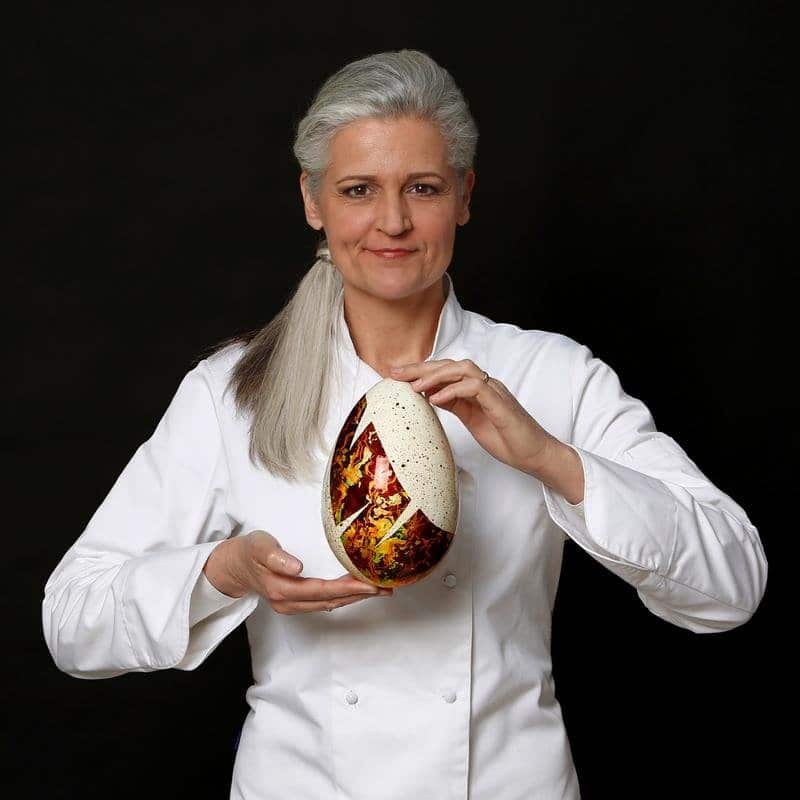

Great dedication and a creative mind can lead to impressive results
Andrea is originally trained as a tailor and for many years has worked with costumes and theater art. However, one evening she was inspired to send an application to the ‘The Great Bake Off‘ on DR.
“It was by chance, because it was absolutely not thought through. I was watching the show, and when it ended, an info came up about if you wanted to participate, you could sign up here. I sat there for 2 minutes and thought it could be fun. At that time, I knew nothing about dessert art. I could bake buns and bread, but not much else. But I could see that the participants’ level increased throughout the season, both in their development and creative process, and I thought it could be fun to learn. So I sent an application and went into the family and said I had signed up, and they asked ‘why?'”, she says with a laugh.
However, she ended up being called in for casting, which was a big surprise for her. Along with 300 other hopeful applicants, she showed up with a bread basket she had baked at home.
“We had to bring something we had baked ourselves and talk a bit about ourselves. After the casters deliberated, we were told that some of us would be invited for an interview and personal conversation. After that, we had to go to the final casting, where we had to bake in front of the judges and were given a secret challenge. There were 25 of us, of which 10 would be chosen. I thought it was a cozy day and had no expectation of moving on,” she says.
Despite her low expectations of participation, they called and gave an unexpected message – she would be in the next season of ‘The Great Bake Off’.
“I just thought ‘Shit, now I’m going to be on TV’. I was happy and excited, but before that, I hadn’t really ventured into the dessert kitchen. I thought I didn’t have many baking technical skills, but that my creative mind would probably carry me forward and that over time I would crack the code. I have lived off my creativity all my life, and if I just got a handle on the technical part, it should be fine. The most important thing for me was to learn something,” she says.
She grew up in a home where cooking wasn’t a significant part. It was more of a duty, which in the end was meant to fill some mouths. This changed when she met her husband, who introduced her to the value of taking the time to cook and that, in the end, it should give one well-being. Before that, she didn’t cook with the same zeal and desire as she does now.
“For me, it came with age, and especially after I met my husband, who is really good at cooking and very into it. It was the first time I found out that food shouldn’t just fill people, but that it should also be an experience. He could, for example, start a stock in the morning, which would become a sauce in the evening. He introduced me to slow food, and that food has a meaning. That you might as well spend the time and coziness making something proper,” she says.
Therefore, Andrea’s way through ‘The Great Bake Off’ has also been somewhat reminiscent of H.C. Andersen’s fairy tale ‘Clumsy Hans’. She had never imagined winning the competition, but her goal was to learn and have fun in the process. Nonetheless, she was ultimately crowned the winner of ‘The Great Bake Off’ in 2017.
“It was a bit surreal, and I never thought I would be the one to win. I never had that thought. I had more of a sense of seeing how far I could get. The goal was mostly to get the chance to make some exciting cakes. My ambition was to do it as well as I could – mixed with humility – because there are so many who want to be in ‘The Great Bake Off’. There are 8-10,000 people who want to participate, so I felt I owed it to myself to do my best. Sometimes I got a bad assessment, but where I was really happy because I knew I couldn’t have done better. Other times it was the opposite, where I got a good assessment, but where I felt I could have done better,” she says.
She would describe herself as being present, creative, and empathetic, but always with an ambition for what she does.
“I am present in the sense that it’s about being present in what you do. That means that the task in front of me has my full focus. It can be both in my craft, but also when I meet and talk with people. It has both positive and negative sides. The negative side is that I get tunnel vision. A bomb can go off next to me, and I won’t even notice. The more positive part is that I have total engagement in what I’m doing,” she says.
She later took a chocolatier education, which she completed in the summer of 2019. Today she works professionally in the dessert kitchen, where she makes cakes by order but also holds courses for other dessert enthusiasts.
We Ask – Andrea Answers
Get to know the winner of ‘The Great Bake Off’ as we ask her a series of personal questions. You can, among other things, read about what her show-off dessert is and what guilty pleasure she has.
How has your path to what you do today been?
Everything has been shaped by coincidences, and after I won, there were a lot of people who wanted to taste my cakes. So I thought it might last for 2 months, and then they would probably forget me. But every time I delivered one cake, I got two new orders. So my husband said it was over with standing here at home and filling the whole kitchen, and the whole house being stuck with sugar. So I rented an industrial kitchen and bought a small cake van, which I drive around the country in. However, I always keep in mind that my product should stand on its own, and that it is not the quick fame that makes me interesting. Therefore, I also value my privacy very much.
What do you think the future holds for you?
Diversity in my work life is important to me. I shouldn’t just sit and make wedding cakes, because then I lose the passion. It should be an interplay between pastry making, chocolate, teaching, and the artistic part. And I can also feel that after taking the chocolatier education, I’m not done with that part. So I need to take more further education and courses, even if I have to travel for it.
What is your best memory from the kitchen?
It is the first weekend in December, where we have a confectionery day with our children. It involves chocolate, marzipan, nougat, nuts, and everything else that goes with it. We feel like if we don’t have that confectionery day, then it won’t be Christmas. So my 3 children come home – along with their partners – on the first Sunday in December, where we listen to Christmas music, sing, and totally Christmas it out. And every other piece of confectionery goes into the mouth (She says laughing, ed.).
Which cake/dessert do you prefer to make?
The best ones are those that contain chocolate, and that applies to dessert cakes as well. They obviously contain all sorts of other things, but it’s rare that I make something that doesn’t contain chocolate.
What is your show-off dessert?
It evolves and also depends on who is visiting. When my dad visits us, he always wants lemon mousse, and that’s what he gets. Otherwise, it should be traditional Danish apple cake, where you make a compote, which you layer with granola or something crunchy, topped with whipped cream. That’s also really something for my dad. It’s always traditional when he visits. There are some things I make – purely decorative – that are show-off, like delicate dessert decorations. These are designs I have developed myself. But otherwise, I think a show-off dessert is something that contains a perfect balance between something sweet and tart, and crunchy and creamy. The textures must be just right because you should have a pleasant mouthfeel when you eat it.
What is your nemesis?
It must be puddings, which are packed with gelatin, so they almost stand on their own. I don’t understand why people eat that. Otherwise, I also have a thing with American cupcakes, and it comes from a time when I lived in the USA. They are crazy about putting a big layer of buttercream on top, and I have never understood that. It’s a really boring dry cake that almost only consists of sugar and butter. But now it’s also trendy to make cakes that are vegan, and I’ve never succeeded in that. So that’s probably my real nemesis. I have difficulty making cakes that I am satisfied with, without using butter, eggs, and cream. My cakes are often not calorie-conscious.
What is your favorite ingredient?
I’m probably very traditional, so I don’t use fermented things, for example. So I work a lot with seasonal berries, various herbs, nuts, and there is spirit in all my desserts and cakes. It doesn’t have to be much, but it’s always in the recipe. It works both as a flavor enhancer and does something good for the texture.
What do you always have in your fridge/pantry?
I always have eggs, cream, and a good creamy mascarpone in the fridge, and otherwise, I always have nuts and almond flour in the pantry.
What is your favorite dish?
I really like fish and vegetables, preferably steamed or grilled. I actually don’t eat much meat because I prefer the greens. So I like food that isn’t too heavy because then there’s also room for dessert (She says laughing, ed.).
Where and when were you last impressed?
That was when I went out to eat with a friend at ‘Grønnegade‘ in Copenhagen, where we had 5-7 courses. It was essentially a meal where we stopped talking because we were just busy tasting all the different elements in the dishes. It was very successful.
Do you have a favorite restaurant?
It used to be ‘Babette’, which unfortunately is closed now, but now I have a really lovely restaurant called ‘b-spis‘, where the head chef is trained at ‘Babette’. I generally think there are many fine restaurants in Copenhagen, but otherwise, I also think the provinces have a lot to offer.
Do you have a guilty pleasure?
A good whisky! We have a bit of a whisky-fetish at home. I prefer Scottish ones, although we have other types too. My husband thinks there should be water in some of them, and I completely disagree. It should be little but good, and that applies to many of my favorite things, like red wine, cakes, or chocolate. Rather have 2 pieces of good chocolate than a whole bar of bad chocolate.
What machines can’t you do without in the kitchen?
I can’t do without a mixer, and it should preferably be a good and solid machine that only has basic settings but performs at the same stable level. In addition, I use a gas oven because it bakes very evenly and well, and the last thing I can’t do without is a microwave. I use it to melt chocolate. A microwave heats from the inside out, while a water bath heats from the outside in. Therefore, a water bath also takes longer, and you risk water vapor getting into the chocolate, which is the raw material’s enemy number one. So with a microwave, the chocolate can stand and melt without a great need for supervision.
Can you name the three most important techniques you use as a dessert chef that others could benefit from?
When working with desserts and the sweet kitchen, it’s about chemistry. It’s easier to cook by feel in the savory kitchen, but in the sweet, you have to be pretty precise with your recipes. If you don’t have the right training, the most important advice is to be accurate to get something to succeed. And you have to be very aware of temperatures when mixing different components. It’s crucial. So you should always have a thermometer in the sweet kitchen. This also applies when baking. Temperatures are often what determine whether something becomes a success or a failure, and it’s a fine line.
Fact Box
Name: Andrea Søllested
Age: 53
Residence/City: Næstved
Job: Pastry chef and chocolatier
Company: Andreasoellested.dk
You can follow Andrea and her work on Instagram under @andrea_soellested.
/Photo:/ Private photo