
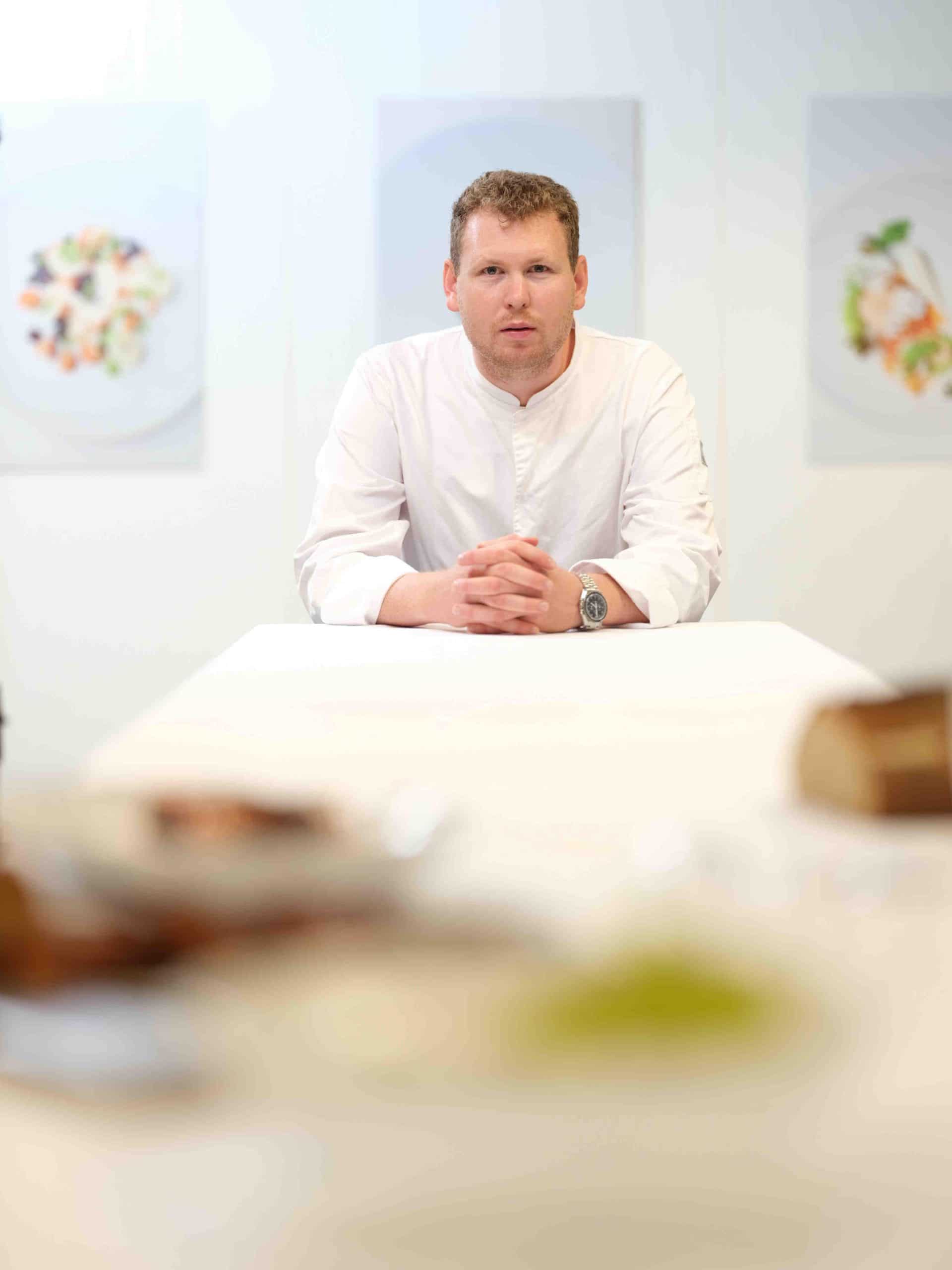

Great Competitive Spirit and a Unique Approach to Culinary Experiences – You Can Never Make Bad Ingredients Good
Morten Falk graduated in 2010 from ‘Henne Kirkeby Kro‘ in West Jutland. He hails from Esbjerg, and cooking has always been a significant part of his childhood.
“My stepfather ran a restaurant called ‘Kunstpavillonen’ in Esbjerg for over 30 years. They sold it a few years ago and retired. So, I was kind of born into the cooking profession,” he says.
He initially wanted to be a pastry chef like his grandfather but was inspired at a young age to pursue a culinary path instead. At 13, he started as a dishwasher at his stepfather’s restaurant but quickly became part of the kitchen team. The reason he ultimately chose the culinary path was a unique experience he had one summer in 2006, just before starting culinary school in Esbjerg.
“Before I started culinary school, I interned at ‘Henne Kirkeby Kro’. It was a special experience because I hadn’t been in a professional kitchen before, but it was wild to experience. We were 10 people in the kitchen, picking our own ingredients in the inn’s garden. It was a special experience for me. Even though I grew up with a large vegetable garden at home, it was different to do it with people you looked up to,” he says.
Since then, he has achieved great results, winning both the title of ‘Chef of the Year’ in 2014 and the ‘Sol over Gudhjem‘ competition in 2015. He was subsequently selected to represent Denmark at the ‘Bocuse d’Or’ in 2017. He believes he has a strong competitive spirit, which stems from his high ambitions for his own abilities.
“I’ve always aimed quite high with my ambitions, and it didn’t take long before I realized I was pretty good at navigating this industry. I liked the discipline and direct feedback. A somewhat militaristic approach to the profession. There wasn’t much consequence in school, but I could feel it during internships because otherwise, the guests wouldn’t get any food,” he says.
He has always enjoyed measuring himself against others who were just as passionate about food, which drove him to participate in many different competitions. He believes he has had many interim goals that served a higher purpose, continuously expanding his ambitions. Therefore, he has several highlights in his career, although there is one feeling that surpasses all others.
“It’s always the first times you win that you remember best, and the title of ‘Chef of the Year’ is undoubtedly one of my biggest highlights. Back then, I didn’t think it was the biggest thing I could achieve, but when I was in it, I had a much greater joy winning ‘Chef of the Year’ than advancing in ‘Bocuse d’Or’. It comes from the fact that the first time you win something, the joy is much greater than the joy you experience the second time,” he says.
He stepped down as head chef at ‘Kadeau’ in 2016 to focus on other things. Today, he runs the catering company ‘Babette’, where he appreciates the predictability of his daily routine, compared to working in a restaurant.
“After having children, I’ve realized it’s nice that everyday life has become more specific. At a restaurant, you never know how many guests will come. In the catering business, you know every day what you’re dealing with. You know it’s an event for 10 or 100 people, and therefore you know what they need. It’s more tangible and easier to plan,” he says.
When asked about his competitive spirit, you can sense that he hasn’t completely shelved it.
“I find it really exciting to be part of competitions, but I shouldn’t participate myself, as things stand right now. But I can feel the itch when I see participants training for events like ‘Bocuse d’Or’, but I think I’m better on the sidelines, where I can help out if they need some sparring,” he says.
We Ask – Morten Answers
Learn more about Morten Falk and find out why food should be seen as an experience in good company, and why quality ingredients are crucial for your cooking.
What is your best memory from the kitchen?
I have plenty of good memories, but I like sharing food with loved ones, where I can feel people have put effort into the meal. The most important thing for me is that people have invested time and energy in cooking. It’s about the love of cooking for others, and that people shouldn’t just be fed.
Is there one dish you particularly like to make?
No, not really, as it varies depending on what I feel like making and what’s in season. I recently had some friends over for bouillabaisse, and that’s a fun dish to make. I caught the cod myself and served the soup in a large pot with some good wine. Everything doesn’t have to match, but it’s more about the atmosphere around the meal that I focus on.
Do you have a dish for when you want to show off?
I’m kind of over those labels because that’s what I focused on when I was competing. But I love making fish and especially vegetables because much of my passion lies there. I grew up with a herb garden and trained at a place that had an inn garden. So it gave me a special perspective on ingredients, and I quite like what vegetables can do. The vegetable kitchen can do it all!
Do you have a nemesis?
I’m not good with bad ingredients. I don’t want to cook with them. I also find it hard to cook with things I don’t personally appreciate. For instance, there are many offals I like, but there are also some I wouldn’t cook with. It could be veal kidneys, which I wouldn’t make a dish with unless it was an assignment.
What dish do you make most often in your own kitchen?
Right now, I’m making dishes with lumpfish roe. I think it’s really delicious. Otherwise, during the winter, I’ve been making a ‘chicken tagine‘, which is a North African way of cooking where you prepare the food in a type of clay pot. It comes from when I worked in Morocco, where I worked with some skilled chefs who taught me the correct way to use that cooking method.
Do you fish yourself?
Fishing has become a hobby during the Corona period because I needed to do something. Besides, I’ve always found it exciting to go hunting and hear people talk about hunting. But when you live in the city, it just requires a bit more to get out, but you can still catch fine cod in Copenhagen harbor.
Do you have a favorite cuisine?
I get inspiration from all the world’s cuisines, but if I have to choose one specifically, it would be French cuisine. It’s also the cuisine that inspires me in my professional work, and it’s the cuisine I’m trained in.
Do you have a favorite ingredient?
Not as such, because it depends a lot on what’s in season. If I go to a food market, I see different ingredients that inspire me. Then I feel like making a dish with those things. It could be sun-ripened tomatoes or large, beautiful bunches of asparagus. I’m inspired by the availability and quality of the ingredient. But if there’s one thing I have to eat for the rest of my life, it would be chicken, because it can do everything. The breast can do one thing, the thighs another, and the carcass a third. You can use chicken for so many different things and pair it with so many different vegetables.
Do you have a favorite dish?
Not really, because I love when others cook for me. I greatly appreciate it when others have cooked, and you can feel they’ve put a lot of energy into the dish.
Where and when were you last impressed?
It’s those times when I’ve had a dish that made me ponder how something so simple can taste so good. I have a friend who once made a pasta dish with tomato, where I just thought, could it really taste that good? There was something magical about that experience.
Do you have a favorite restaurant?
I have some restaurants I would always return to. For example, I’ve dined many times at ‘Geist‘ because I think Bo Bech’s food has something very special. It can be unpredictable and simple, yet still be extremely refined.
What type of knife do you use the most?
It’s a tourné knife, which is a type of small paring knife. I use it to peel and prepare vegetables.
What brand are your knives?
Right now, I’m using ‘KAI knives’, a Japanese knife brand made in collaboration with Michael Bras. They are incredibly beautiful knives, and the manufacturer has really put in the effort to make good knives. There are proud traditions in Japan for making good knives, and we don’t have that tradition quite the same way here at home. But it doesn’t have to be expensive to be good, but you should find knives that feel good in your hand. You should buy something that suits you best.
Do you have any favorite kitchen equipment?
I have a coffee machine that I can’t do without, but I also have some pots and pans from the French brand ‘Mauviel’, which I expect to have for the rest of my life because they are really high quality.
Are there any kitchen appliances you have a strained relationship with?
I don’t think I have a strained relationship with any kitchen appliances. I rarely use ‘Sous Vide‘, but I can see that in some cases, it’s smart. For example, I find it exciting to cook vegetables in a water bath. However, I have a feeling that it’s overused and in the wrong contexts. Many people think you can put any piece of meat in there and end up with a perfect result. However, you need to understand the cut you’re working with, and I would definitely recommend learning the basic principles of cooking before diving into ‘Sous Vide’.
Can you name the three most important techniques you use as a chef that others should know?
You should make sure to have proper equipment, including the pots and pans you have. If you invest in something that is expensive but lasts a lifetime, it’s a cheaper way to have pots and pans of really good quality. You should buy something that lasts, and this also applies to knives. The same goes for ingredients; you should buy proper and good ingredients because they taste much better. You can make mistakes with good ingredients, but you can never make bad ingredients good.
What basic principles are the most important to master?
Food is always very individual, but you should always remember to taste and not be afraid to try something. You should try to use the entire flavor palette, and it’s okay if it may be a bit too salty one time, at least you’ve tried. Add salt or acid if the dish is lacking, or add some oil or butter if you feel it lacks richness. You should experiment and constantly fine-tune the nuances you think are good in the dish. It’s about working with flavors and finding out what best highlights the dish. And you should familiarize yourself with common cooking methods. Being in the kitchen shouldn’t be a chore but an opportunity to expand your own taste horizon. For example, it’s really fun to go into the kitchen with the kids and try making ice cream.
Fact Box
Name: Morten Falk
Age: 30
Residence/City: Copenhagen
Job: Chef and Co-owner
Company: Babette
Morten Falk works daily in the catering company ‘Babette’, but also runs the consultancy ‘Morten Falk Dining and Food Consulting’, which offers advice to the food industry and fine-dining for businesses and private clients.
Follow him and his work on Instagram at @mortenfalken.
/Photo:/ Montgomery