
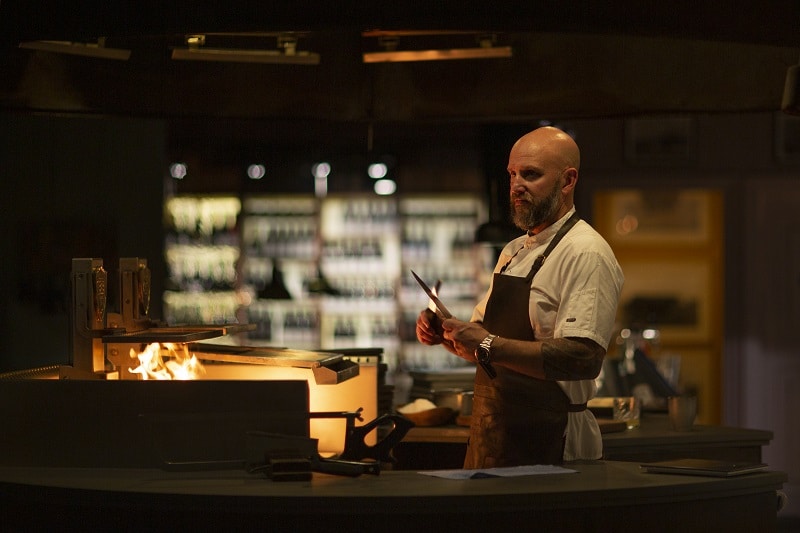

Creativity and Ambition Mixed with Jutland Groundedness
There are not many in Denmark who do not know about Thomas Castberg, and most have followed him on TV, where he has appeared in ‘Kniven for struben’ and, not least, ‘Masterchef‘. As the tall, bald, and tattooed host, he has year after year hosted one of Denmark’s most successful TV concepts. Many hopeful contestants have over time faced him and his fellow judges to showcase their culinary skills. With his warm demeanor and fresh smile, he has either sent people forward or out of Masterchef, but not without them all receiving praise or good advice along the way.
“We rarely give criticism without also presenting a solution. So, telling people they’ve made a bad dish doesn’t teach anyone anything. Therefore, we always try to mention what went wrong or what they might have done instead. It’s a very important part of how we make the program. Sometimes people become too ambitious about a dish, and other times something just happens that you can’t control, and that’s how it is,” he says.
Thomas’s own path to becoming a chef has always been influenced by his childhood. He says he always wanted to be a chef, and his love for food comes particularly from one place.
“It’s from home, it’s always been a part of my childhood. I’ve always carried it with me, and we always had good food at home. My dad often took me out to eat from as early as 5 or 6 years old. So, I almost got it with the baby spoon,” he explains.
He was born in Aarhus and graduated as a chef in 1997 from restaurant ‘René’, but before that, he started at the age of 14 at a place called ‘Huset’ in Aarhus.
“I started as a dishwasher and did some kitchen work. It wasn’t a shelter but sold good food at cheap prices. After that, I went to France at 17, where I started with Michel Michaud. I was there for half a year before returning home and starting at restaurant ‘René’,” he explains.
He describes himself as a dedicated father with a penchant for outdoor life. He has always cycled a lot but also emphasizes that he keeps his professional life separate from his private life.
“Generally, I am quite outgoing; you have to be with the work I do in television. However, I protect my private life a lot. I don’t think everyone should know about it. Because I’ve been doing TV for 14 years, it’s due to my professionalism, not because of who I am as a person,” he says.
His free time is mostly spent with his three children, which feels natural to him. Furthermore, he is a big cycling enthusiast, having engaged in track cycling, mountain biking, and road biking.
His path through the culinary profession and his journey to TV has been quirky and marked by coincidences. Despite that, he has never doubted his ambition.
“When I came to Copenhagen, I found that I had the same technical level as the others but not the same ambitions. So quite quickly, I sought another direction, where I moved a bit higher up in the helicopter. I developed more of an interest in management and restaurant concepts, where I was greatly inspired by Claus Meyer. He is one of those who has played the biggest role in how one views food and what it can do. The reason I ended up on TV was because I had to cook for children’s TV at ‘Meyers’, and someone from the production thought I expressed myself well. After that, I started doing something called ‘Vores Restaurant’, which was a side show in 2006. Then there was some children’s TV with Bubber called ‘Børnenes Restaurant’, and I did some cooking on morning TV. Eventually, someone from ‘Metronome’ in 2010, which produces Masterchef, asked if I would like to help start Masterchef, and I said yes,” he explains.
He is in the process of establishing a new restaurant but is not finished with Masterchef.
“I am in the process of creating a new restaurant, but I am still part of Masterchef. Even though it’s going into its 10th year, it’s something we agree on from year to year, and that’s always how I’ve felt about the concept. It’s a lot of fun, and we are by now experienced gentlemen, and so is the production team, even though there is turnover from year to year. We are a well-oiled machine that likes to work together. That’s why I return every year, even though I don’t plan to do Masterchef for the rest of my life. I return because it’s such a good workplace. But I haven’t thought of doing TV for the rest of my life, and I’ve always been convinced that I should run a restaurant. I do TV because I cook. I don’t cook because I’m on TV. The actual restaurant should be in Copenhagen, and I’ve always dreamed of running a grill restaurant. It will have an open fire and wood, and all food will be cooked on that,” he explains.
We Ask – Thomas Answers
Get to know one of Denmark’s biggest TV personalities when we ask him some personal questions. Among other things, you can read about the worst dish he has been served on Masterchef and the tips and tricks he has for improving one’s own cooking.
What is it like to taste so many different dishes as a judge?
We only eat a little of the dishes presented to us, and by now, we also have a lot of experience in discerning what kind of dish is coming. As chefs, we dissect a lot, looking at what processes are happening and the fundamental things that need to succeed and what the ambition around the dish is. Sometimes, part of the process doesn’t succeed, but then we look at how the dish holds together. Everyone gets a chance, and it’s what you serve that determines your judgment. Therefore, there is also a very strong sense of fairness. We don’t know much about the contestant, and that’s how it should be. It should be natural when they come in.
What has been the best and worst dish you have received on Masterchef?
The worst dish I have received was raw bull testicles. They weren’t supposed to be raw, but that’s just how they ended up. Even for me, who eats almost everything—except oysters—it was a really bad experience, and I won’t do it again. It was awful! But I’ve also seen a bearnaise sauce made with oat milk, which I thought was dreadful. There are several experiences, but it all revolves around handling and ambition around the dish, which we look at. Some of the best dishes I’ve had, of course, come around the final week because, at this point, the contestants have come so far and become so skilled that the food they make is truly excellent. Karoline Trier will always stand out as a shining example to me because she made many dishes that were really good.
What’s your best memory from the kitchen?
I have many, and it goes all the way back to my mom and my older brother. My mom has always cooked good food, so it was a part of my childhood, and there has always been an interest in food. As a culinary student, I was—like others—very ambitious and participated in various competitions. There’s not really one memory that stands out. But I remember when I was the grilling chef at ‘Skagen Fish Restaurant’ in 1999, I was called by Mikkel Maarbjerg from ‘Kommandanten’ in Copenhagen. It was wild. I was about to start service when I got the call, went into my boss, and said that Maarbjerg had called me. He just said that after we’ve finished service, you can just go. He also knew it was a once in a lifetime opportunity I got there. So I did and got hired.
What dish do you like to make the most?
I prefer to grill. So, I don’t really have a specific dish. I care a lot about my food being something everyone should be able to eat. I’ve always wanted to have a big grill restaurant.
Do you have a show-off dish?
Not really, because if I have a good ingredient, I grill it. Whether it’s a fish, a large squid, or some good meat. Always with a good marinade, and then I serve it on a cutting board with a knife for people to cut themselves. I’m a big fan of sharing food at the table. Therefore, I’m not the type to go wild in the kitchen because then I don’t eat myself. So either we make something very rustic or I unfold in the kitchen, but then I’m not part of the meal because what I’m making is so advanced, and it takes too much time.
What is your nemesis?
I can’t stand oysters! I hate oysters, and it’s actually a bit funny because when I was training in France, I learned a lot about them. But I almost get the urge to vomit when I see an oyster, which is a great amusement on ‘Masterchef’ because I can’t get through a season without tasting oysters. It’s become a bit of a standing joke.
What dish do you make most often in your own kitchen?
I don’t really have one, but I’m a big fan of a dish with chicken with lots of vegetables at the bottom, a bit of stock, and lemons, then baked in the oven. It’s filling, and it’s proper food. Otherwise, it’s meatballs in curry and other Danish classics. But I’m not too proud to buy a frozen pizza and then spice it up with other ingredients.
Do you have a favorite cuisine?
If I had to choose one world cuisine to eat from all the time, it would probably be Italian. But a lot of the inspiration I use comes from the Moorish kitchen (North African, ed.). I’m getting a bit tired of the new Nordic cuisine because I think one should focus more on taste. The more skilled you are, the more you can integrate the good flavors from all the world’s kitchens.
What is your favorite ingredient?
It has to be lemon or eggs. Lemon can be used in almost all dishes, regardless of what you make, and I have lemon in almost all the dishes I create. Eggs are the kitchen’s super ingredient that can be used for everything. You can make actual dishes with eggs, like scrambled eggs or fried eggs. But you can also use them as an emulsifier, so its technical possibilities are very versatile and fantastic.
What is your favorite dish?
Homemade meatballs in curry. And it comes from when I learned to make it myself. Sautéing apples, onions, and celery, then making a curry from scratch, mixing it together, and ending up with a spicy version of the dish. I’m really into that. It’s not better than much else, but I’ve always liked it.
Do you have a favorite restaurant?
I have a few, but I don’t want to name any to disregard others. But I will say that after Jesper (Jesper Koch, ed.) made ‘Restaurant Syttende’, it’s one of them. Here you get maximum value for your money. And then ‘Mielcke & Hurtig Karl’, it never disappoints me. Additionally, I’d like to mention ‘Hos Fischer’ out in Østerbro, which makes pasta and antipasti, where I’ve been many times, and otherwise ‘Anarki’ on Frederiksberg. If we’re going a bit higher up, when I go out with Jakob and Jesper (Jakob Mielcke and Jesper Koch, ed.), then ‘Kong Hans’ and ‘Søllerød Kro’ never disappoint either.
Do you have a guilty pleasure?
I like pepperoni pizza! It should be proper, but that overly spicy and salty taste, I really like it. It’s super unhealthy, but I don’t have a sweet tooth, so a pepperoni pizza is just right for me.
What type of knife do you use most?
I mostly use a knife that’s slightly larger than a paring knife. I use it for just about everything, and it’s 20 years old. Normally, I have three knives of different sizes that I use the most. But I don’t care much about knives because I think more: “If it works, it works.”
Do you have any favorite machines?
No, I have an immersion blender and a kettle, but that’s it. I think machines take up space, and I don’t use them for very much. So, I’ve actually chosen not to really have any machines. If I were to have one, it would be a mixer because I like to bake.
Do you have a kitchen appliance you have a strained relationship with?
No, I don’t, but I have a feeling that everyone who participates in ‘Masterchef’ has more equipment than I do, and I don’t understand it. But they just have a different relationship with machines than I do, and that’s fine. When you’re driven by an interest, it’s something else. I just don’t need them in my private life.
Can you name the three most important techniques chefs use that others can learn from?
One thing would be to learn how to cut things. Learn to use a knife and the aesthetics involved in cutting different ingredients properly. It’s about that mouthfeel, because if people have the wrong mouthfeel, it can still taste good but seem unappealing. So learn to use a knife correctly and think the thought through. Another thing would be to use romesco sauce. I make it a lot myself, and I use it a lot in my dishes, regardless of what I’m making. There’s no dish that can’t benefit from a little romesco sauce. Whether it’s salads or meat, it complements the dish with umami, enhancing it. It binds everything together. So, you should always have some condiments that you can use in your dishes, and it can also just be salsa.
Is there something people almost always do wrong in the kitchen?
People are generally too ambitious. We see it in Masterchef, where it’s the contestants’ biggest challenge. They try too much and attempt to elevate a dish to something beyond their abilities. One should focus a lot on a little, instead of focusing a little on a lot. For instance, it can be quite good to serve a steamed broccoli with a boiled potato and salsa. It may seem unambitious, but if it tastes good, then all the other things don’t matter. Therefore, one should learn to manage taste. So turn down the ambition and turn up the focus instead.
Fact Box
Name: Thomas Castberg
Age: 45
Residence/City: Copenhagen, Amager
Job: Chef, Head Chef, and TV personality.
You can follow Thomas Castberg and his work on Instagram at @thomascastberg.
/Photo:/ Theis Mortensen