
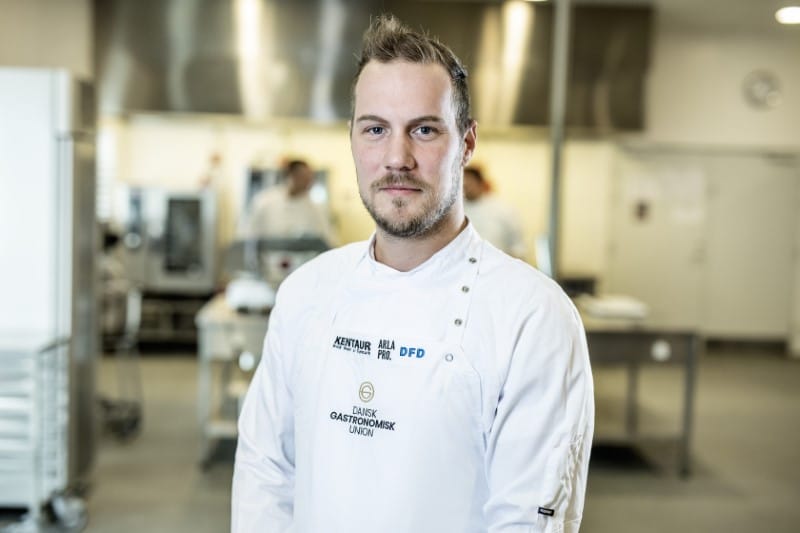

A Dream Can Drive Ambitions Far
Christoffer’s path to becoming a chef has been long and filled with challenges. Nonetheless, he has managed to win Olympic gold for Denmark and achieved impressive feats in his career. It has all required hard work and dedication, and a family that supported him every step of the way.
Christoffer was born in Aalborg in 1990, but moved to Sønderborg with his family at the age of 7. He got the inspiration and desire to become a chef after his sister’s confirmation in 2000.
“That’s when I saw two chefs preparing the food, and they had such a great banter, and I loved the way they worked. After that, I said: That’s why I want to be a chef. It was everything to me,” he says.
Many tried to talk him out of it, but he had only one dream – he wanted to be a chef.
“When I was at boarding school, I caused trouble because the punishment was to go down to the school’s kitchen and work for a few hours, so I did that quite often. I did it to get down there and peel carrots or potatoes, or whatever I was tasked with. That was until they found out that the boy probably wanted to be a chef,” he says with a little laugh.
In 2006, he began his apprenticeship as a chef, but even here he faced unpredictable challenges.
“When I started my apprenticeship at EUC Syd in Aabenraa, it went pretty well. I chose 20 weeks, but ended up getting 40 weeks, and to this day, I’m grateful for that. Back then, I thought I was God’s gift to mankind, and I just wanted to show what I could do. But in those 40 weeks, I learned things I didn’t know anything about. After that, I got an apprenticeship place and was super happy with it, but I worked 250 hours a month, so it was tough. I had my first main course in Kolding, and when I returned, the apprenticeship place had gone bankrupt. And it’s actually the duty of the apprenticeship place to find a new one, but they didn’t. They had kind of disappeared,” he says.
He then ended up as a bartender but was pleasantly surprised when some people from the chain ‘Penny Lane’ came and asked if he would like to open a kitchen that would be a lunch restaurant opposite ‘Penny Lane’ in Sønderborg. He accepted, and just half a year later, the place was named “City’s Best Café.” After that, Christoffer’s mother pulled him aside and said, “Christoffer, that’s not what you want, you want to be a chef.”
He then got an apprenticeship at ‘Hotel Lyngheden’ (now called Hotel Svanen, ed.), where he graduated as a chef in 2011.
“It was a great time, but it was incredibly hard. I was only 18, so I just thought that’s how it was because I had heard it was a tough industry. But for me, it’s about the guest being the focus, and they should have an experience to take home. That’s why it’s been great when guests have praised me and my food, but for me, it’s just as important to receive criticism. I don’t really need to be told that I’m skilled because I’m just doing my job. Praise boosts your confidence, but criticism strengthens your skills even more. Here you learn more about the mistakes you’ve made, and that’s why you strive harder next time,” he says.
Afterwards, Christoffer found an ad on Facebook where the Danish Gastronomic Union was looking for participants for the Catering National Team. He applied for an audition, with strong support from his girlfriend, and was one of the 10 selected.
“I’ve never been so nervous in my entire life! I was told I had 2 hours to make a chicken dish and finger food for two people. Although it was my dream to be on a national team, I could only do my best. After my audition, they told me they saw me on the national team, where I just clutched my head and mouth, and asked: Is it true? It was such a relief, and I felt amazing,” he says.
The Catering National Team itself consists of 8 people, with a team captain who functions like a head chef. For the actual Olympic competition, they had to prepare a menu consisting of a vegetarian dish, a chicken dish, and a fish dish. Additionally, they had to make a salad and two types of finger food. The finger food had to be served in a bowl or on a spoon and could only be one to two bites. They had 5.5 hours to prepare the food and then ran “service” for 1.5 hours. A competition where you are not judged so much on the good things but more on the small mistakes the team makes along the way.
“You start with 100 points, and then you can only get penalty points. They can cover anything from forgetting to wipe surfaces to something being placed incorrectly. So it’s all the small margins that count. For example, you must not wipe your hands on an apron or take something out of the oven with an apron, just as you must not place a knife on a cutting board, and you can use a maximum of 5 electric machines. So there are many rules. We scored 93 points out of 100. Cooking is 50%, and the remaining percentages are how you behave in a kitchen,” he explains.
The team succeeded in winning Olympic gold, and the feeling of winning was very special for Christoffer.
“It was completely surreal! We shouted and screamed and ran around. It was a huge relief! The funniest part was actually that after we received our medals, we packed up our things, and after a few hours, we were sitting at the airport, where we later landed in Kastrup. I sat for two hours at Burger King, waiting to be picked up, and thought: ‘What just happened? We just won Olympic gold for Denmark, the first ever, and now I’m sitting at Burger King in Denmark.’ Even to this day, when I see pictures from that, I still get a tear in my eye,” he says.
Today, Christoffer is employed at the Design School in Kolding, where he teaches and serves as the head chef when his students prepare meals for the school and the guests who come to dine there. He started at the Design School after he had his second child, as he thought that his girlfriend had sacrificed a lot of her time to allow him to pursue his dreams, and now it was his time to step back a bit and get a more predictable daily life.
“We are an international design school, so we think a lot about asking the students what they want to cook, and then they send a recipe, which we make. It also gives the students a trip down memory lane, as they are far from home. We then make that recipe for the whole school, and we experiment a lot with the food. So it’s important to me that I get to experiment with my students, where we try new things or hold specific themes. It’s about having a curious approach to everything, from the small elements to the most basic things.”
We Ask – Christoffer Answers
Get to know Christoffer better as we ask him a series of personal questions. Find out, among other things, what his show-off dish is and what advice and tips an Olympic-winning chef has for preparing vegetables.
What is your best memory from the kitchen?
I remember when I was in work experience at boarding school. I ended up at ‘Gyldne Hane’ in Kolding. We had to scoop ice cream balls, and I had never done that before. We stood in an ice-cold room where we had to scoop 1800 balls, and I couldn’t figure out how to scoop them. The first ones I made didn’t have the right appearance, so I found out that I could make them round by putting them in my hand. So I ended up scooping 1800 balls by hand and got frostbite. My hand hurt so much afterward. It was only later I realized I could have worn a glove. But they ended up praising my ice cream balls.
What dish do you like to make the most?
I love stews, so when my girlfriend says she wants osso buco, I go down to the butcher and buy a good shank, which I sear well in a pot. Then I add some celery and carrots and just let it simmer, so the flavor just gets better and better. Otherwise, I love halibut with lumpfish roe and asparagus when they are in season. Therefore, I am also very seasonal and look forward to cooking the dishes that are in season.
What is your show-off dish?
It is homemade tortellini with white truffles and sauce on ‘Gammel Knas‘ (An Arla Unika cheese, ed.)
Do you have a nemesis?
No, not as such, because it comes in periods. Initially, I didn’t want to make bread and sourdough, but I can make desserts, so in the end, it would probably be bread.
Do you have a favorite cuisine?
There are 4 cuisines I like and draw inspiration from. They are Nordic, French, Italian, and Japanese. But it’s mostly about combining the different cuisines because they can add various elements to any dish that work superbly together. For example, fermentation from Japan, combined with the deep flavors of French cuisine, and then the Italian, which is just super simple.
What is your favorite ingredient?
It must be carrots, and that was something I learned in school. One should think that carrots come in different colors and flavors, depending on when you harvest them. In spring, there are baby carrots, while in autumn, they have grown larger and have a more full-bodied flavor. So you can do everything with carrots. You can bake them, use them in savory dishes, and make desserts with them. It is a genius ingredient for everything.
How do you use vegetables correctly in the kitchen?
One should think that vegetables are like a piece of meat. They should be treated with as much care, and you should pamper them, giving them the time they need. Previously, people would overboil cauliflower or broccoli, but it doesn’t taste of anything. So instead, you should, for example, brown it on a pan with pepper, salt, or a dollop of flavor, in the same way, you would do with meat. It just makes the flavor more pronounced, and you can actually taste the ingredient and the umami that comes out of it.
What is your favorite dish?
It is meatballs in curry, but that’s because you can make the dish in 100 different ways. The way my mom makes it is completely classic. Whereas the way I do it, I add some apples, a little beer, and season with some mango (see Christoffer’s version of meatballs in curry here).
Where and when were you last impressed?
It was when I was in Berlin, which is a bit atypical, because the place where the restaurant was located was incredibly dirty. It was down an alley that was very unsanitary, but when we got up to the actual restaurant, it had white walls and wooden tables, and you could really see that it was a 1-star Michelin restaurant. We just had absolutely brilliant food there. I had ravioli with mushrooms, parsley oil, and truffle, and it just tasted insanely good!
Do you have a favorite restaurant?
I don’t, because it depends on where in the world I am. It reflects my love for food quite well because the surroundings of the food you eat also play a role. The experience is a whole.
Do you have a guilty pleasure?
It must be olives! I have a great fondness for olives, and I have 45 different types of olives at work.
What type of knife do you use the most?
It is a utility knife, which is a medium-length knife because you can really navigate with it. It’s not so big and cumbersome, and I think it works well with my hands. Whereas a large chef’s knife is more difficult for me to work with.
What are your favorite machines?
My favorite is definitely a Thermomix, and then a mixing bowl from ‘Bjørn’, which I simply cannot do without. But otherwise, I have a shed with 4 large shelves filled with machines. You should not skimp on equipment.
Can you name the three most important techniques chefs use that others can benefit from?
It must be care, and one must be meticulous with what one does. I think many have a quick approach to things, where they just want to whip something up quickly. At school, we spend a lot of time teaching that you should respect the ingredient and immerse yourself in what you are doing. And then you should have good precision concerning the dish and the flavors you are trying to put together, so it becomes a whole. The last thing would probably be that you should handle vegetables the same way you handle meat.
Is there something people almost always do wrong in the kitchen?
You should use your common sense. Instead of seeing what they do in MasterChef, you should accept that you can come home after a hard day and have to cook, where you might think, “What should we make?” Then it might just end up being a quick pasta with meat sauce. But here many make the mistake of buying the tomato sauce in the store. Here you should probably have a different approach to things, where you buy proper and fresh ingredients because it is just as easy to make good food out of, but the taste itself can turn a hard day into an experience. Even on a weekday. Good food gives good energy and joy and can similarly be experienced as easy, but just much more delicious. It gives you joy in everyday life!
Fact Box
Name: Christoffer Bro Andersen
Age: 30
Residence/City: Vejen
Christoffer works today at the Design School in Kolding but is still affiliated with the Catering National Team through DGU. He sees himself as a collaborator with a team of students at the Design School, where there is ample opportunity for the students to express themselves. He also values fresh ingredients highly and mentions himself: “Letting me loose at a food market is like letting my girlfriend loose in a clothing store. I quickly become very nerdy about the ingredients and have a lot of questions I just need answers to.”
Job: Head Chef and National Team Chef
Company: Design School and Danish Gastronomic Union
Follow him and his work on Instagram under @christofferbrochristiansen.
Photo: Rais photo