
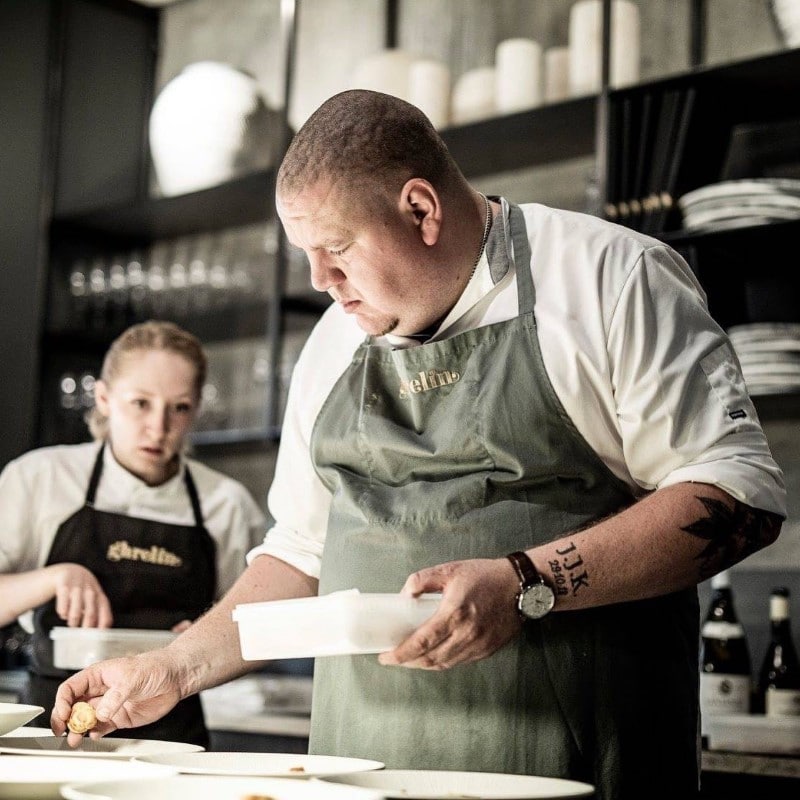

Ghrelin is About the Guests
Anders Kuk Kristensen, 35 years old, is a trained chef from LeCoq and co-owner of restaurant Ghrelin, located at Aarhus Ø. He owns the restaurant with his good friend and partner, Nicklas Friis Nielsen.
“The idea behind Ghrelin was – and is – that it’s about the guests. It’s not the chefs who should be in focus, and we shouldn’t have a specific theme. There should be food that we know people like, the chairs should be ones that people enjoy sitting in, and not just ones that look nice. We want to show the guests that they are important,” says Anders Kuk Kristensen about the restaurant.
In addition to being a co-owner of Ghrelin, he runs some restaurants in Horsens, where he is employed as the operations manager.
Previously, Anders Kuk Kristensen has been a chef at Ruths Hotel under Michel Michaud and head chef at Dauphine and Miro.
We Ask – Anders Answers
We asked Anders Kuk Kristensen a series of questions so you can learn more about who he is – and where his passion for the culinary profession originates. He also tells which kitchen appliance is absolutely not his favorite.
Education?
Trained chef from LeCoq located in the Latin Quarter in Aarhus.
Why did you become a chef?
It actually happened a bit accidentally. Many chefs tell how they sat on grandma’s kitchen counter and helped out, or that they were in the kitchen with mom stirring pots from when they could walk and stand. That wasn’t the case for me. I was 20 years old and rootless. I didn’t really know what I wanted to do, and I didn’t really fit into any boxes. In the restaurant industry, there was – and is – room for everyone, no matter who you are. Everyone fits in there. So that’s how it happened.
When did you become a chef?
15 years ago.
What is your best memory from the kitchen?
I have a lot of good memories from the kitchen, and it can be difficult to mention just one.
What has meant the most to me was when I had just become head chef at a restaurant where my former head chef and mentor came to dine with some of his friends. I was 23 years old, so I wasn’t that old. I’m not normally the type to get nervous, excited, or scared – I’m quite much a Westerner in that regard. But I could feel that I was excited to see if he thought my menu was good. I wasn’t used to composing menus in that way, or leading a kitchen.
I made a dish that he liked, and he praised me a lot – which he normally didn’t do, as that’s not the type he is. But he came and said it was a good dish and that he was proud of me. It was a big moment.
Which dish do you like to make the most?
I love making meatballs in curry for my wife. It’s her favorite dish when I make it, and it means a lot because she gets so happy about it. It’s as classic as it can be – and maybe still with a twist.
There are broccoli, spring onions, and leeks and all sorts of things in ours. So it’s actually a bit of a combination of classic meatballs in curry and a stir-fry.
My wife was a vegetarian when I met her. Mainly because she had eaten so much meat in her childhood that she didn’t like eating it anymore.
One day she came and said that she wanted to learn to eat more meat, so as not to always be a bother when she was out. So I started slowly introducing her to dishes with meat.
That’s also why there are a lot of vegetables in my meatballs in curry. It was a way to introduce her to it. For example, the meatballs could consist of 50/50 meat and vegetables.
I get bonus points from my wife every time I make it, and that’s why I like that dish.
What is your show-off dish?
There aren’t many – I’ve heard – who are as skilled as I am at composing food. It applies both to pairing food and wine, but also when it comes to flavor composition in individual dishes.
When we make a dish at Ghrelin, we don’t choose the protein first, but the vegetable. So we work from the vegetable and then add fish or other vegetables afterwards. There is a greater difference between a beetroot and a carrot than between a veal culotte and a veal tenderloin. So you can make more differentiated dishes with vegetables.
I have a love for caviar. I make a lot of dishes where I use caviar and have it as an element. I’m probably a bit known in the industry as the guy who is good at making dishes with caviar, and generally caviar and champagne pairings.
What is your nemesis?
It’s desserts. I don’t feel like making desserts and I don’t want to read recipes.
My old master said that making food is about passion, tastes, and having your heart in it. But making desserts is chemistry and physics. That’s how I feel too.
I don’t feel like it’s “mine” if I have to follow a recipe point by point. I can use the recipe as a guideline, but I can’t follow it slavishly. In many desserts, you have to follow the recipe because you have to hit it right on, if it’s not going to fail. So I don’t make desserts that often.
What dish do you make most often in your own kitchen?
There’s not really a dish that I make over and over again. It changes a lot. Then there’s a month where I almost only make Italian, and a month where I make Asian. Currently, I have a thing for French fries, so I make that a lot these days.
At home, it’s actually my wife, Stephanie, or “lillemor” as I call her, who does most of the cooking. I’m happy when she cooks for me – everything she makes. However, I handle the preparation of all the meat.
Do you have a favorite cuisine?
No, I actually don’t. I don’t like putting things in boxes. I think the different cuisines each have their own charm. For example, I love Italian cuisine for its simplicity, I find the American cuisine exciting, and the Spanish cuisine is really good for their strong flavors and spices.
If I have to say something, I would say that I could eat pasta every day. We don’t have it that much at home – it’s not so good with the white pasta – but I love it. The way the Italian kitchen is just simple but delicious, I really like.
What is your favorite dish?
It’s food that I haven’t made myself.
If I have to mention one thing, it’s Stephanie’s meatballs. She is employed as the restaurant manager at Ghrelin, and at home, she has been my own little chef apprentice, so she makes them exactly how I think they should be, and there’s so much love in them.
When I come to dinner at people’s homes, I generally think it’s great if people just make a lasagna or meatballs as they usually do. That way I can taste what they like and it shows me who they are.
If someone just opens a cookbook and makes a roast for the first time, it’s a bit of a half-finished product compared to something you make often, which you know and know how to make. I taste for love, and you can really taste if love is missing in a dish.
Where and when were you last impressed by a dining experience out?
In January 2020, I was at Geranium where I had a soup with porcini mushrooms, dried apple, and white truffle. I had high expectations for the experience, but I probably didn’t expect to be impressed by flavors in that way. Geranium is a feminine and floral kitchen. But that soup blew me away flavor-wise.
The best experience I had with food in all of 2020 was a goulash I had, prepared by Josef and Maria from Slovakia, who have moved to Denmark. Once a year in May, in the village Josef and Maria come from, there is a goulash festival. I know their son, and we were therefore invited to dinner in the parents’ garden.
The pot in which the goulash was made was over 100 years old, and the food was made over a fire. Maria was in charge of the vegetables and putting things in, but Josef stirred the pot. It took them all day. I had tears in my eyes when I tasted it. It was masterful.
Do you have a favorite restaurant?
Of course, I think my own – Ghrelin – is the coolest.
Besides that, Frederikshøj is probably my favorite restaurant in Aarhus. I love eating there, I love Wassim Hallal’s food, and I think the level is extremely high.
What kitchen equipment is your favorite?
My knives. It’s absolutely the most important thing in a kitchen. You also need pans, pots, and a stirring spoon, that’s clear, but you can’t get anywhere without a good knife.
At home, I use Kai Shun knives. In my knife case and otherwise, I use knives from the brand Michel Bras. I also have them at home, but they are large and a bit overwhelming, so little mom doesn’t like using them. That’s why we also have Kai Shun at home.
If you could only have 6 pieces of equipment to cook with, what would they be?
Actually, I would say that a good knife and a cutting board are the most important. Then you can do most things.
Professionally, I can’t do without my hand mixer and my immersion blender. A sieve is also important. Many things could be good if people bothered to throw it through a sieve. Some restaurants could also learn from that, instead of serving lumpy purées. Throw it through a sieve – it only makes it better.
What kitchen equipment do you (almost) never use?
I never use a sous vide. I don’t actually mind sous vide cooking, but I have something against people who don’t have control over it!
People shouldn’t think they can throw everything into a sous vide because they can’t. And you shouldn’t serve meat that’s all grainy because you don’t have control over your sous vide. You can certainly use the technique on large cuts of meat – for example, a hindquarter or a breast cut – with lots of connective tissue. But when you sous vide something without much connective tissue, it becomes grainy, and it’s not nice.
Sous vide has become very widespread, and it’s also a super fine tool, which, of course, more people know how to use. But I dare say that many ordinary Danes also don’t know what can be sous vided and therefore throw everything in there. For example, a pork roast or a tenderloin. I actually think it’s a shame for the animal to give its life only to end up in a sous vide machine.
What basic dishes are most important to master?
The classic French brasserie kitchen provides you with many tools.
For example, with a stroganoff. If you make a good stroganoff, you have learned to make many things. You have learned to prepare tenderloin ends, you have learned to season, and you have learned to boil potatoes without salt, because you need it for mashed potatoes. In that way, you learn many techniques by actually just making one dish.
It’s the same principle with meatballs in curry. You learn to make a good minced meat mixture that is well-seasoned, you learn to make a roux-based sauce, and you learn to cook rice.
You simply learn the food step by step and get the technique in that way.
It’s clear to taste whether people making lasagna know what they are doing or if they’ve just made a meat sauce and separated it with pasta sheets. It’s about the composition, how thick the meat sauce should be, how the pasta sheets are, and so on.
Fact Box
Name: Anders Kuk Kristensen
Age: 35 years
Residence: Aarhus
Job: Co-owner of the gourmet restaurant Ghrelin, located at Bernhardt Jensens Boulevard 125, 8000 Aarhus C
Follow Anders on Instagram at @chefonekuk and Ghrelin at @ghrelingourmetrestaurant.