

The clock is nearing dinner time, stomachs are starting to rumble, and you haven’t done any shopping for the evening. The solution? Pizza. The easiest and most delicious way to make everyone around the dinner table happy and satisfied.
Don’t want to order in? You can make your own pizza and achieve fantastic results with a pizza oven. We recommend one of the following ovens:
A Dish with Many Interpretations
Pizza is loved by almost everyone around the world. It’s that simple. And many countries have their own interpretations. In fact, pizza is so common that most of us don’t give much thought to where pizza actually originated from, and not least: How a “real” pizza should be made. Because what exactly is a real pizza?
Danish Pizza
Pizza is a favorite on Danish dinner tables, and the “Danishized” version, which most of us probably know from childhood, is typically made on a relatively thick crust, preferably in a baking tray, with plenty of toppings. And when we say plenty, we mean really plenty. The layer of toppings can be even thicker than the crust itself, and there’s almost no limit to what Danish families can think of putting on a pizza. Without a doubt, it’s the toppings that play the primary role, and that’s probably one of the reasons it’s such a popular dinner choice: All family members’ individual preferences can easily be accommodated, whether it’s beef, ham strips, corn, pineapple, bacon, or cocktail sausages.
American Pizza
Americans have a somewhat different take on pizza. When you say American pizza, generally two types are meant: New York-style, which are very large, soft, and “gooey” with plenty of cheese and otherwise limited toppings, and Chicago-style – the so-called deep pan pizza – which, as the name suggests, is cooked in a deep pan and has a rather thick and more “bread-like” crust.
French-German Pizza
If you go to the French-German region of Alsace, you will find flammkuchen / tarte flambée, which has become a regional specialty. This pizza is super thin and crispy, and it’s probably the one that most resembles Italian pizza.
Authentic Italian Pizza
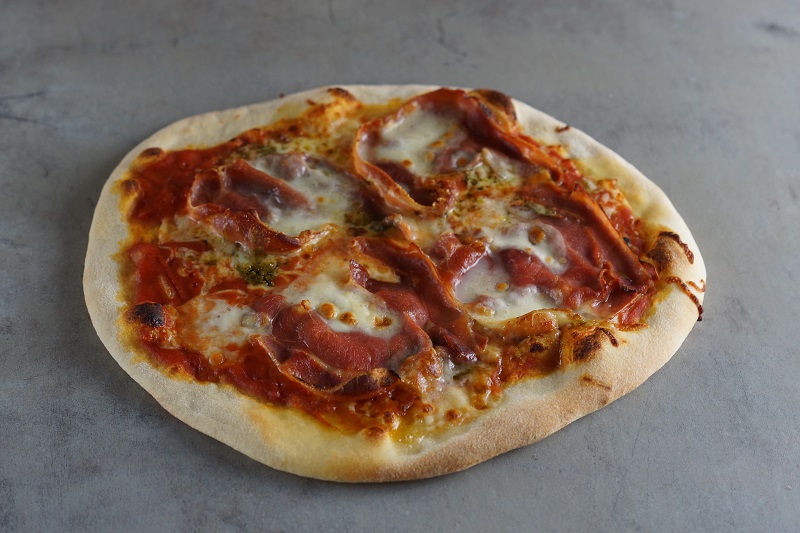
If we say Italian food, what do you think of? We’d bet our old hat that the answer is either pizza, pasta, or lasagna. Despite this, the origin of pizza cannot be precisely determined. It wasn’t until 1918 that the word “pizzeria” was officially included in Italian dictionaries, and at the same time, other Mediterranean countries also have their own words for pizza: The Turks have pide, and the Greeks have pitta.
We’re not here to debate who came first. There is hardly any doubt that pizza is generally considered quintessentially Italian, but to make matters worse, not even Italians themselves entirely agree on what characterizes true Italian pizza.
There are many different types of Italian pizza. Some are ultra-thin and ultra-crispy, while others are quite thick and more spongy. The best-known “pizza schools” are undoubtedly the Neapolitan and Roman.
Neapolitan Pizza
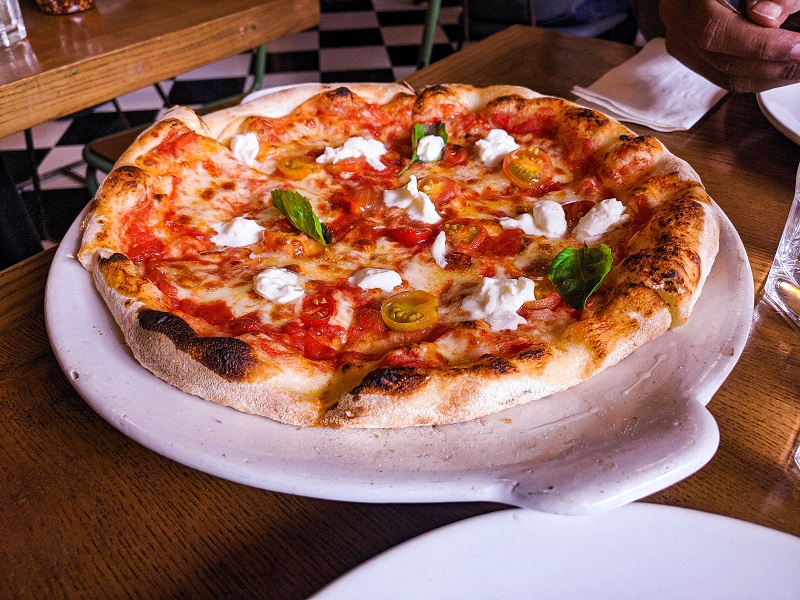
La pizza Napoletana! Most Italians will probably tell you that true Italian pizza comes from Naples. And even though Neapolitan pizza might not immediately ring a bell, we dare to say that it’s the type of pizza you’re actually most familiar with. Certainly from your local pizza vendor’s menu.
A pizza Napoletana has a soft, elastic, approximately 3 millimeter thick crust with a high, “puffed” edge.
The Pizza Dough
The crust is made of wheat flour, yeast, salt, and lots of water to make the dough wet and sticky. The dough is left to rise at room temperature for up to a day, then hand-stretched, topped with very few but delicious quality ingredients, and finally baked at around 450 degrees Celsius for just 90 seconds.
Advertisement: Typically, caputo flour is used for Neapolitan pizza.
The Topping
In Naples, they are extremely particular about the crust, which is why the pizza is typically only topped with marinara (an Italian tomato sauce) or both marinara, mozzarella, and fresh basil. The latter is the popular Pizza Margherita, allegedly created in honor of the Italian Queen Margherita and symbolizes the Italian flag, Tricolore. The Neapolitan “pizza school” forms the basis for most of the pizzas we find here when dining out.
Roman Pizza
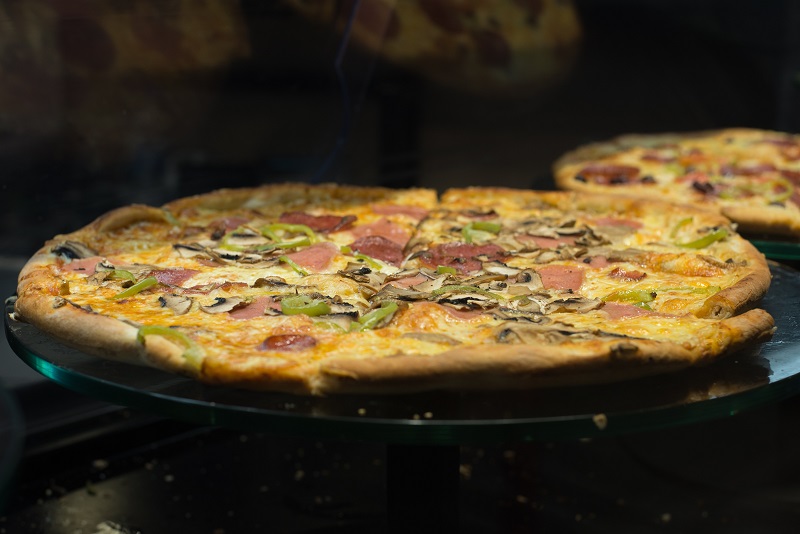
La pizza Romana! This is not the only type of pizza originating from Rome, but it’s probably the most famous. Pizza Romana is almost the opposite of the Neapolitan. It is ultra crispy, and the crust is even thinner. If you’ve ever visited Rome and its surroundings, you’ve surely encountered this super-thin and delicate pizza.
The Pizza Dough
Considerably less water is used for the pizza dough than in Naples, and oil is also added. The pizza is baked for up to 3 minutes at about 350 degrees Celsius, resulting in a much crispier outcome than the shorter and more intense baking of the Neapolitan.
The Topping
Unlike the Neapolitans, Romans are less afraid of toppings, and a true Roman classic is the so-called Capricciosa, topped with ham, mushrooms, black olives, and artichokes.
The Perfect Pizza Crust
One must be cautious in calling a pizza perfect, as it all depends on the cuisine and region being praised.
Yeast or Sourdough?
Here at home, most of us agree that a really good pizza has a nice thin, slightly crispy and chewy crust with few, delicious ingredients – not much different from Italian pizza. Italians use regular yeast for their pizzas, but you might want to try making a sourdough pizza. Some might even call it the ultimate pizza crust!
Baking Powder
If you’re in a hurry, you can also use baking powder. By using baking powder, you avoid letting the dough rest, and thus, you can actually have food ready in under 30 minutes. You’ll get a pizza crust with a little less flavor and depth, but fortunately, we Danes love our toppings so much that it can easily be camouflaged.
The Super Quick One
This might not be the one to serve when you really want to impress guests, but it’s perfect when you have no more than 10 minutes to spare: Pizza made from tortilla wraps!
Should Fruit Be on Pizza?
Oh, this is the discussion that can really get things going around the table! Does pineapple really belong on pizza?
The idea of pineapple on pizza comes from the Hawaiian pizza, and although the name sounds exotic, it actually originates from the town of Chatham in Ontario, Canada. Some might call it downright blasphemous to put pineapple on pizza. However, one could argue why pineapple on pizza isn’t such a bad idea: It’s well-known that it’s important to include all five basic tastes when creating the perfect meal: Salty, bitter, umami, sour, and sweet. Last time we checked, the pineapple was sweet, so it must add an extra “oomph” to the salty ham and tangy tomato sauce on the Hawaiian pizza. Whether pineapple belongs on any other pizza than the Hawaiian, well, the answer is as vague as it depends on the other toppings.
If you’re completely against fruit on pizza, you might want to scrutinize the menu a little more closely next time you visit Sweden. They are quite fond of putting banana and curry on pizza. Fortunately, the word for banana is the same in Swedish as in Danish, so it’s easy to spot!
Pizza and Ninja Turtles
Teenage Mutant Ninja Turtles! Ninja Turtles were all the rage in the ’80s and early ’90s, and if you thought these mutated turtles were battle-ready, you should’ve seen the pizza giants.
If there was one thing the cool turtles loved, it was pizza – there wasn’t an episode where pizza wasn’t on the menu.
Domino’s and Pizza Hut therefore fought a fierce battle for sponsorship rights leading up to the film adaptation of Ninja Turtles in 1990. Who won? Well, in the movie, it’s very clearly a pizza from Domino’s that’s ordered, and they even say something like: “Did you know a Domino’s pizza is free if it’s not delivered within 30 minutes?”
Nonetheless, Pizza Hut got the rights to run a commercial at the start of the VHS tape. Pizza Hut reportedly also invested $20 million in the marketing of a Ninja Turtles live show in 1990.
The Two-Pizza Rule
Prefer to keep the guest list to a minimum? Then you can always refer to the “Two-Pizza Rule”.
The Two-Pizza Rule was “invented” at Amazon, and the purpose of it is to streamline internal meetings within the company. At Amazon, they believe that good ideas too easily drown in large gatherings. So if two large pizzas aren’t enough to feed everyone, the group is simply too large.
Try convincing your partner of that when making a guest list for the wedding.
Pizza Recipes


Pizza with Ham and Truffle Pesto


Pizza with Mashed Potatoes and Pork Cheeks


World’s Best Gluten-Free Pizza


Pizza with Lumpfish Roe and Smoked Salmon


