
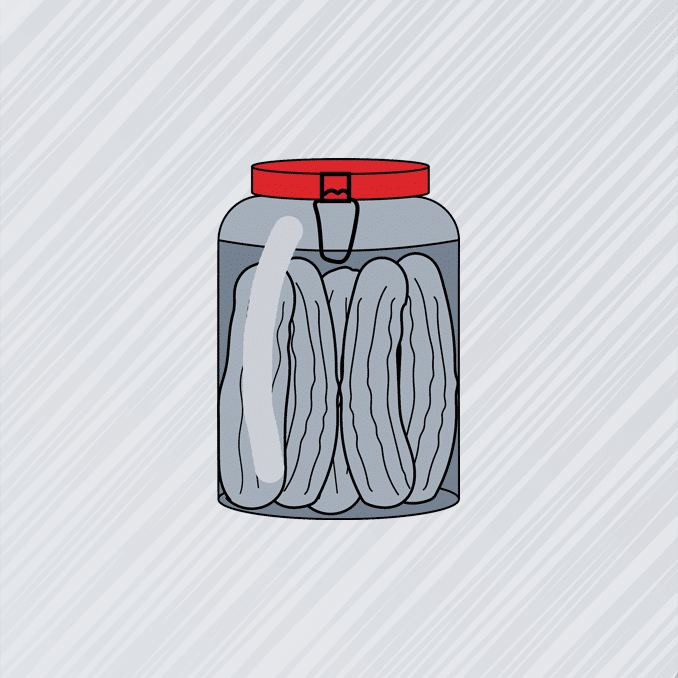

Fermentation is on everyone’s lips these days. And it is increasingly making its way into Danish kitchens.
Fermentation is a very old and traditional craft that has been somewhat forgotten for many years – at least in private homes.
Therefore, we were pleasantly surprised by how sought-after the book “Noma – Guide to Fermentation” was, when we had the opportunity to give away three copies. Many of the competition participants reported that they were already experimenting with the craft on a small scale.
The reason for the sudden surge in interest in fermentation is likely due to a growing desire to try out both industrial and restaurant methods.
The German regional dish, sauerkraut, is something most of us have been more or less familiar with for years, just as many of us have been served kimchi in Asian restaurants.
Kombucha tea has also become very popular – and the dough for honey hearts is actually fermented too.
But what is fermentation really? And what can you ferment?
You can learn about this and much more in this article.
What is fermentation?
Fermentation is Latin for “to ferment” – or to make something ferment. Fermentation is a chemical process where organic material breaks down in various ways.
Thus, fermentation plays a role in a variety of contexts, for example, in the development of antibiotics and alcohol, including beer.
The process of getting a variety of microorganisms to develop consistency and flavor is already commonly used in the development of, for example, cheese and yogurt.
The same applies when we add sourdough to flour to bake delicious bread.
The most popular form of fermentation here at home is undoubtedly the aforementioned sauerkraut, which is fermented cabbage.
In the East, however, the delicate kimchi is the most popular, and kimchi is also based on cabbage.
Cabbage is generally extremely easy to ferment as it is naturally covered with a lactic acid layer that is full of sugars.
These sugars are very easy for bacteria to feast on, which is the whole idea behind the fermentation process.
Cabbage is therefore also a really good starting point for those new to fermentation.
What happens to ingredients when you ferment?
Regarding both fruits and vegetables, the fermentation process is quite identical to the process that starts when we add sourdough to flour during baking, or when we produce cheese and yogurt.
The fermentation of fruits and vegetables occurs when lactic acid bacteria lower the pH value in the ingredients.
All fruits and vegetables are naturally covered with numerous bacteria. Vegetables are typically covered with lactic acid bacteria, some more than others, and these therefore ferment the natural sugar content into lactic acid.
This makes the vegetables sour, and it also results in an environment where bacteria that can cause diseases cannot grow.
The shelf life of the ingredients is also significantly extended, while the fermentation develops completely new interesting flavors in the ingredient.
And it’s a smart way to combat food waste.
Where does fermentation originate?
It is believed that thousands of years before our time, fermentation was used for vegetables along Asia’s coasts.
However, we have to go forward to about 600 years before our time for actual written evidence of the use of fermentation.
It was allegedly Mongolia’s ruler, Genghis Khan, who brought the fermentation method to Europe in the 13th century, and it gained particular traction in Eastern Europe and Germany.
What can you ferment?
In reality, you can ferment all kinds of fruits and vegetables. Some fruits and vegetables, as mentioned earlier, are better suited than others, including both cabbage and root vegetables.
You might consider fermenting based on the current season and use fruits and vegetables when they are cheapest and contain the most flavor and nutrients.
How do you ferment?
There are several ways to ferment, depending on the type of ingredient.
The only things you need, besides the chosen ingredient, are salt and possibly water. Additionally, you can choose to add spices or other flavorings such as whole peppercorns, cinnamon sticks, ginger, or chili. The possibilities are many.
The most optimal method would also be to use an actual fermentation kit. In the absence of better tools, you can achieve good results by using the method we describe below.
Since cabbage is known as a good “beginner’s ingredient,” we will focus on cabbage.
Start by shredding the cabbage and sprinkling salt on top.
Then massage the cabbage, which will release the juice from it.
The sugars are in the cabbage juice, which is why massaging results in good conditions for the lactic acid bacteria that will kickstart the entire fermentation process.
The softened cabbage is then pressed to the bottom of a sterilized (preferably both scalded and Atamon-rinsed) preserving jar, and the cabbage is covered by the juice that the preceding massage has released.
Finally, seal the jar, and then all that’s left is to wait.
You can find a more detailed guide to fermenting white cabbage in our sauerkraut recipe.
8 good tips for successful fermentation
There are few things in life you can be 100% sure of. The same naturally applies to fermentation.
There is no guarantee that the fermentation will go as planned: the result may not be sufficiently flavorful, or it may be directly harmful, necessitating discarding a batch.
To avoid wasting time and effort, you can do your best to follow the prescribed steps for a perfect fermentation process.
- Plenty of salt: Harmful bacteria cannot thrive in high concentrations of salt, which is why salt is an essential part of fermentation. A rule of thumb is about 20 grams of salt per kilo of vegetables. However, the recommended amount of salt varies from ingredient to ingredient.
- Add enough liquid: Ensure that the ingredient is completely covered by juice. This is where it may be necessary to add homemade brine to the jar. If the ingredient is not covered, it will either mold or completely dry out.
- The jar should not be too cold or too hot: The perfect temperature for fermentation is about 20 – 22 degrees Celsius. If you go too far below 20 degrees, the fermentation will not be properly kickstarted, resulting in a dull flavor. If you go too far above 22 degrees, the fermentation process will go too fast, and the flavor will not have time to develop into something really strong.
- Avoid sunlight: Lactic acid bacteria are destroyed by UV rays. Therefore, place the jar in a spot where it is not exposed to sunlight or cover the jar, for example, by wrapping a towel or cloth around it.
- Release the pressure in the jar: Fermentation/fermenting creates pressure in the jar. Remember to release the worst of the pressure by just slightly opening the clamp on the jar and immediately closing it again. Repeat this a few times during the fermentation process, but only start on the third day.
- Avoid letting air into the jar: A good fermentation process cannot tolerate air. Therefore, be careful not to open the jar too much when the pressure needs to be released periodically.
- Give fermentation peace and quiet: The gases formed in the jar during fermentation are important for a good result. Therefore, you should resist any urge to open the jar more than absolutely necessary (to avoid excessive pressure build-up in the jar).
- Use your senses and common sense: You will not be in doubt if something has gone wrong during fermentation, and there is nothing else to do but taste the contents of the jar.