


In our endless pursuit of expert knowledge, here is a guide to homemade rolled pork.
We have the text here from the book: “Aamanns Smørrebrød“, written by the Danish “smørrebrød king” Adam Aamann-Christensen:

Rolled pork remains a classic on the lunch table!
It is one of the few cold cuts that significantly differs from other cured and boiled types.
A rolled pork can be rolled with either a pork belly or a lamb breast, but you can also try with veal brisket or deboned poultry.
There are also many possibilities with different seasonings during the salting process, where you can toast and crush all the lovely whole spices for explosive aromas in your rolled pork.
Allspice, black pepper, bay leaves, nutmeg, and juniper berries pair well with pork.
For lamb, a seasoning of coriander seeds, black pepper, bay leaves, fennel seeds, cinnamon, cloves, or anise is suitable.
You can also add different herbs to the cooking process, try with lovage, fresh hops, or sage.
The classic seasonings for the filling are pepper or parsley, with the latter primarily used for the seasoning of lamb rolled pork.
Try instead fresh chervil, lovage, or dulse, a type of seaweed, for the pork.
For lamb, you can try fresh mint or a mixture of fresh oregano, thyme, and rosemary.
Unfortunately, very few people venture to tie their own rolled pork, and that’s a shame!
As with everything else, the homemade version is simply of much better quality than the pre-produced one.
It’s not difficult to make your own rolled pork – so what are the good excuses for not giving it a try?
If you’re missing a rolled pork press, it doesn’t cost much in stores, or you can find a really cheap one at a flea market.
You can even easily put your personalized spin on your rolled pork.
The preparation might be a bit long, but as already mentioned, the actual work effort during the process is both easy and not very time-consuming. I promise you’ll be proud of the result of your efforts.
TIP:
It’s actually just as easy to make three rolled porks as it is to make one, so I often make three rolled porks at home in one go.
But since rolled porks don’t keep for much longer than a week, you shouldn’t finish them all at the same time.
When the rolled porks are fully salted, tied, and ready for boiling, I put two of them in the freezer and boil and press the last one.
Cool the cooking liquid, save it in the freezer, and use it again and again for the other two sausages.
HOW TO TIE YOUR ROLLED PORK
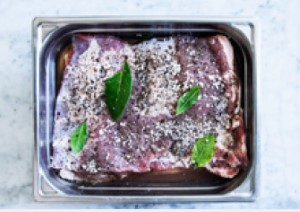
1. Take the spice-salted cut out of the tray and rinse it free of excess salt and spices under running water. Don’t be afraid that the flavor will disappear. Plenty of aroma has been drawn into the meat along with the salt. Pat the meat dry with kitchen paper or a dish towel.

2. Place the cut on a cutting board. Lay it with the fattest side towards the cutting board and the most meaty side facing up.
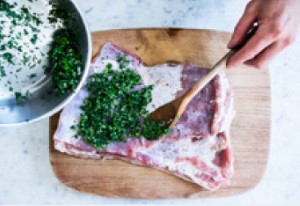
3. Spread your cooled parsley-onion-herb mixture in an even layer over the entire meat surface.

4. Roll the meat together with both hands and secure it lengthwise with a piece of kitchen string, which is lightly tightened.
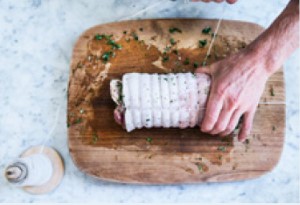
5. Tie the roll tightly and evenly. If you tie too tightly at the start, the roll will become trumpet-shaped!
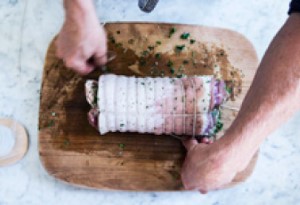
6. Finally, tie a knot on the last round so that the roll doesn’t unravel itself during boiling.
We have the recipe from the book: “Aamanns Smørrebrød“, published by Politikens Forlag.