
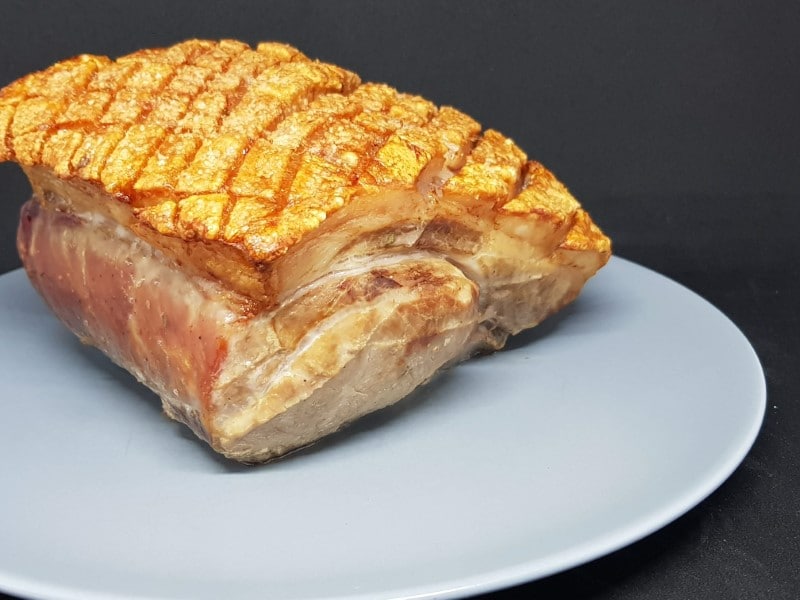

♫ High from the top of the tree shines the Christmas glow… ♫ – yes, that’s how a Christmas Eve usually ends. But before you get there, there’s a large amount of Christmas food that needs to be prepared and taken care of. And especially one part of the Christmas meal often causes big problems in the kitchen – namely the pork roast.
Of course, you don’t want to make mistakes with possibly the most important dinner of the year, where the whole family is gathered. What we eat on Christmas Eve varies greatly, but typically we find brown sauce, potatoes (white and caramelized), and red cabbage on most tables. And, of course, pork roast, duck, turkey or goose – or even several of the above.
This article attempts to provide you with a guide on how to prepare the very best pork roast. The techniques used in this recipe are dry aging of the meat and cooking through Sous Vide. These methods are used to achieve a delicious and at the same time juicy roast – of course, with crispy crackling. But let’s take a step back and take a closer look at the aforementioned techniques.
A small guide on the meat aging process
When an animal is slaughtered, a concept called rigor mortis occurs. This process creates lactic acid in the muscles, and the protein in the meat stiffens and becomes harder to absorb. That’s why you often hear about meat that has aged for 15, 20, or 30 days before it ends up in stores. The aging process simply helps to loosen up the proteins again. When talking about the aging process, there are typically two methods – wet aging and dry aging.
The most common process is wet aging, where the meat is cut and packed directly in vacuum bags. When these vacuum bags have been sitting for a couple of weeks, they are sold in stores. The other method, which is starting to become more popular, is dry aging. You may have heard of terms like dry-age or hook-aged meat? These are terms that cover the same thing – namely dry-aged meat. But what is it?
When the animal is slaughtered, the meat is hung on hooks. Here it is allowed to hang for up to 28-30 days depending on which animal it is. It is a very meticulous process where everything is highly controlled. The temperature is kept around 2 degrees during the entire process, and the meat is aired using strong air circulation with air that is filtered through various carbon and UV filters. This very meticulous process is to protect the meat from bacterial infections that can later be transferred to the end consumer.
When meat is dry-aged instead of wet-aged, the meat usually gets more flavor, while the moisture is removed from the meat. And precisely because there isn’t so much moisture, dry-aged meat is perfect for, for example, pork roast, where crispy crackling is desired. It is indeed, among other things, the moisture in the roast’s crackling that makes it incredibly difficult to get them perfectly crispy.
Sous Vide? What is that?
The term comes from France and literally means “under vacuum”. This description fits perfectly, as the cooking method essentially involves cooking meat, packed in a vacuum bag, under water. The water temperature is controlled by a Sous Vide machine. This means you have a constant and very stable temperature throughout your cooking.
Especially in connection with beef, a Sous Vide machine is absolutely brilliant. If you want to cook a medium rare roast beef, this can be done by setting the temperature on the Sous Vide machine to 55 degrees. The result is a roast beef with a uniform temperature throughout the meat, achieving a roast that is pink from edge to edge. The long cooking time in a Sous Vide also ensures that bacteria are killed, even though the temperature used is somewhat lower than in normal cooking.
If you haven’t used a Sous Vide before, you should be prepared that the cooking time is much longer than with normal cooking. For example, an Entrecote steak should be cooked for over 1½ – 2 hours, while a roast beef should be cooked for up to 5-8 hours. The cooking time largely depends on the thickness and tenderness of the meat.
When the meat is finished cooking in a Sous Vide, it is taken out of the vacuum bag and quickly seared on a pan or grill at very high temperature. This way, you get the usually desired crust on the outside of the meat.
So how do you prepare a perfect pork roast?
The first thing you should focus on if you want a perfect pork roast is which cut you use. Many use the classic loin roast, which unfortunately doesn’t have much fat on it. A good suggestion for a fantastic pork roast is the cut that lies right between the neck and the loin. This has a bit more fat than the classic roast. And then to the actual cooking method. You might think it sounds completely crazy to make a pork roast in a Sous Vide, but the purpose of this is to achieve a roast that is much less dry compared to if it were made in an oven. In this recipe, a roast that has been hook-aged for 21 days is used. This gives a good and more intense flavor in the meat, and it makes it much easier to get those delicious crispy cracklings.
- Before your roast is ready for the Sous Vide, you place it in an ovenproof dish with the crackling facing down. Fill the dish with very salty water, and let the roast soak well in the saltwater for at least 30 minutes – preferably longer.
- Once your roast has soaked in the saltwater, season it with salt and pepper on both sides. You now place it in a vacuum bag and cook it in your Sous Vide for five hours. The temperature should be 59 degrees.
- After five hours, take the vacuum bag out of the water bath, and cut a hole in it. Carefully remove the meat from the bag, and for heaven’s sake, save the meat juice that’s in the bag – this juice is perfect for a good Christmas gravy.
- In principle, your pork roast is now ready to serve, but that would be without crispy crackling. So now it’s time to get the oven going.
- Set your oven to the highest temperature and convection. While the oven is heating up, dry the roast well, and season your crackling with another round of salt.
- Place the roast in the oven and turn on your oven’s grill function. Preferably leave your oven door slightly ajar, as it is only the crackling that needs heat – your roast is already ready to serve.
- Keep a really close eye on the roast while it is on the grill function. It takes between 10 and 25 minutes to get all your cracklings crispy. In the oven, the cracklings will pop up one by one, and when you feel all the cracklings have popped and look delicious, you take the roast out. A good tip is to turn the roast every 5 minutes if you’re the unlucky owner of an oven that doesn’t heat evenly.
You have now, with the help of good preparation and the best cooking techniques, prepared a perfect Christmas roast that your guests will surely love. Merry Christmas, and enjoy your meal!