Like most other men, I’ve reached the grill master phase of my life. That phase where family life runs in established routines, and as a man, you need a hobby to immerse yourself in that doesn’t involve the wife and kids. It’s usually during this phase that a man declares himself the undefeated champion in Gøl Sausage preparation when the grill is lit, and both wife and children receive stern instructions to keep a respectful distance from the Weber.
The grill master phase doesn’t necessarily involve a grill. It can also be a hobby that revolves around brewing your own beer or foraging herbs to make your own schnapps – and then there are those (that’s me – and maybe you too), who invest in a curing cabinet so they can dry-age their own meat at home.

This distinctive method of refining meat is my great passion, and I’m far from alone in this. As a true enthusiast, I want to share everything I know about dry-aging with all of you who also have this rather peculiar (yet delicate) hobby – whether you are men or women, and whether you’ve reached the infamous grill master phase yourself.

From Beef to Pork
I was fortunate to meet celebrity chef Jesper Koch at the Food Festival in Aarhus. He is an ambassador for the Gold Room and invited me for a tour there.
It’s wonderful to have something you’re passionate about. That’s why I’ve equipped myself with a cameraman, fighting spirit, and a clumsy boiler suit and headed to my hometown, Kolding, to visit Danish Crown’s ‘Gold Room,’ which is every dry-aging enthusiast’s answer to Narnia. It’s certainly cold, and (almost) magical things happen.
Danish Crown is the world’s largest exporter of pork and Europe’s largest producer of pork. It’s no surprise that they are the first in the industry to venture into dry-aging pork. Most people associate dry-aging with beef, and that’s a bit of a pity. Pork offers entirely different taste experiences and is particularly suitable for dry-aging.
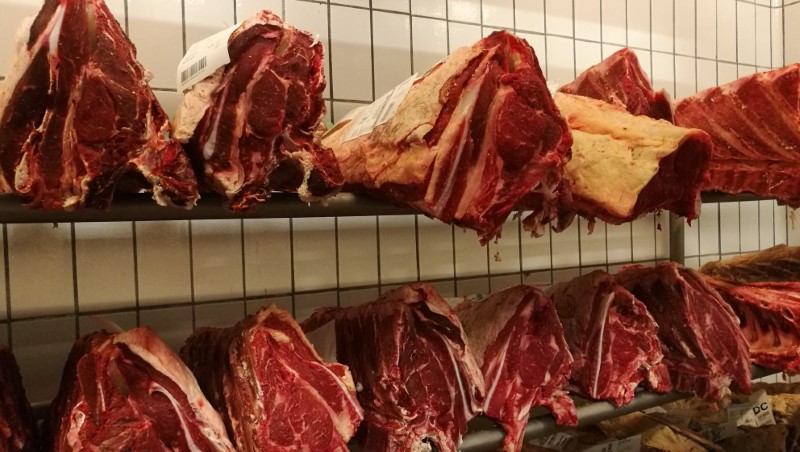

The pigs used for dry-aging at Danish Crown are carefully selected. They are raised on a different feed composition than regular slaughter pigs, resulting in a fat composition that is ideal for dry-aging. The pigs are older than usual and therefore weigh more, and each pig is specifically selected based on its suitability for dry-aging.
Good fat marbling is crucial for both pigs and cattle to be suitable for a dry-aging process, which is why Danish Crown also uses dairy cattle selected for good and high fat marbling. However, not all cuts from pigs or cattle can be used for dry-aging. Tenderloin, hams, and small cuts are unsuitable, as they dry out so much that there’s no edible meat left. On the other hand, cuts like neck, shank, loin, sirloin, and beef fillet are ideal due to their size and fat marbling.
On the Tour
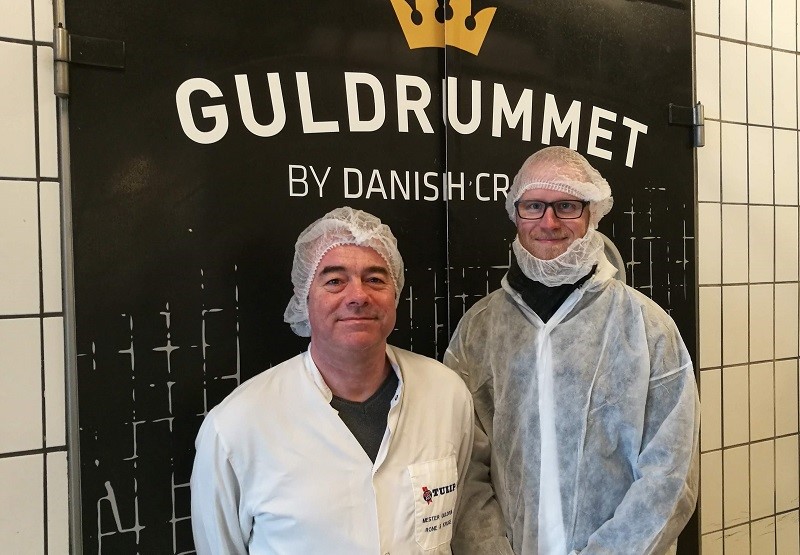
It’s a regular Thursday in October, and outside there’s an Indian Summer. Yet, I’ve crawled into a meat-filled cooler in Kolding, where I’m chattering teeth as Rone Stokholm Kruse, the daily manager of Danish Crown’s Gold Room, tries to drown out the noisy air circulation systems that ensure the meat matures under the right conditions. It’s about 1 degree warm (or should one say cold?), and it helps the meat mature without harmful bacteria finding their way to it.
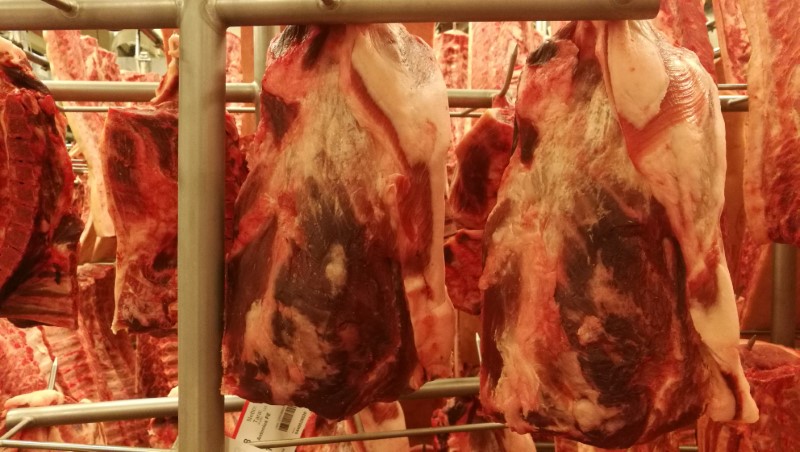
After a quick tour, I’ve ended up where it all started: In the original Gold Room. Where ideas once became reality, and reality became success. The room offers both beef, lamb, and pork. Some cuts are hung on hooks dangling from the ceiling, while others are arranged in rows on shelves along the wall. In total, the Gold Room can hang pork loins on 200 ‘Christmas trees’ with 16 hooks each. That’s equivalent to 3,200 pork loins at once.

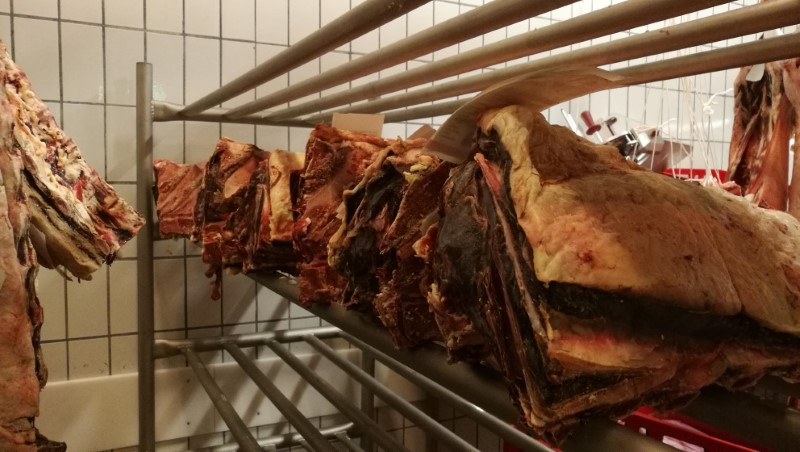
The cuts are at different stages in the maturation process. One of them was hung up way back in January – almost 10 months ago. It brings to mind Denmark’s darling, the dear Peter Palland, who in a famous TV clip says, “Then I don’t want it,” when a chef at a restaurant presents him with a five-year-old ham. But I’m not shy about tasting the meat. In fact, I’m standing there hoping I’ll get the chance.
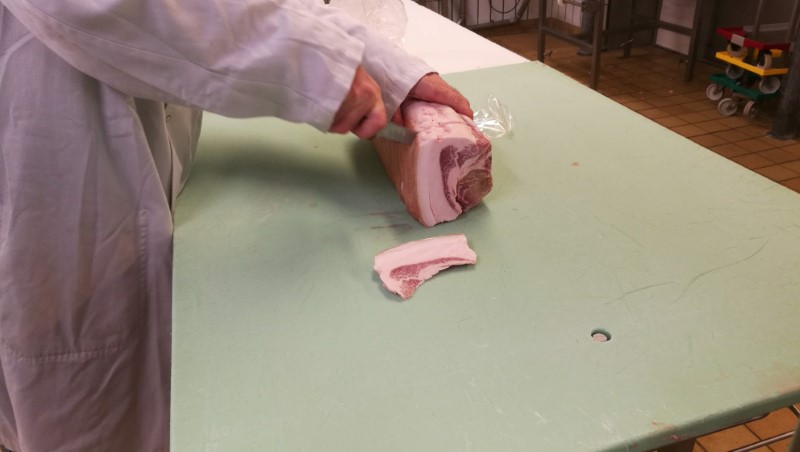
Fortunately, Rone summons an employee with a butcher’s knife, and with a skilled hand, he cuts the bark off the cow so I can taste the tender meat underneath. The flavor is intense and concentrated, and the texture is a bit like brie. I’m in heaven. Oh, how many exquisite dishes you could make with this meat!
Close Collaboration Elevates the Level
Danish Crown was – and perhaps still is to some extent – perceived as a producer that delivers products to the general consumer. It was precisely this perception that initially led to the creation of the Gold Room.
“We wanted to prove that we can do something no one else can, and we’ve done that with the dry-aging of pork. We have a collaboration with some of the country’s most talented chefs, and we supply meat to several Michelin restaurants,” Rone explains.
In the Gold Room, they continuously experiment with maturation. They explore which cuts can be successfully aged and how long different cuts should hang to achieve the best results. Therefore, Danish Crown also has contact with a number of star chefs across the country – 30-40 of them – who are allowed to prepare the meat and assess its gourmet level. The collaboration allows them to give each other feedback, further elevating the level.

The thinking behind the Gold Room and collaboration is that Danish Crown can eventually create even better meat for Danish consumers:
“It can be compared to when Ferrari spends a lot of money developing new and better brakes for their Formula 1 car, they simultaneously build competencies that enable them to make better brakes for regular Fiat cars,” Rone explains before we move on to the next room.
What’s Happening?
When the meat matures, enzymes begin to break down the fibers, concentrating the flavor and making the meat so tender it almost melts on the tongue. The longer the meat is allowed to mature, the more intense the flavor becomes. It can be anything from 15 days – like Tulip’s XV Dry-Aged – to 12 months. It’s the same process most people know from both red wine and cheese, whose flavors also intensify during the maturation period.
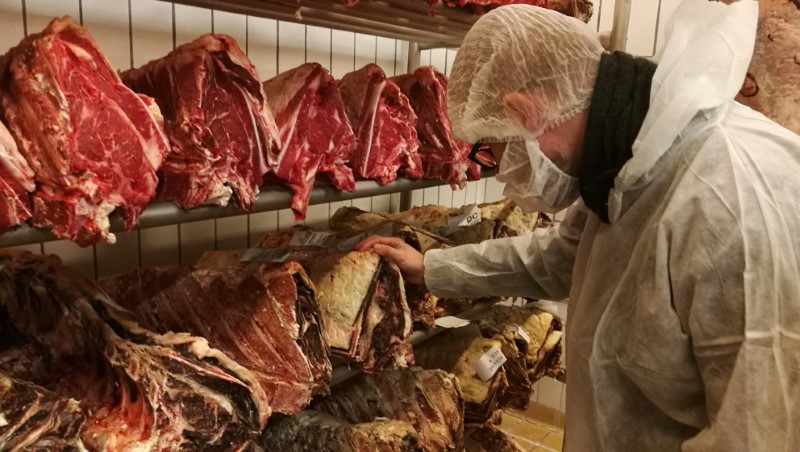
While I’ve always seen the dry-aging process as an ongoing process that can easily stretch over many months, Rone sees it more as a process that takes between 15 and 30 days. He calls it the period when the meat is allowed to dry out a bit and shed its moisture. After this, the meat begins to ferment, which can give it a sharper taste – a bit like blue cheese. And it’s a matter of personal taste whether you like it. I’m currently conducting a significant experiment at home, where I’m aging a sirloin for 12 months. I’m curious about the result, as I’m 11 months into the process, and the best way to describe the meat is like the Grauballe Man. If it doesn’t turn out a success, at least I’ve learned something along the way.
The Ideal Conditions
It’s extremely important that the temperature is both low and constant when dry-aging meat. If the meat gets too cold, the maturation process stops, and if it gets too warm, maturation can happen too quickly, resulting in sticky meat and unwanted bacterial growth. At the same time, the air needs to circulate around the meat; otherwise, it can’t release its moisture, which is the whole point of maturation.
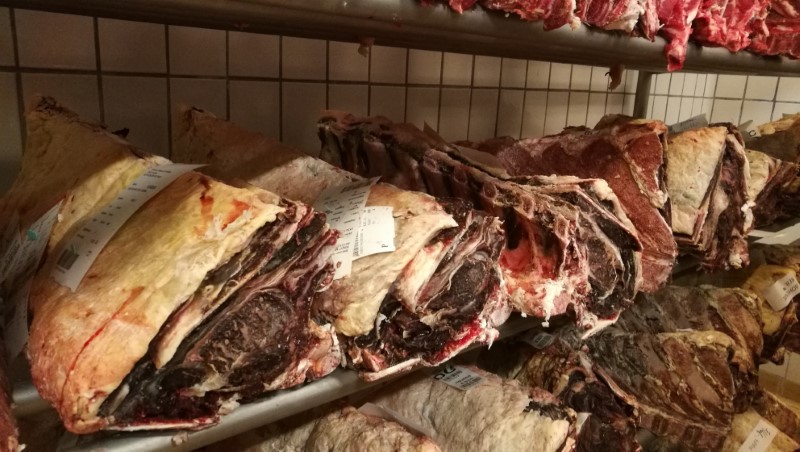
If the circulation is too intense, it can dry out the meat, and then you won’t get a good result either. The entire process involves having a steady hand and hitting the perfect temperature (between 1 and 4 degrees) and optimal air circulation.
In the Gold Room, the humidity is around 80%, and the air circulation systems need to be adjusted based on the amount of meat. Leading up to Christmas, when the room is brimming with pork cuts, Danish Crown is therefore forced to activate extra systems to maintain the conditions. And if you think the noise is already unbearable (it feels a bit like someone is battering your eardrums with a baseball bat), it’s nothing compared to how much noise there is leading up to Christmas:
“During that time, it’s completely impossible to talk to each other, and we may need to turn off the extra systems for the short periods we’re inside,” Rone tells us, who already has to speak quite loudly under regular conditions.

Wet Aging and Dry Aging
Dry-aging, dry curing, hook curing – yes, a beloved child has many names, and the only difference is really that the meat in hook curing hangs on a hook (hence the inventive name). The process and method are the same.
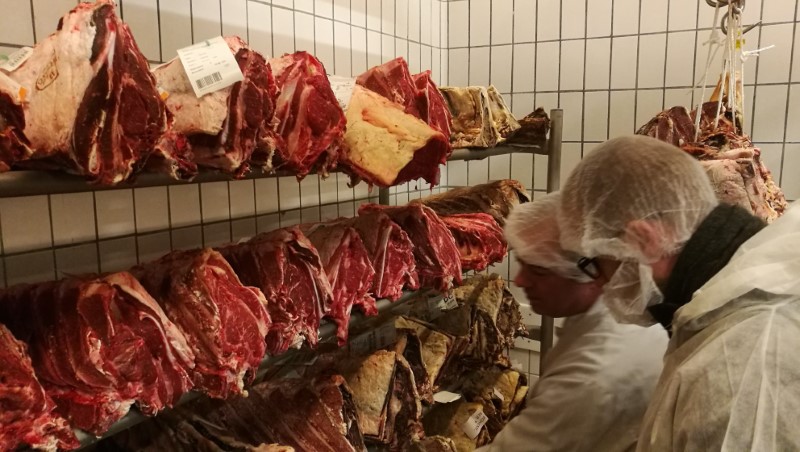
Dry aging is, as you may already know, the opposite of wet aging. Most of the meat you find in the supermarket is wet-aged. This means the meat is packaged immediately after slaughter, and the maturation process occurs in the packaging. This is the most advantageous method from the producer’s and grocery stores’ perspectives. Here, the meat can mature both during transport and in the stores’ refrigerated displays, and at the same time, there is no moisture loss, which means the meat retains its weight. That is until you cook it at home, where the meat shrinks as soon as it hits your hot frying pan or oven.
Immediately, it’s wet-aged meat that attracts consumers when they look at their wallets. It seems as though you get much more for your money because you can’t see how much moisture the meat contains.
When you buy dry-aged meat (or age your own meat), the situation is quite different. Here, the meat is roughly allowed to shed its moisture before cooking. The meat becomes more concentrated and tender and achieves a completely different umami flavor than the one you know from the dull chops in the refrigerated aisle.


Since moisture loss occurs during the maturation process, and the inedible bark on the meat must be trimmed off, the meat is reduced by 30-40% before it’s ready for use. However, the meat doesn’t shrink further during cooking, making it easier to achieve a good result. Because dry-aged meat is more compact, you can’t eat as much of it, and although the experience might be that you get more for your money when you buy wet-aged meat, the difference is actually minimal. On the contrary, you get a much more delicate piece of meat when you choose the dry-aged.
Home Again
After the nerdy trip to Kolding, I’ve become much wiser on how professionals go about it, and I’m ready to continue experimenting at home. The trip was definitely worth it. Even if it took a couple of hours before the last toes thawed again.
Imagine if I can create something Michelin-worthy for myself and my family? Or if I can become that grill master type who not only masters the grill but can also serve extraordinary meat from it!?