
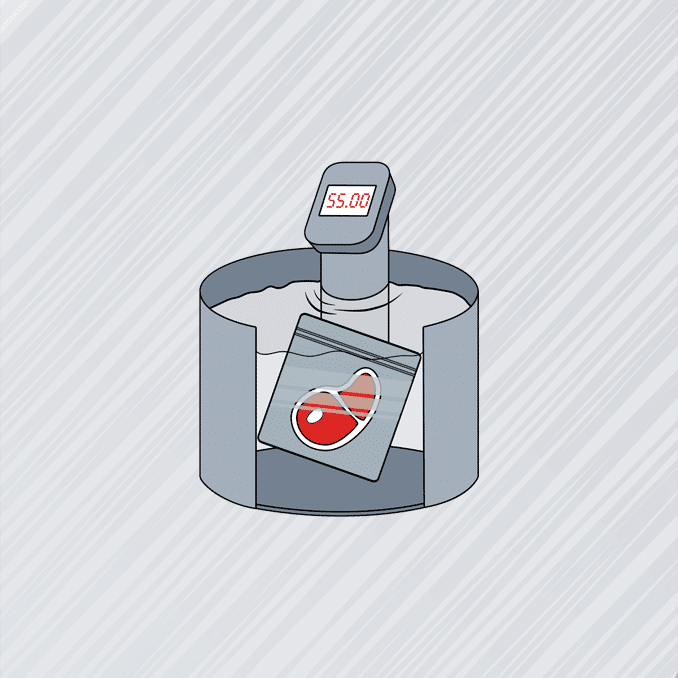

In this post, you will learn about what Sous vide means and why it is a super cooking method.
Basically, it means ‘cooking in emptiness’. This is to be understood as in a vacuum. It is a cooking method where the food is heat-treated (typically in water) while it is in airtight vacuum-packed plastic bags.
When something is treated Sous-vide, it happens at temperatures below 100 degrees and often over longer periods.
If you want an overview of the different options for sous vide equipment, check either our guides here or Shopalike’s different options here.
Advantages
There are several taste advantages with this cooking method. Among other things, all flavor nuances can be preserved because they do not remain on pots, grills, pans, or other kitchen utensils. All flavors are collected in the bag and thus in the food cooked with the method.
This is also exemplified by the fact that, for example, vegetables cooked Sous vide “retain” far more vitamin C than traditional methods.
The difference in vitamin C levels in Sous vide cooked broccoli versus traditional methods can be seen below.

There are also some durability advantages. Among other things, a Sous vide cooking has the advantage that the food is not contaminated by airborne bacteria and flora after cooking. At the same time, the vacuum ensures that especially fats in the cooked food are not exposed to oxygen (which over time contributes to spoilage).
It is important to note that Sous vide takes time if it is to work pasteurizing. An example can be the time it takes to kill a typical food bacterium such as Listeria monocytogenes. Here, you need to give your Sous vide bag 23 seconds at 75 degrees before the bacteria are ‘dead’. At 70 degrees, this time is 2 minutes, while at 60 degrees, it is a full 54 minutes.
Returning to the taste advantages of Sous vide cooking, the big factor is also that all moisture is retained in the meat cooked Sous vide. You can also more easily cook meat at low temperatures over a longer period without it becoming cold, especially compared to an oven for example. Here, much of the moisture in the meat evaporates.
Finally, you can achieve meat that has been cooked at the precisely same temperature throughout. The difference can be seen and tasted clearly.
To exemplify this, I have attached the difference between a traditionally cooked piece of meat and a long-cooked piece of meat Sous vide.

Disadvantages
If you are a public restaurant, there are a number of legal requirements you must adhere to. For example, you must not generally cook food Sous-vide at below 75 degrees. Here, a number of exceptions apply, including; whole pieces of meat, portion-wise serving of meat that the consumer does not want well done, individual chicken eggs, and other foodstuffs that due to their nature cannot be heated to 75 degrees.
In general, it can be both an expensive and difficult affair as a private person to cook sous vide. It often requires great precision to ensure it does not become dangerous to eat the food afterward.
At the same time, for example, fish, which are susceptible to, among other things, pressure, require that the bag is filled with harmless gas (to reduce the pressure on the product). It can be a mixture of Di-Nitrogen and CO2 or just Di-Nitrogen. Again, a factor that makes a project with Sous vide cooking a bit expensive to start with as a private person.