



Recipe for velouté with dark roux (sauce)
My take on a delightful sauce that can be made from scratch in about 45 minutes.
If you have a busy schedule, you can easily use a stock you already have, whether it’s homemade or not.
I made this dish on a weekday with a rather empty vegetable drawer in the fridge. If this had been a planned dish, I would have definitely had more ingredients in the stock. But the taste turned out good anyway.
You can, for example, use these in the stock: celery, bell peppers, celeriac, bacon, marrow bones, or similar. As always with stocks, you can make large batches and freeze it if you don’t need it all in the near future.
Here, the sauce was used with leftovers of brisket and the German/Austrian pasta spätzle.
Roux is simply the French name for a flour mixture. Typically, we know a white roux as what we usually use here in Denmark for, for instance, parsley sauce or other thickened sauces. Here, the flour mixture just needs to be cooked through so the flour taste is gone. By cooking it for a longer time, either on the stovetop or in the oven, it gains more caramelized flavor notes, though it can become bitter if cooked too long. It becomes a light roux after a while and eventually ends up as a dark roux.
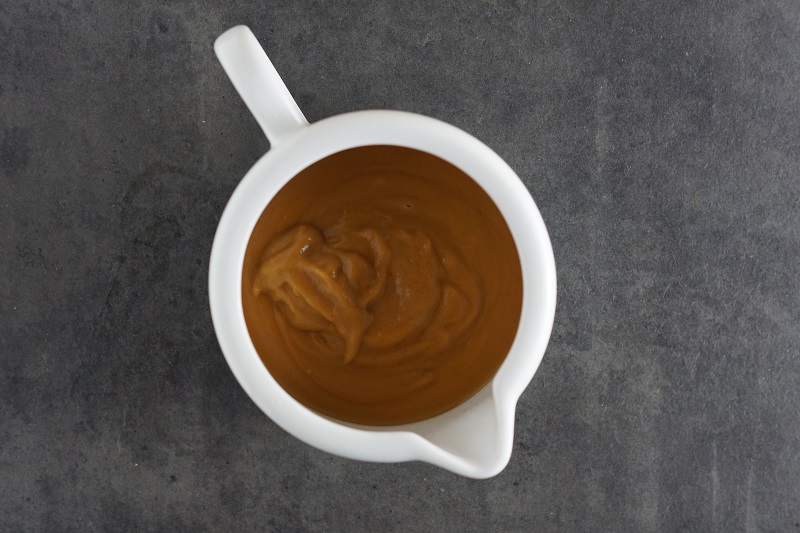

Velouté with dark roux (sauce)
Equipment
- Pot Thick base
- Cutting Board
- Knife
- Sieve
- Bowl
Ingredients
Vegetable Stock
- 27 gram Oil neutral in taste
- 15 gram Tomato Puree
- 1/3 pcs. Leek
- 2 pcs. Onion I used a regular onion and a red onion
- 1 clove Garlic
- 1 pcs. Carrots
- 39.5 gram Alcohol I used rum
- 100 gram White Wine can be replaced with red wine
- 1 l Water
- 5 pcs. Peppercorns
- 2 pcs. Bay Leaf
- 1 pcs. Rosemary Sprigs
Dark roux
- 25 gram Butter about 2 tbsp
- 35 gram Wheat Flour about 3 tbsp
Velouté
- 0.5 l Vegetable Stock above
- Roux above
- 5 gram Lemon Juice about
- 20 gram Currant Jelly
- Vinegar
- Salt and Pepper
- Spices if you lack flavor, you can use Worcestershire sauce, balsamic, English sauce and/or bouillon cubes
Instructions
Vegetable stock
- Heat a thick-bottomed pot over medium-high heat (10 out of 14 on my stove).
- Add neutral-tasting oil to the bottom and when it's hot, add the tomato paste. Let it brown a bit before adding the rest.
- Cut onions, garlic, carrots, and leeks into smaller pieces and add them to the pot.
- After 2-3 minutes, turn down to medium heat (7/8 out of 14 on my stove).
- Add the alcohol and ignite it. Make sure the extractor fan is off and do not stand too close.
- When the flames have died out, add the white wine.
- Let it simmer for a couple of minutes and then add water, peppercorns, and bay leaves.
- Cover with a lid and let it cook for 30 minutes. If you have more time, you can certainly let it cook longer.
- Strain the liquid into a new pot.
Dark roux
- Melt the butter in the pot over relatively high heat (9 out of 14 on my stove).
- Add the flour and whisk it well.
- After about 2 minutes, turn down to low heat (3 out of 14 on my stove) and let it sit in the pot. Either I put the pot directly in the oven at about 180 degrees Celsius (356 degrees Fahrenheit) or leave it on the stove. It takes quite some time to achieve the right color, so keep an eye on it and stir now and then. It took about 25-30 minutes on the stove for mine.
Velouté
- Heat the stock in a clean pot and add a little of your roux at a time while stirring.
- Once it's all in, you can start seasoning it.
- There is no salt in it yet, so quite a bit will need to be added. It's hard to taste it properly before that.
- Add a large spoonful of redcurrant jelly to the sauce; generally, more is needed than you think. The sweetness helps to enhance the flavors.
- Season with freshly ground pepper, add a little lemon juice and your favorite vinegar (I typically use apple cider vinegar or balsamic).
- If you're missing flavor, you can use Worcestershire sauce, balsamic, English sauce and/or bouillon cubes (I recommend fond du chef).
- Strain the sauce into a gravy boat to ensure any lumps of flour don't make it in.
- The sauce is now ready to serve, and remember that sauces shouldn't be eaten piping hot; otherwise, you can't taste all the flavors.
- Bon appétit.