
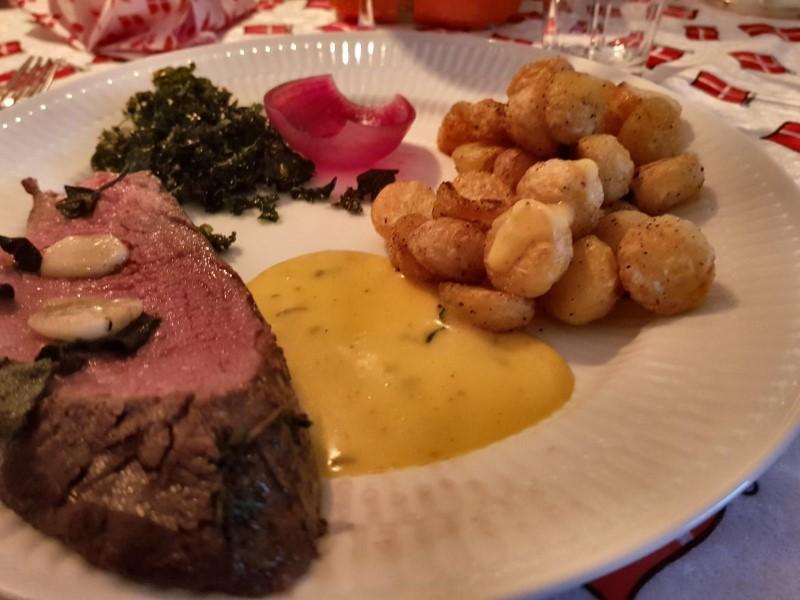

Served with Homemade Béarnaise Sauce, Cabbage Chips, Pickled Red Onions, and Small Crispy Potatoes
Recipe for sous vide dry aged beef tenderloin
Who doesn’t love the taste of well-cooked beef tenderloin and homemade Béarnaise sauce? Here is the recipe to make it happen.
Now you can elevate the popular classic to new heights – in this recipe, you’ll get a version where the beef tenderloin is prepared sous vide, which allows you to control the cooking process and temperatures. If you’re not up for trying sous vide, you can easily skip this step and use a pan or grill instead.
Additionally, you’ll get a detailed guide on how to make homemade Béarnaise sauce step by step. Enjoy!
Servings: people
Sous Vide Dry Aged Beef Tenderloin
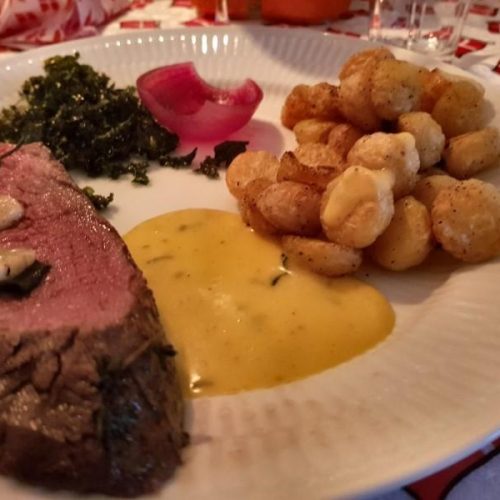
Served with Homemade Béarnaise Sauce, Cabbage Chips, Pickled Red Onions, and Small Crispy Potatoes
Ingredients
- 1 kg Beef Tenderloin
- 6 cloves Garlic
- 2 kg Potato As large as possible
- 200 gram Jerusalem Artichokes
- 600 gram Butter
- 60 gram Bearnaise essence
- 5 pcs. Egg Yolk
- Spices Salt, white & cayenne pepper, lemon juice
- Herbs Tarragon and optionally chervil
Instructions
Crispy, small round potatoes
- Start by peeling all the potatoes. Hollow them out with a melon/potato scooper (2.5 cm in diameter) and place the small round potatoes in water. The "waste," which looks like holey cheese, should be used with the Jerusalem artichoke mash.
- Boil the potatoes for 5 minutes and let them dry afterwards.
- Toss the potatoes in melted butter, oil, salt, and pepper.
- Bake them in the oven at 170 degrees Celsius (338 degrees Fahrenheit) (convection) for 1 hour and 15 minutes.
- They're now ready to serve.
Jerusalem Artichoke Mash
- Peel the Jerusalem artichokes and cut them into small pieces. Use the potato scraps and boil everything in water (add a bit of lemon juice – this ensures they don't discolor) until they're soft. Drain the water.
- Then mash the boiled potatoes and Jerusalem artichokes together with the butter from browning the meat, cream, and milk, and season with salt, white pepper, gastrique, and lemon juice.
Beef Tenderloin
- For this dish, we use dry-aged beef tenderloin. You can also use a regular tenderloin, but we find the meat is more tender, and the flavor is more intense when it’s dry-aged.
- We cook the meat in a sous vide/water bath for 3 hours at 54 degrees Celsius (129 degrees Fahrenheit).
- Take the meat out and pat it dry.
- Heat a pan on fairly high heat with oil and add the meat, butter, and garlic.
- Sear the meat for about 15-20 seconds on each side.
- Remember: save the butter from browning the meat, as you’ll need it for the potato-Jerusalem artichoke mash later.
Béarnaise Sauce
- The most important thing when making a Béarnaise Sauce is to have as few temperature differences as possible. So be sure to take your egg yolks out of the fridge in plenty of time and ensure that you melt the butter well in advance so the temperature has time to drop significantly.
- Start by melting the butter over low heat in a small saucepan and pour it into a small jug. Clarified butter is needed for the dish, which means the white sediment that occurs when melting the butter should be discarded. If you get some white sediment in, it won’t matter much.
- Separate your eggs so the yolks are kept apart from the whites. You can use the whites to make a meringue or add a bit extra to an omelet. When combining the sauce, there are several different methods in our world - directly in a small, thick-bottomed pan on the stove, in a bowl over a water bath, or in a kitchen machine with a heating element (e.g., Monsieur Cuisine édition plus).
- In this recipe, we’ve chosen to do it in a small, thick-bottomed saucepan on the stove at very low heat.
- Generally, there is one golden rule when making these sauces: Whisk, whisk, and whisk. Keep going, and whisk vigorously - all the time. It’s hard work, but it’s worth it 🙂
- The essence and yolks are whisked together over low heat until it foams and thickens.
- Then the butter is added little by little - again with vigorous whisking. Continue for a few minutes until the sauce is ready. Finally, add the chopped tarragon (we always use a mix of fresh and dried), white pepper, salt, and cayenne pepper. Optionally season with extra tarragon and lemon juice.
- The sauce is ready to serve and should be eaten immediately.
- Preferably serve it in a small casserole that has been in the water bath to help keep the sauce at the right temperature a little longer. You risk having a sauce that becomes too hot if it remains in the pan that was on the stove.
Notes
Serve with pickled red onions and kale chips.
 Advertisement:
Our wine partner BayVine.dk recommends the following:
We recommend CHATEAU DU PAPE-DOMAINE SENECHAUX .
Big, rich, and meaty, that is exactly what you can expect from Chateauneuf-du-Pape.
From one of the oldest domaines in the area, this red wine, made from the grapes Grenache, Syrah, and Mourvedre, is the perfect match for beef tenderloin.
Read more about the wine and buy it here
 Advertisement:
Our wine partner BayVine.dk recommends the following:
We recommend CHATEAU DU PAPE-DOMAINE SENECHAUX .
Big, rich, and meaty, that is exactly what you can expect from Chateauneuf-du-Pape.
From one of the oldest domaines in the area, this red wine, made from the grapes Grenache, Syrah, and Mourvedre, is the perfect match for beef tenderloin.
Read more about the wine and buy it here