
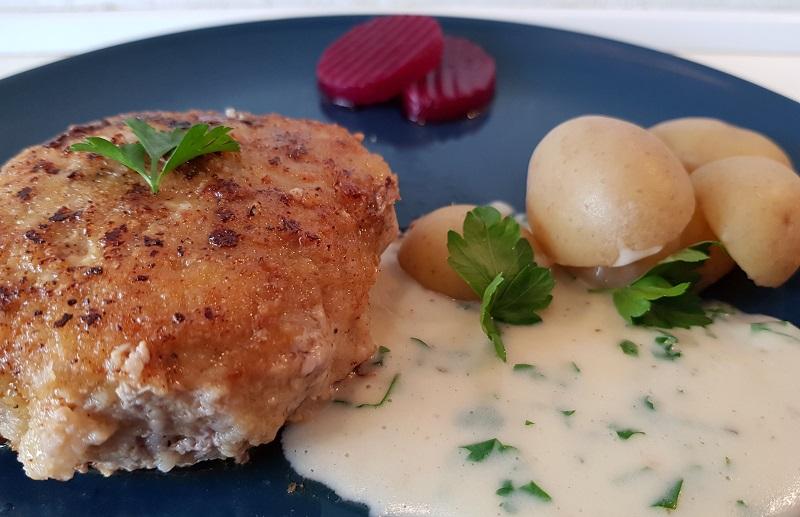


Recipe for pan-fried pork patties
I think that karbonader epitomize wonderful childhood memories and are quintessentially Danish, traditional, and “grandmother-like.”
The other day, I made karbonader for my daughter and my husband, and already during the cooking process, memories of the good old, cozy home life from my childhood home started to wash over me. It’s truly amazing how tastes and smells can evoke emotions to such an extent!
Maybe you call them karbonader, maybe you call them krebinetter, but regardless of which version of the breaded “pork patties” you grew up with, both names refer to classic meat dishes in many Danish homes.
Karbonader or krebinetter?
Let’s settle this once and for all: Karbonader and krebinetter are not the same. So, we’ve established that at least.
There are significantly regional differences that account for whether one grew up with karbonader or krebinetter: Jutlanders typically grew up with karbonader, while islanders have indulged in krebinetter.
– but what exactly is the difference between karbonader and krebinetter?
Broadly speaking, karbonader originated in Italy, while krebinetter originated in France. The Italians originally shaped karbonader as large, round, flat patties of pure ground pork, which were then grilled over coals – hence the name “karbonader”: The Italian word for coal is carbonata.
Krebinetter, on the other hand, have roots in France, where they were originally made in oval shapes. Here, either ground meat, poultry, or offal was used, after which the patties were breaded or wrapped in a fat net. The French word for a fat net is crépine, which is also the French name for krebinetter.
Today, the differences are mostly blurred, as karbonader are now also chosen to be breaded before frying, and both karbonader and krebinetter are typically made with either pure pork or a mixture of pork and veal.
And that’s not all: There are additional, regional variations of both karbonader and krebinetter.
I myself grew up with karbonader, and I know that in some regions, breadcrumbs are mixed with the ground pork, while in others, the patties are coated first in egg, then flour, and finally breadcrumbs. Additionally, there can be differences in how thick or thin the patties are made.
So – it is entirely understandable that quite a few questions may arise when the discussion turns to karbonader versus krebinetter. It’s no longer straightforward to pinpoint the differences.
My recipe for pan-fried karbonader
Where I come from, a karbonade is made from either pure ground pork or a mixture of ground pork and veal – and then it is breaded in egg, wheat flour, and breadcrumbs.
I served my “childhood memories” with boiled potatoes and parsley sauce – just as I was served as a little girl.
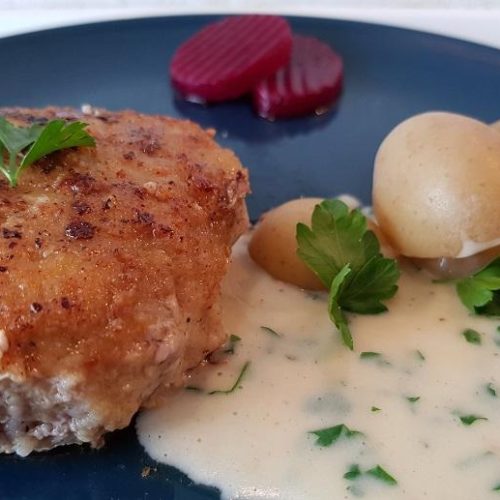
Pan-fried Pork Patties
Ingredients
Carbonates
- 400 gram Minced pork
- 50 gram Grate
- 60 gram Wheat Flour
- 1 pcs. Egg
- Spices Salt and pepper
- 15 gram Butter
- 12 pcs. Potato
- Salt
- 20 gram Butter
- 16 gram Wheat Flour
- 300 gram Milk
- 200 gram Water From the potatoes
- 15 gram Lemon Juice
- Spices Salt and pepper
- 1 bunch Parsley
Instructions
Pork Patties
- Take the meat out of the refrigerator about 30 minutes before it needs to be cooked and divide it into 4 equal portions.
- Shape them into relatively flat patties and season with salt and pepper.
- Let the meat stand covered until it's time to fry. Heat a pan over medium-high heat and melt the butter on it. When the butter foams, the pork patties are ready to be added.
Parsley sauce
- Rinse the parsley thoroughly and finely chop it.
Notes
See for example a recipe for pickled beets here.