-
Basically, it's about achieving the smoothest possible consistency for the filling, so the quantities I've listed are quite indicative.
I coarsely chopped my garlic and shallots and put them in my mini chopper.
The langoustines were peeled in advance, as they were bought from a local fishmonger.
I just cut them into smaller pieces and put them in the mini chopper.
Then I added the egg, half of the cream, and half of the flour.
Everything was chopped up, and the spices and the rest of the cream and flour were added.
It was chopped again and then chilled.
-
Pour the flour out on your countertop and make a well in the center of it.
Put the eggs into the well and whisk them with a fork. Add the salt.
Gently push some of the flour into the eggs while whisking.
Continue until the fork can no longer whisk, then use your hands for the rest.
When you start kneading the dough with your hands, use the heel of your hand to knead.
It takes up to 10-15 minutes to get the dough smooth, glossy, and supple, so it becomes too tough if you only use your fingers.
Brush the dough with oil using a small brush and wrap it in plastic wrap or a bag.
Let it rest on the countertop for half an hour.
Then dust your countertop with flour and roll the dough out lengthwise on the table. I use a rolling pin for this, but if you have a pasta machine, it's naturally much easier.
The pasta should be about 1/2-1 millimeter thick.
Make sure you have two strips of the same size and place a large teaspoon of the filling on them, leaving a 5 cm gap in all directions.
Now put the other strip on top and press them well together.
Cut squares of about 5x5 cm - I used a pastry wheel for this.
I got about 15 ravioli out of my amount of filling/pasta.
Bring a large pot of water with a little salt to a boil and carefully place your ravioli in it. Preferably boil them in two batches if that makes more sense.
They should simmer for 3-4 minutes, after which the water should be drained.
They are now ready to serve.
-
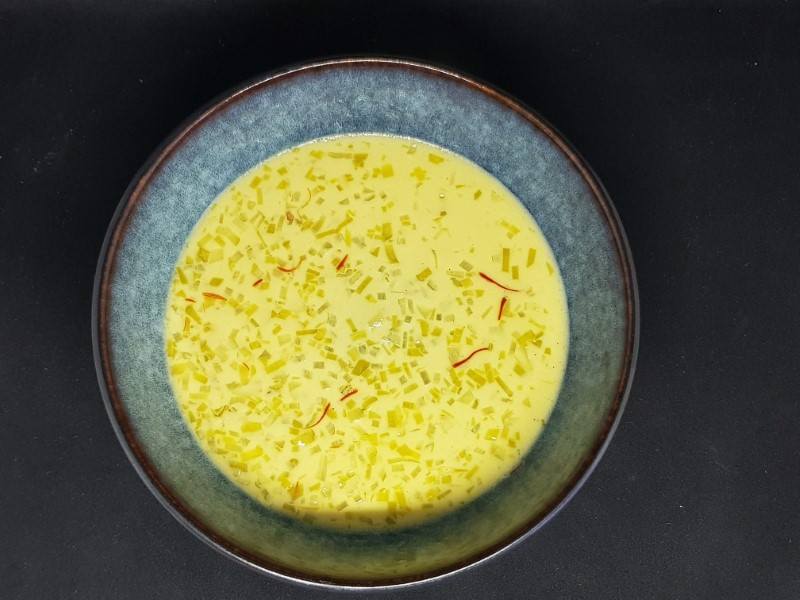
Start by adding boiling water to a small bowl along with your saffron threads.
Chop onions and leeks into very small and fine pieces.
Sauté them in butter in a thick-bottomed pan over medium heat. They should not brown, just become translucent.
Add white wine and turn up to relatively high heat.
Stir it regularly and let it reduce to half the amount.
Add stock and let it reduce to half the amount again. If you don't have stock, just use boiling water along with a bouillon cube, "Fond du Chef," or similar. Note that these contain salt, so be aware that you almost don’t need to add any salt when seasoning at the end.
Now add the cream and the saffron water (with the threads) and let it reduce a bit again.
Season with salt, pepper, lemon juice, vinegar, and sugar.
The sauce is now ready to be served.
-
Pour the sauce at the bottom of a deep plate and place the ravioli on top.
Bon appétit.