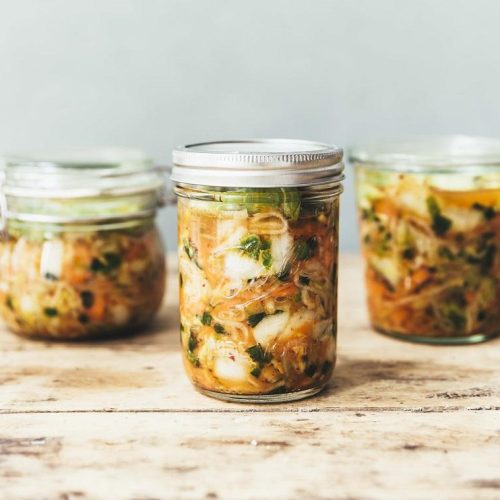
Servings: jar
Quick kimchi
Lovely and delicious recipe for kimchi made from, among other things, Napa cabbage. Most people are familiar with the popular German dish sauerkraut, this is the Asian counterpart to it.
Ingredients
KIMCHI PASTE
- 50 gram Garlic
- 50 gram Ginger
- 0.5 pcs. Apples
- 25 gram Chili Powder Spicy. Preferably Korean chili flakes
- 34 gram Miso
- Water
KIMCHI
- 1 kg Chinese Cabbage
- 36 gram Sea Salt
- 250 gram Carrots
- 250 gram Chinese Radish
- 150 gram Scallion - Spring Onions
- 50 gram Kimchi Paste
- 20 gram Sea Salt
Instructions
- Start by making a kimchi paste; peel garlic, peel ginger, and chop both coarsely.
- Cut the apple into small cubes, and along with the garlic, ginger, and the rest of the ingredients, add to a food processor or blender and blend until you have a paste.
- Put the paste in a clean jar and store it in the refrigerator.
- Remove one of the outer leaves from the head of cabbage, rinse it, and set it aside for later use.
- Cut the Napa cabbage into wide strips and put them in a large bowl.
- Sprinkle salt over and gently massage the cabbage for about 2-3 minutes.
- Let the bowl stand for about 1-2 hours until it has released a little liquid.
- Rinse the Napa cabbage thoroughly in clean water 2-3 times to wash out all the salt – use a large sieve.
- Peel the carrots and grate or chop them into small cubes.
- Peel the daikon radish and slice it thinly or use a spiralizer.
- Clean and coarsely chop the scallions.
- Put the vegetables, kimchi paste, and salt in a large bowl.
- Put on gloves and massage all the ingredients for about 5-10 minutes until the cabbage mixture releases its juice and the vegetables become soft.
- Put the mixture and the juice in a clamp-top jar.
- Press it down well in the jar, so everything is covered by the brine.
- Use the outer cabbage leaf from the Napa cabbage to place on top, so it presses everything under the brine.
- There should be about 2-3 cm of air at the top of the jar.
- Close the lid and place the jar on a plate.
- Let the vegetables ferment for about 3-5 days, preferably at a temperature of around 20 degrees Celsius (68 degrees Fahrenheit).
- Make sure to open the jar every day, so it does not build up pressure
- Taste the kimchi after 3 days, and when you think it has a good flavor, it's ready – but it should be ready after 3-5 days.
- Store the jar in the refrigerator after this.
- Kimchi can last a long time in the refrigerator, but it tastes best in the first month.