Dissolve your bouillon cube in boiling water and keep it warm in a pot.
Melt 30 grams of butter and your marrow (from your osso buco) in a thick-bottomed sauté pan. It should have a large surface area so the liquid can evaporate more easily.
Sauté the onions in the pan.
They should not turn golden; they should become translucent—so be careful with the heat.
Pour the contents of the pan through a sieve into a bowl.
Return the fat from the bowl to the pan and add the rice.
The rice should also turn translucent and almost shiny. Again, be careful not to use too high a heat as the rice should not turn golden.
Add the wine and let it cook off.
Then add 1 dl (or a ladle) of bouillon at a time. It should be almost completely absorbed each time before adding more liquid.
Make sure to stir constantly.
Continue this way until there is almost no liquid left.
When there are a few minutes left, add your saffron and give it a couple of minutes.
Then turn off the heat and add the Parmesan cheese and the rest of the butter.
Taste and optionally season with salt, lemon juice, lemon zest, or balsamic vinegar.
Let your risotto rest for a couple of minutes before serving.
Rinse your parsley and make sure it is dried well before you start.
Grate the zest of 1/2 organic lemon (they are untreated) using a fine grater. Be careful not to include the white part, as it is bitter.
Peel your garlic and cut it into large pieces.
Blend everything together, preferably with a mini chopper or a chef's knife.
Once everything is well combined, it is ready to serve.
Our osso buco was about 4 cm thick and
dry-aged for 60 days. Therefore, one slice was enough for 2 people. Normally, I would eat 1-2 slices of 3 cm each when the meat is "regular" wet-aged.
This recipe is made in a cast-iron pot on the stove, but it can also be made in the oven or in a roasting pan.
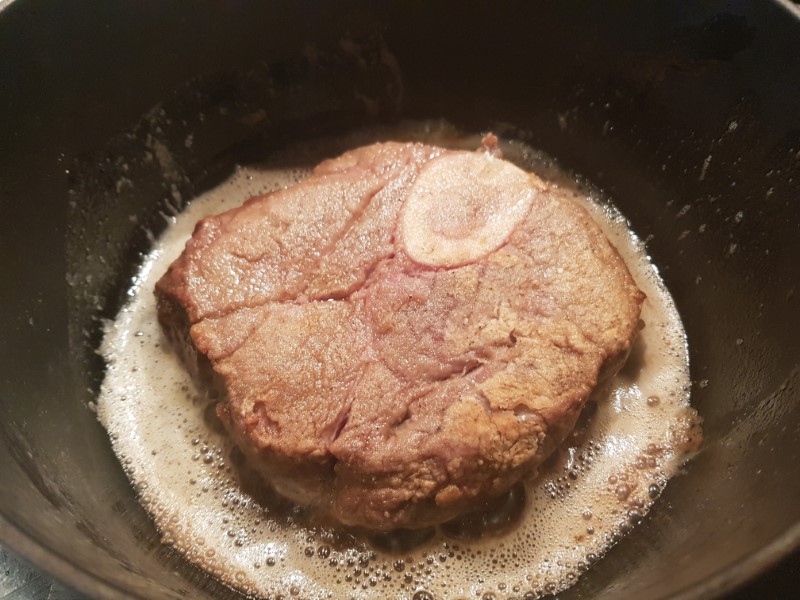
Start by cutting into the tendons at the edges of the meat; this ensures that it doesn't curl up and cooks evenly.
Mix salt and flour on a small plate and coat the meat in it. This helps the meat form a crust and thickens the sauce afterward.
Heat butter and oil and place the meat inside to form a crust.
When you turn the meat, add the tomato paste to "brown" it.
Peel the vegetables and cut them into smaller pieces.
Place them in the pot and let them gain a little color.
Add red wine, water, and a bouillon cube, making sure the meat and vegetables are covered with liquid. If not, add a little more water or wine.
Put the lid on and turn the heat down to low.
The meat now takes care of itself and needs at least 2.5 hours, but preferably up to 4 hours.
When the meat is done, remove it from the pot and blend the sauce thoroughly with an immersion blender. The vegetables and the flour help to thicken it.
Let it cook down a bit more if necessary.
Season with salt, pepper, balsamic vinegar, and optionally lemon juice.
You can add a bit of cream to the sauce if you feel it needs it.
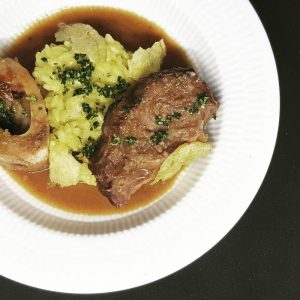
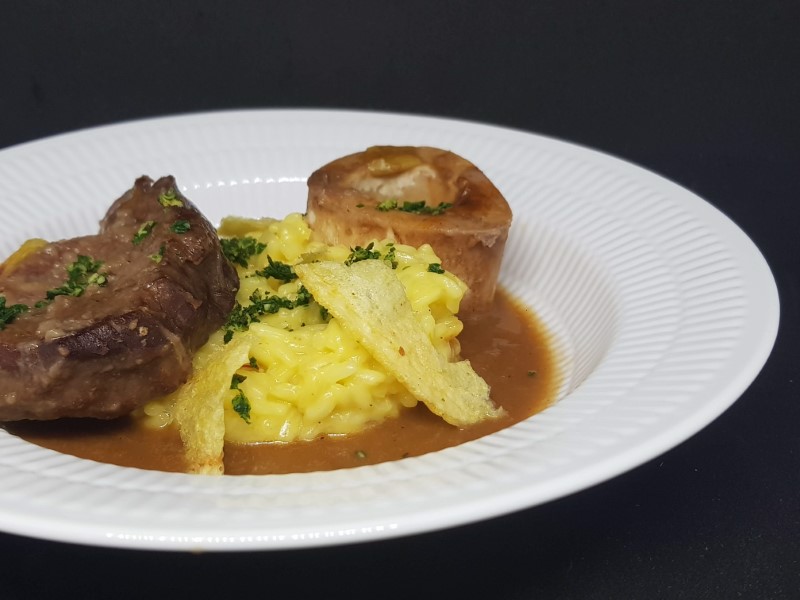
Place the risotto on one side of the plate and the meat with the sauce on the other side. Sprinkle gremolata on top of the meat and serve immediately.