Start with autolyse. Mix the different types of flour and cold water together and let it rest for an hour. (Autolyse: chemical process where the flour absorbs the water and makes the dough elastic).
Add sourdough starter and mix for a couple of minutes on low speed with a machine. Add salt and knead for another 8-10 minutes, gradually increasing speed. The dough should be nice and elastic and still soft. Perform the gluten test. Stretch the dough and see if it is elastic enough.
If not, knead a little longer.
Place the dough in an oil-greased bowl and make 4-5 "butt" folds. Wet your hands and lift the dough so it folds under itself.
Let the dough rise 20-30% (2-4 hours) under a lid.
Turn the dough out onto the table and wet your hands.
Shape by pulling the sides of the dough towards the middle, tightening the underside of the dough. Make 6-8 pulls. Turn it over and use your hands to turn and tighten the dough a couple of times. Your hands should tighten the dough under itself.
Let the dough rest on the table for 30-40 minutes.
Sift flour on the table and sprinkle a little flour on the dough. Repeat the pull-tighten process and also the turn-tighten process - now with flour on the table and your hands. Place the tightened dough in a proofing basket sprinkled with rice or corn flour.
Let it rise overnight in the fridge. At least 12 hours.
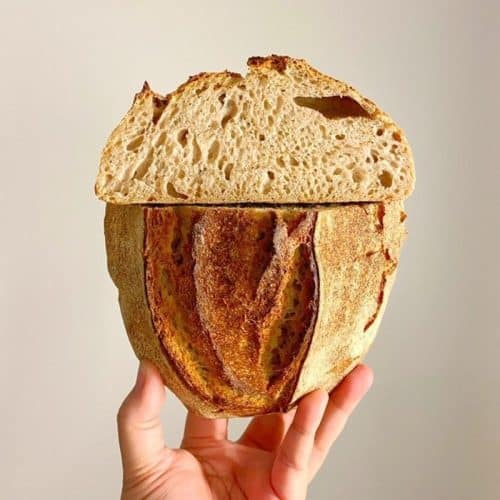
Preheat a cast iron pot or Dutch oven in the oven for at least 45 minutes to 250 degrees Celsius (482 degrees Fahrenheit) with fan. Place the dough on clipped parchment paper and make a deep and long cut. Take the Dutch oven out of the oven and carefully place the bread inside. Add one or two ice cubes between the side and the parchment paper and quickly put the lid on. Bake at 250 degrees Celsius (482 degrees Fahrenheit) with fan for 30 minutes. Remove the lid and bake for another 20-25 minutes at 220 degrees Celsius (428 degrees Fahrenheit).
Take the bread out, let it cool, and enjoy!
Have a great time baking.
Ps: check big.