

The perfect roast pork with crispy crackling and juicy meat EVERY TIME! A completely foolproof version that ensures you the same perfect result year after year.
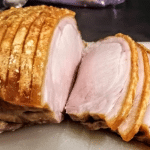
Recipe for danish pork roast – flæskesteg
Tender and juicy pork roast with delicious crispy cracklings is something that can make many Danes scratch their heads a bit.
I actually think I’ve cracked the code to a totally foolproof and perfect pork roast with crispy cracklings every time!
If you follow this recipe to the letter, the roast is guaranteed to be spot on.
Now let me tell you how to go about it.
Pork Roast Recipe

Servings: roast pork
Roasted Pork Belly - Danish Flaeskesteg
The perfect roast pork with crispy crackling and juicy meat EVERY TIME! A completely foolproof version that ensures you the same perfect result year after year.
Equipment
- Chef'S Knife
- Roasting Pan
- Tinfoil
- Oven
- Wooden cutting board
Ingredients
- 1200-1500 g Rib Roast or rib roast
- Boiling water
- Salt ordinary fine
- 3 Bay Leaf dried
- Whole cloves
- Peppercorns black
- Fresh thyme
Instructions
- Preheat the oven to 200 degrees Celsius (392 degrees Fahrenheit) convection.
- Place the roast in the middle of the roasting pan with the skin side down. Use a high-sided roasting pan if possible.
- Pour boiling water into the roasting pan until the crackling is just covered.
- Place the roast in the middle of the preheated oven and give it 20 minutes.
- Take the roast out of the oven.
- Turn the roast over so the skin side is up.
- Check if the crackling is sufficiently scored all over (sometimes the butcher is a bit too quick). Cut along the existing cuts but do not cut all the way down to the meat.
- Apply a good amount of salt to the crackling (not excessively, but sufficiently). Gently rub the salt into the crackling with your fingers so the salt finds its way into the grooves.
- The roast is usually uneven on the surface, so take some aluminum foil and crumple it under the roast on the side that needs to be lifted: When the top side is approximately level and even, the entire top side is exposed to the same cooking process. What often goes wrong is that all the juices and fat from the crackling never reach the surface and out of the crackling, resulting in soft crackling.
- Place the bay leaves under the roast and distribute cloves, peppercorns, and thyme sprigs around it. Many people stick the bay leaves between the cracklings, but this is solely for appearance and does NOTHING for the flavor! When the leaves are placed under the roast, they, along with the other spices, will cook in the broth, which becomes a wonderful sauce. Optionally, you can put some extra bay leaves between the crackling if you want to decorate your roast pork.
- Return the roast to the center of the oven at 200 degrees Celsius (392 degrees Fahrenheit) convection and let it roast for an hour and a half.
- Take the roast pork out of the oven and let it rest in the roasting pan for 15 - 20 minutes. It's important to let it rest before slicing it so that all the good juices do not run out as soon as you start cutting. Don’t worry about your roast pork getting cold during this time - it won't!
- Cut the roast into appropriate slices.