


Finding the right temperature and time when cooking sous vide can easily be confusing, as there are many different sources (both online and physical) that provide you with different “optimal” temperatures. One of the main reasons for this is the variation in personal preferences/tastes. Although most foodies agree that medium-rare is the best way to cook a steak, there are those who prefer it well-done (which, of course, in my book is ruining it). Sous vide is a cooking method for those who prefer their meat medium-rare because if you simply want it well-done, you can “just” boil or fry it to death, and that’s that. It reduces the risk of getting sick, but it also reduces the dining experience to nothing.
Sous vide gives you perfect control over the temperature, regardless of how long you cook it. So, you have the option to get ingredients like ground meat, poultry, or short ribs/pork shoulder/lamb shank medium-rare or medium – where it’s usually not safe. It’s not just the precision of the temperature that makes a difference; it’s also the fact that often a change in temperature not only affects the cooking time.
Read that last sentence again, because it’s so important to understand with sous vide. For example, if you’re cooking a lamb shoulder, a ham, or a whole chicken in the oven at 180 degrees Celsius, the core temperature will increase over time. The longer you have it in the oven, the warmer the core will become. That’s why many recipes say to roast the ingredient until the core temperature reaches a certain value. At that point, the air around the roast is 180 degrees, and the outer layer of the roast will be closer to 100 degrees, even though your core temperature is what you were “chasing” – for example, 55 degrees. The rest of the roast will be between 55 degrees and 100 degrees. This means the core will be perfect, and the outer layers will be overcooked (dry and less tender).
There are two reasons to cook until a given core temperature is reached:
- To ensure the meat is pasteurized and safe to eat.
- To make it tender.
Both of these things can be achieved by cooking it at 55 degrees. However, it requires that it is cooked sufficiently long. On the other hand, if you take the roast out of the oven before the core reaches 55 degrees, the meat will not be considered safe to eat or tender enough. If you leave it in the oven for too long, the core temperature will continue to increase, as the oven is 180 degrees hot. So if you want the roast to be safe to eat, it requires that you overcook it.
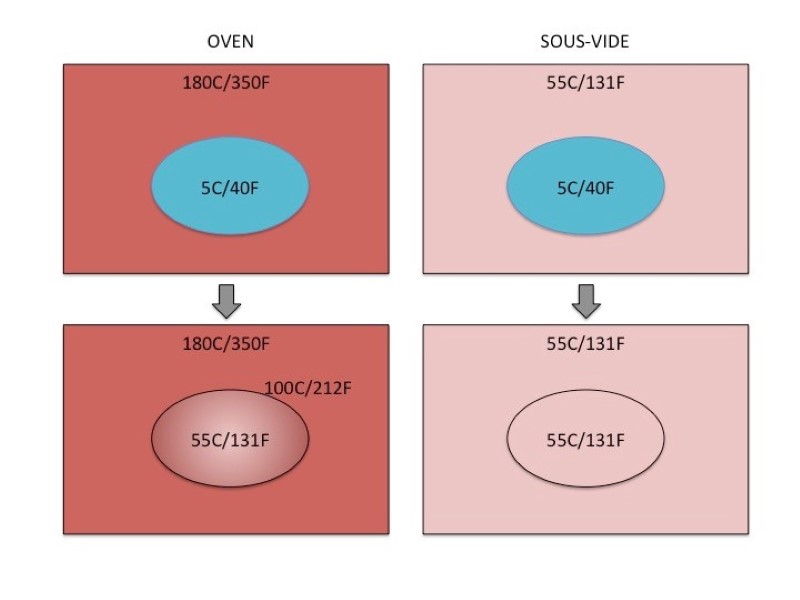
In both cases, the roast starts at fridge temperature cold – 5 degrees. When the core temperature reaches 55 degrees, the temperature will be gradually different in the oven-roasted version and uniform in sous vide. If you let them stay in the oven/water bath, the core temperature in the oven will continue to rise, while it will remain at 55 degrees in the water bath.
By sous vide cooking the roast in a plastic vacuum bag, where the water is the same temperature as the desired core temperature, for example, 55 degrees. This means that no matter how long you leave the bag in the water, the core temperature will never rise above the desired 55 degrees. This way, you can ensure it remains at 55 degrees for as long as it takes to become safe to eat/tender, without it being overcooked.
So, what does this have to do with a turkey breast? Well, if you traditionally cook it in the oven (or on the grill/pan), the turkey breast should be cooked until it has a core temperature of 74 degrees to be considered safe to eat, according to health authorities.
This means people are used to eating overcooked turkey and consider it unsafe to eat and undercooked when it is slightly pink and juicy – as opposed to white and dry.
With sous vide cooking, it is possible to cook the turkey breast at 56 degrees, and it is still safe to eat, provided that the core temperature is cooked for at least 35 minutes to be pasteurized. Considering the time it takes for the breast to reach 56 degrees, the cooking time should, of course, be longer than those 35 minutes. Typically, it takes 1 hour to cook a 2 cm slice of turkey breast and up to 3 hours if it is 5 cm thick.
To find the temperature I liked best, I conducted the following experiment:
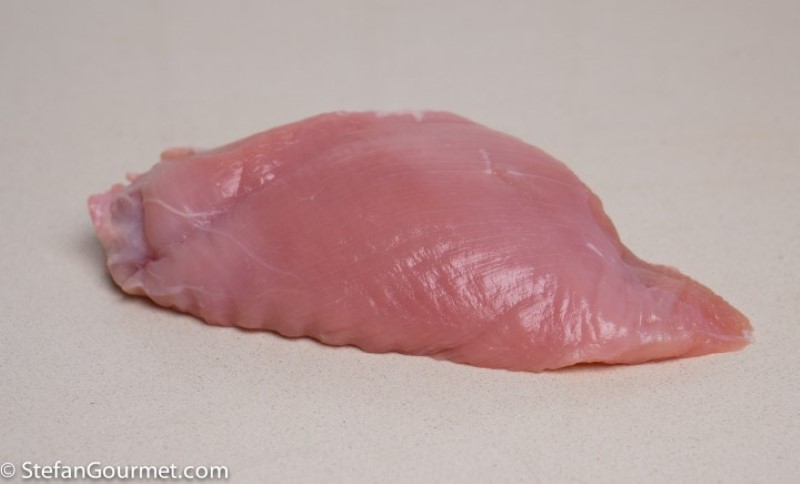
I started with the above piece of turkey breast.
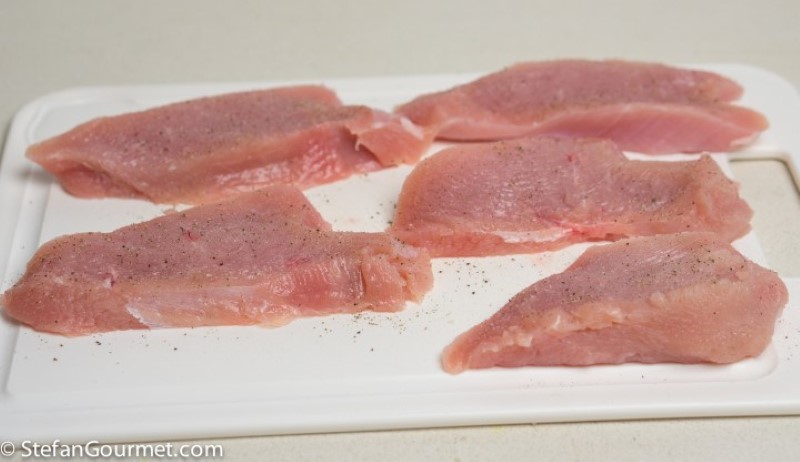
I cut it into 1.25 cm thick slices and seasoned them with salt and freshly ground pepper.
Then I vacuum-sealed them.
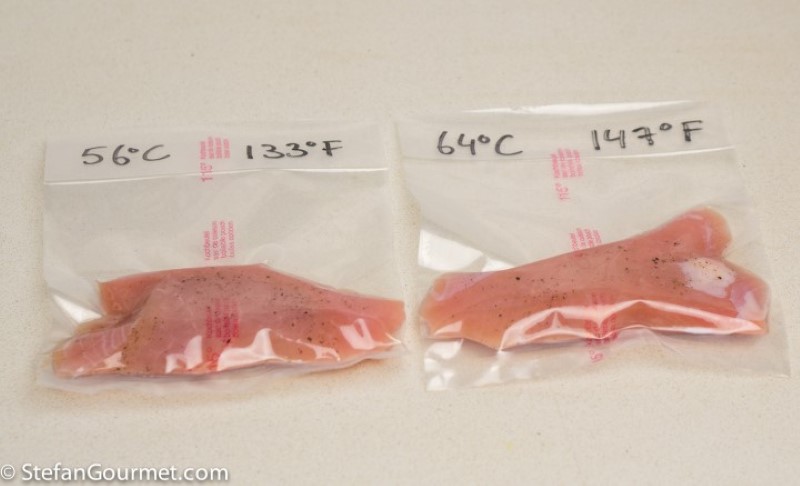
I cooked one of these slices for an hour at 56 degrees and another slice for 1 hour at 64 degrees, as these are the most commonly recommended temperatures for turkey breast. Both times and temperatures are safe to eat, as the slices are thin. If the slices had been thicker, the one cooked at 56 degrees would have needed more time.
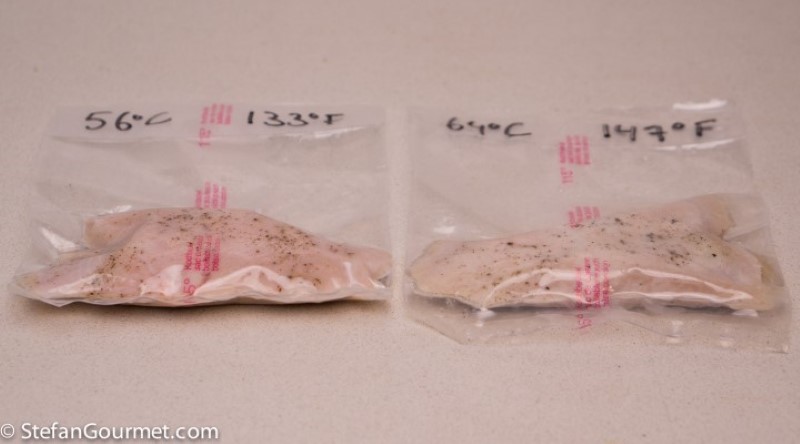
This is how they looked after 60 minutes in the water bath.
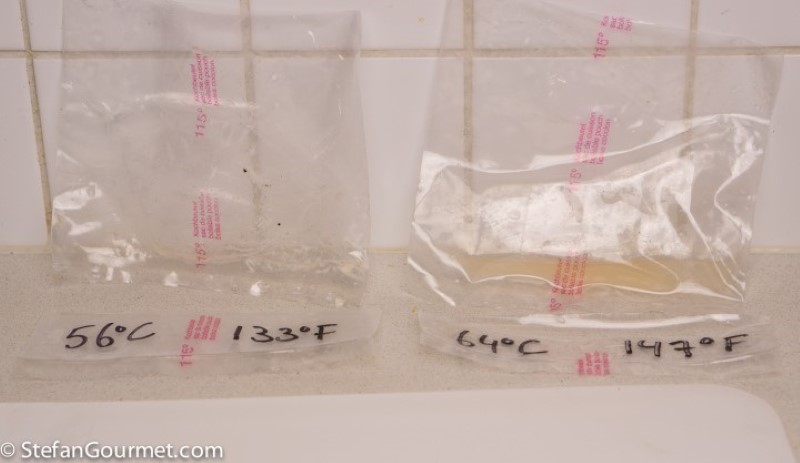
You can see the difference very clearly when you take the turkey slices out of the bags: the breast cooked at 64 degrees has lost significantly more liquid than the breast cooked at 56 degrees (where you can hardly see any liquid loss). This is because a higher cooking temperature will cause the proteins to bind more tightly and squeeze more liquid out of the meat.
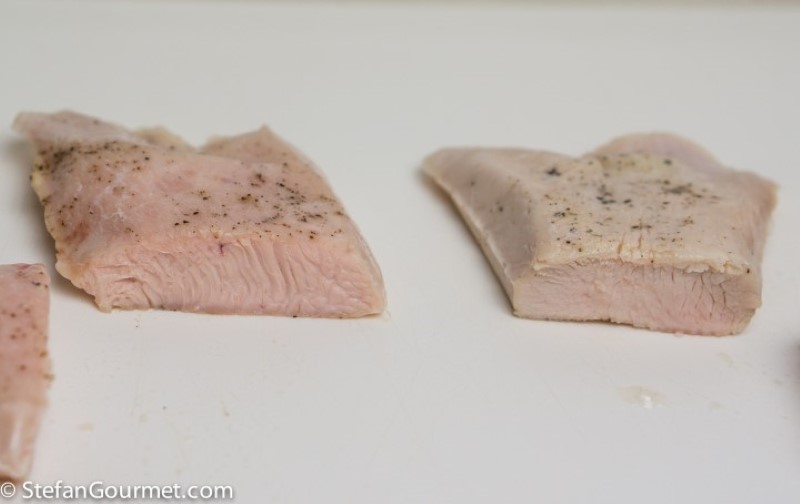
The exterior does not look particularly appetizing yet. A quick sear in hot butter or olive oil will, of course, change that.
When you cut the meat, you can see that the turkey breast cooked at 56 degrees (on the left) is slightly pink and has shrunk a bit less than the other.
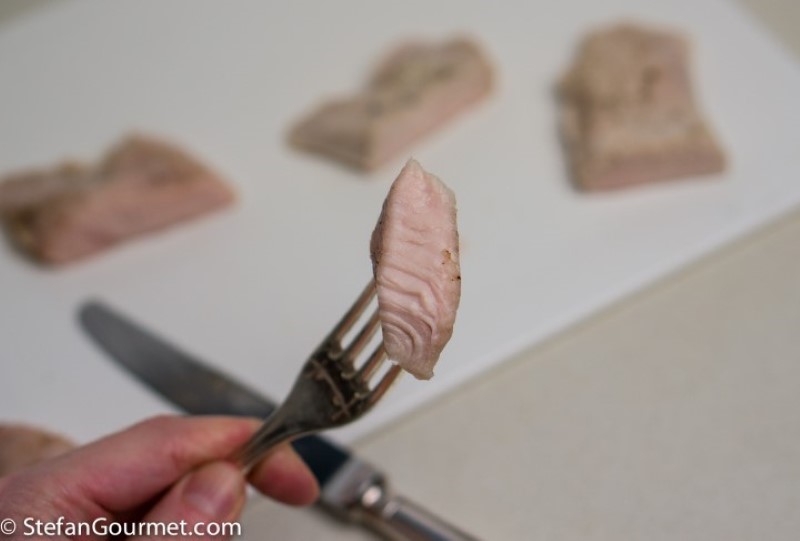
When I taste it, I prefer the breast cooked at 56 degrees, which can be characterized as ‘medium-rare’. It’s juicier and more tender and very different from how you are used to eating turkey breast. It’s a whole new experience compared to traditionally cooked turkey breast and, according to my taste buds, much better. That’s the temperature I prefer.
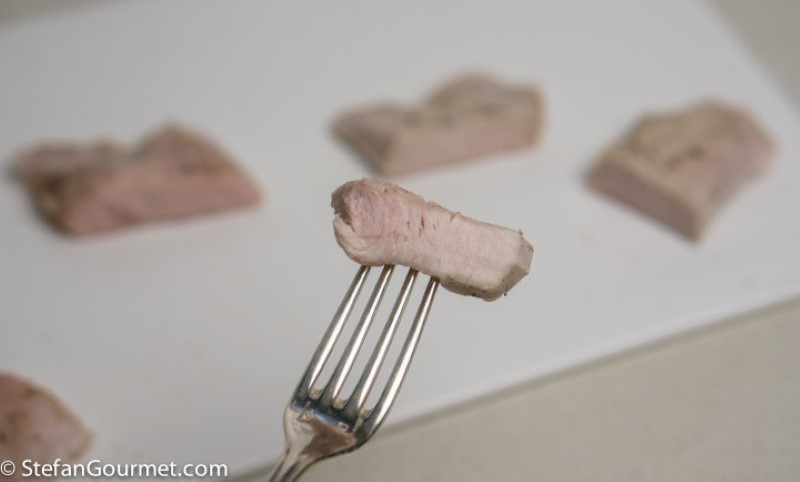
The turkey breast cooked at 64 degrees is still delicious, but not as tender and certainly not as juicy as the other. I would characterize it as ‘medium-well-done’.
It’s more like traditionally cooked turkey breast, although it’s more tender and juicier and certainly overcooked, as it often can be. If your guests are not so adventurous in the kitchen and prefer their meat well-cooked, this is a way to give them a better-cooked piece of meat, even though it does not hit as well as the piece cooked at 56 degrees.