
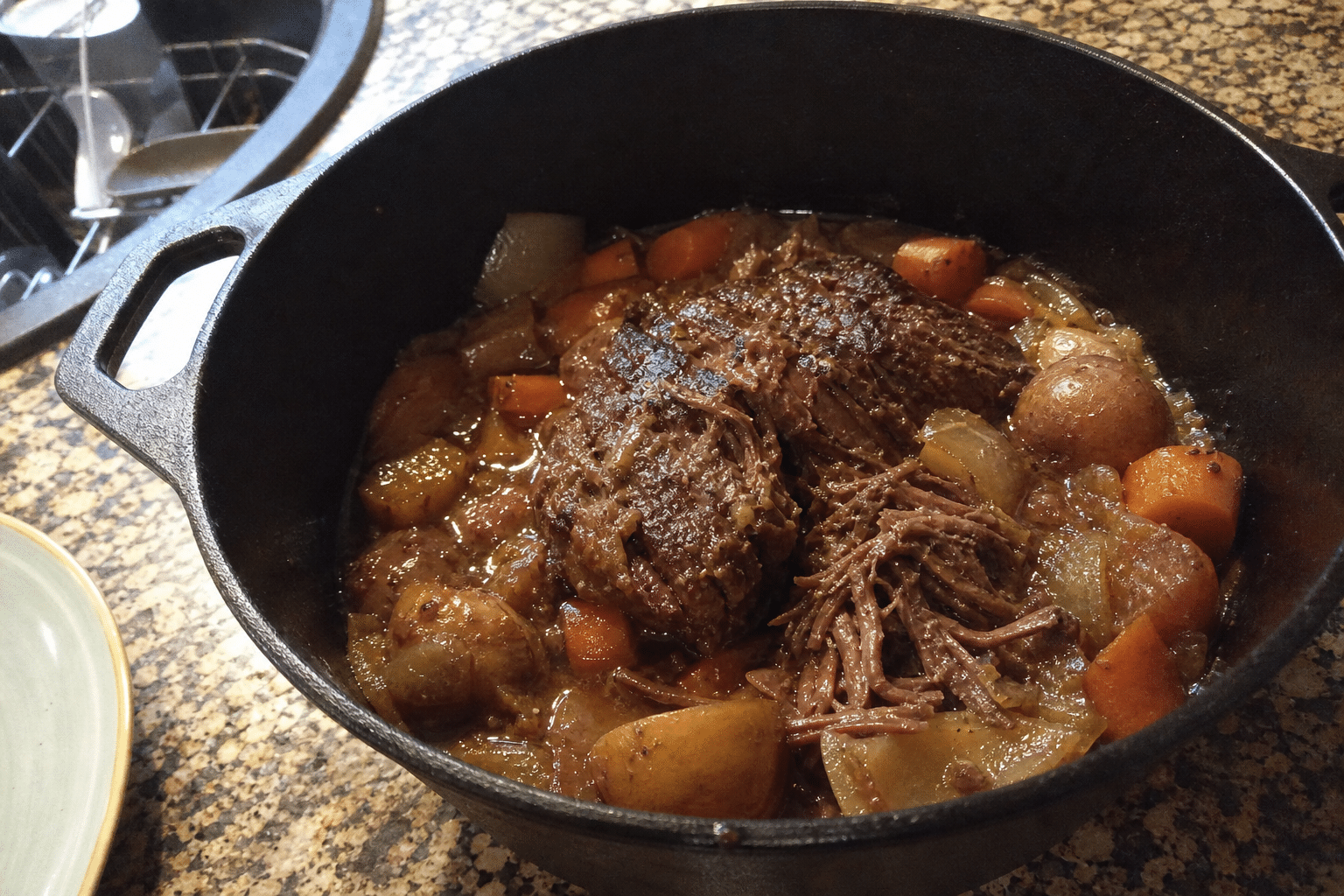

Chuck roast is the cut that makes pot roast what it is. The shoulder is threaded with connective tissue that slowly dissolves into rich, silky gelatin over three-plus hours of low oven heat, turning a tough, inexpensive piece of beef into something that yields to a fork and coats everything around it.
The root vegetables – carrots, potatoes, parsnips, and onions – are all at their peak in winter, which makes this dish perfectly timed for cold Sundays. Everything goes into one heavy pot, and the braising liquid becomes its own sauce.
Why this recipe works
Two steps, both done before the pot goes in the oven, are where the flavor is built.
The first is the sear. Patting the roast completely dry and searing it over high heat for three to four minutes per side creates a deeply browned crust. That crust, formed through the Maillard reaction, is where most of the complex savory flavor lives.
A pale, unbrowned roast cooked in liquid is boiled beef. Brown it properly first and it is something else entirely.
The second is the deglaze. After the roast comes out of the pan, the bottom is covered in browned, caramelized bits called the fond. A splash of liquid and a wooden spoon lifts every bit of that back into the pot before the meat goes back in.
After that, the oven does the work. At 300°F (150°C), the liquid stays just below a rolling boil – hot enough for the collagen in the chuck to convert to gelatin over time, but not so aggressive that the muscle fibers seize and tighten. The result is meat that pulls apart rather than fights back.
Read more: Sea salt vs table salt: a registered dietitian’s honest answer
Ingredients
Serves 6
- 3 1/2 to 4 lb (1.6 to 1.8 kg) boneless beef chuck roast
- 2 tsp kosher salt
- 1 tsp freshly ground black pepper
- 2 tbsp neutral oil (vegetable or canola)
- 1 large yellow onion, cut into thick wedges
- 4 garlic cloves, smashed and peeled
- 2 tbsp tomato paste
- 2 tbsp all-purpose flour
- 1 cup (240 ml) dry red wine, or additional beef broth
- 2 cups (480 ml) low-sodium beef broth
- 4 large carrots (about 1 lb/450 g total), cut into 2-inch (5 cm) chunks
- 3 medium Yukon Gold potatoes (about 1 1/2 lb/680 g total), quartered
- 2 medium parsnips (about 10 oz/280 g), cut into 2-inch (5 cm) chunks
- 4 sprigs fresh thyme
- 2 sprigs fresh rosemary
Instructions
1. Heat the oven to 300°F (150°C). Pat the roast completely dry with paper towels – moisture is the enemy of a good sear. Season generously all over with the salt and pepper.
2. Heat the oil in a large Dutch oven over medium-high until shimmering. Sear the roast until deeply browned on all sides, 3 to 4 minutes per side. Do not move it, crowd it, or rush it. Transfer to a plate.
3. Reduce the heat to medium. Add the onion wedges and cook, stirring occasionally, until softened and lightly browned at the edges, about 4 minutes. Add the garlic and tomato paste and stir constantly until the paste darkens and smells slightly caramelized, about 1 minute. Sprinkle in the flour and stir to coat everything.
4. Pour in the wine (or broth) and scrape the bottom of the pot with a wooden spoon to lift every browned bit. Let it bubble and reduce for 2 minutes, then pour in the beef broth.
5. Nestle the roast back into the pot. The liquid should come about one-third of the way up the sides of the meat. Tuck the thyme and rosemary around it. Bring to a bare simmer, then cover tightly and transfer to the oven.
Read more: The science behind why bread stales faster in the fridge than on the counter
6. Braise for 2 hours. Remove the lid, add the carrots, potatoes, and parsnips around the roast, then replace the lid and continue braising until the vegetables are fully tender and the beef pulls apart easily with two forks, another 1 to 1 1/2 hours (3 to 3 1/2 hours total).
7. Use an instant-read thermometer to verify the roast has reached at least 145°F (63°C) at its thickest point, and let it rest uncovered for at least 3 minutes before serving.
For braised chuck, the internal temperature will read well above 190°F (88°C) by the time it is genuinely fork-tender – the USDA minimum of 145°F is the safety floor; this roast needs to go far beyond it for the collagen to convert fully.
8. Discard the herb sprigs. Taste the braising liquid and adjust salt. Serve the beef sliced or pulled apart, with the vegetables and a generous ladle of the pan juices.
Tips and variations
Use chuck, not round. Chuck roast from the shoulder is the right cut here. Its high connective tissue content is what gives the braising liquid its body and the meat its fall-apart texture. A leaner cut like top round will not achieve the same result and can turn dry.
Read more: These slow-cooked beef short ribs practically make themselves, and they’re perfect for the holidays
According to the USDA FSIS, chuck is a cut that requires moist heat cooking methods like braising.
Add the vegetables in the final hour. Root vegetables need 60 to 90 minutes in a braise – add them too early and they go to mush. The 2-hour mark, with 1 to 1 1/2 hours still to go, is the right window.
No wine on hand. Use all beef broth. The wine adds acidity and background complexity, but a good low-sodium broth alone will produce a rich, satisfying sauce.
Make it a day ahead. Pot roast improves overnight. Cool completely, then refrigerate in its braising liquid – the fat solidifies on top and can be lifted off cleanly. Reheat covered over low heat or in a 300°F (150°C) oven until it reaches an internal temperature of 165°F (74°C).
Storage. Keep leftovers in an airtight container in the refrigerator for 3 to 4 days, or freeze for up to 6 months.
Gluten-free swap. Replace the 2 tablespoons of flour with 1 tablespoon of cornstarch stirred into 2 tablespoons cold water. Add the slurry to the braising liquid during the final 15 minutes of cooking rather than at the start.