
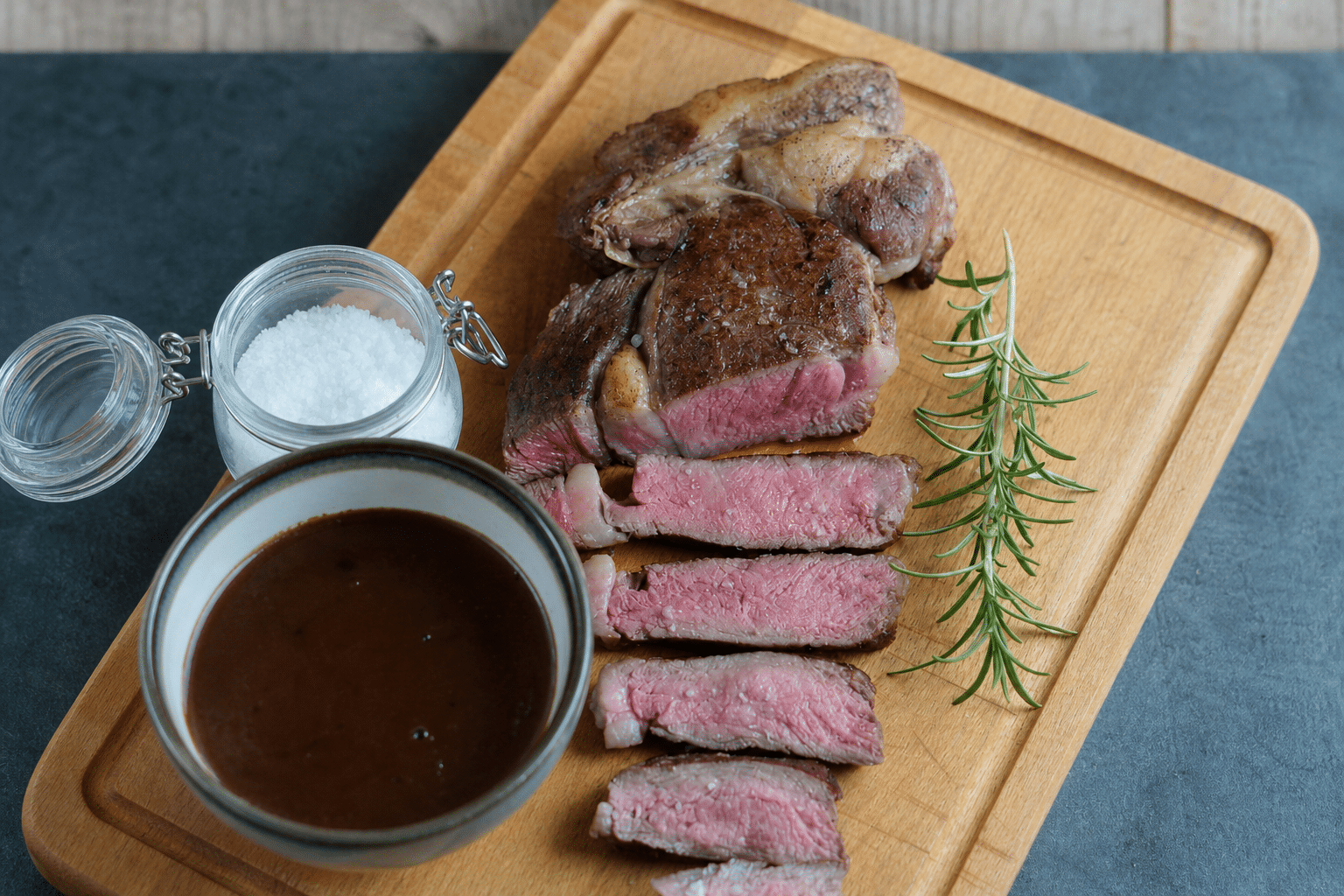

That gap is real, and it’s reproducible. The techniques are dry aging and sous vide, and once you have used them together, the results will genuinely change how you think about cooking steak. Here is how both work, and why the step between them matters just as much as either one.
Trick one: dry aging builds flavor from the inside out
The ribeye I use in this recipe is dry-aged for 15 days. During that time, natural enzymes inside the meat work to break down the structures of the muscle fibers, making the beef progressively more tender. The flavor concentrates and deepens at the same time.
At 15 days, the effect is real but not aggressive. You get a richer, rounder beef flavor without the pronounced, funky edge that comes with longer aging periods. It is a good entry point if you are sourcing dry-aged beef for the first time from a specialty butcher.
If dry-aged ribeye is not available, a vacuum-aged supermarket ribeye works as a substitute. You will not get the same depth of flavor or tenderness boost, but the sous vide and sear will still produce a steak far better than a standard pan-only cook.
Trick two: sous vide for edge-to-edge precision
Sous vide means the beef is vacuum-sealed and cooked in a water bath held at a precise, constant temperature. For medium-rare, I cook at 131°F (55°C) for two to three hours, depending on the thickness of the cut.
What you end up with is a steak at the same perfect pink from edge to edge. No grey band. No dry overcooked layer under the crust. No guesswork. That consistency is exactly what professional kitchens rely on.
One food safety note: the USDA minimum for whole beef cuts is 145°F (63°C) with a 3-minute rest. Sous vide at lower temperatures achieves food safety through extended time at temperature rather than a brief peak. If you prefer to stay within the standard USDA guideline, cook the steak to 145°F.
The step that makes or breaks the sear
When the steak comes out of the water bath, it is perfectly cooked inside — and completely wet outside. Put that wet surface on a hot pan and you are not searing; you are steaming. Surface moisture makes it nearly impossible to form a proper crust, and that crust is what you are after.
Pat the steak completely dry with paper towels before it goes anywhere near the pan. Really dry. Take your time with it and get every bit of moisture off the surface.
Get a heavy pan as hot as it will go. Stand the steak on the fat edge first and let it render for 30 to 45 seconds. Then lay it flat and sear all surfaces in the rendered fat, adding a little ghee or neutral oil alongside. Keep the sear short and hard — the steak is already cooked through; this step is only about building the crust.
Rest for a minute or two, then slice thin against the grain. I finish each slice with a few flakes of salt.
The full plate: potato roses and Madagascar green peppercorn sauce
This recipe comes together as a proper restaurant plate. The potato roses are thin slices of potato rolled into cylinders, baked in butter and thyme until they fan out and crisp at the edges. The sauce is built from Madagascar green peppercorns, rosemary, and red wine, finished with cream and gastrique (a sweet-sour reduction of sugar and vinegar that balances the richness of the sauce).
Serves 3
Ingredients
Ribeye steak
- About 1¼ pounds (600g) ribeye, ideally dry-aged
- Salt and pepper
- Ghee or neutral oil for searing
- Flake salt to finish
Potato roses
- 4 medium potatoes
- 3½ tablespoons (50g) butter, melted, plus extra for the pan
- Fresh or dried thyme
- Salt and pepper
Madagascar green peppercorn sauce
- 1 onion, finely chopped
- 1 garlic clove, finely chopped
- 1 tablespoon (9g) Madagascar green peppercorns, divided
- Butter and oil for the pan
- 1¼ cups (300ml) beef stock
- 3 tablespoons (40ml) cognac, rum, or whiskey
- ¾ cup (200ml) red wine
- 1 rosemary sprig
- 1¼ cups (300ml) water
- 1 teaspoon (5g) gastrique, or a small splash of red wine vinegar with a pinch of sugar
- Scant ½ cup (100ml) heavy cream
- Salt and pepper
Instructions
Steak
- Season the ribeye with salt and pepper. Vacuum-seal and cook sous vide at 131°F (55°C) for 2 to 3 hours.
- Remove from the bag. Pat the surface completely dry with paper towels — every bit of moisture off.
- Heat a heavy pan until very hot. Stand the steak on the fat edge and sear for 30 to 45 seconds until the fat renders and browns. Lay it flat and sear all surfaces in the rendered fat with a little ghee or neutral oil. Keep the sear short and hard.
- Rest for 1 to 2 minutes, then slice thin against the grain. Top each slice with flake salt.
Potato roses
- Slice the potatoes as thin as possible — a mandoline works best. Brush the slices with melted butter and season with thyme, salt, and pepper.
- Lay several slices in an overlapping row, roll into a tight cylinder, and stand upright in a buttered muffin tin. Repeat with the remaining slices.
- Bake until the potatoes are cooked through and the edges are golden and crisp.
Madagascar green peppercorn sauce
- Sauté the onion, garlic, and roughly half the peppercorns in butter and oil over medium heat until softened.
- Add the alcohol and carefully flambé, or just let it reduce down if you prefer not to.
- Add the rosemary, beef stock, red wine, and water. Simmer for at least 30 minutes.
- Strain through a fine-mesh sieve, discarding the solids. Add the cream and reduce briefly until the sauce coats the back of a spoon.
- Season with the gastrique, salt, and pepper. Stir in the remaining whole peppercorns just before serving.