
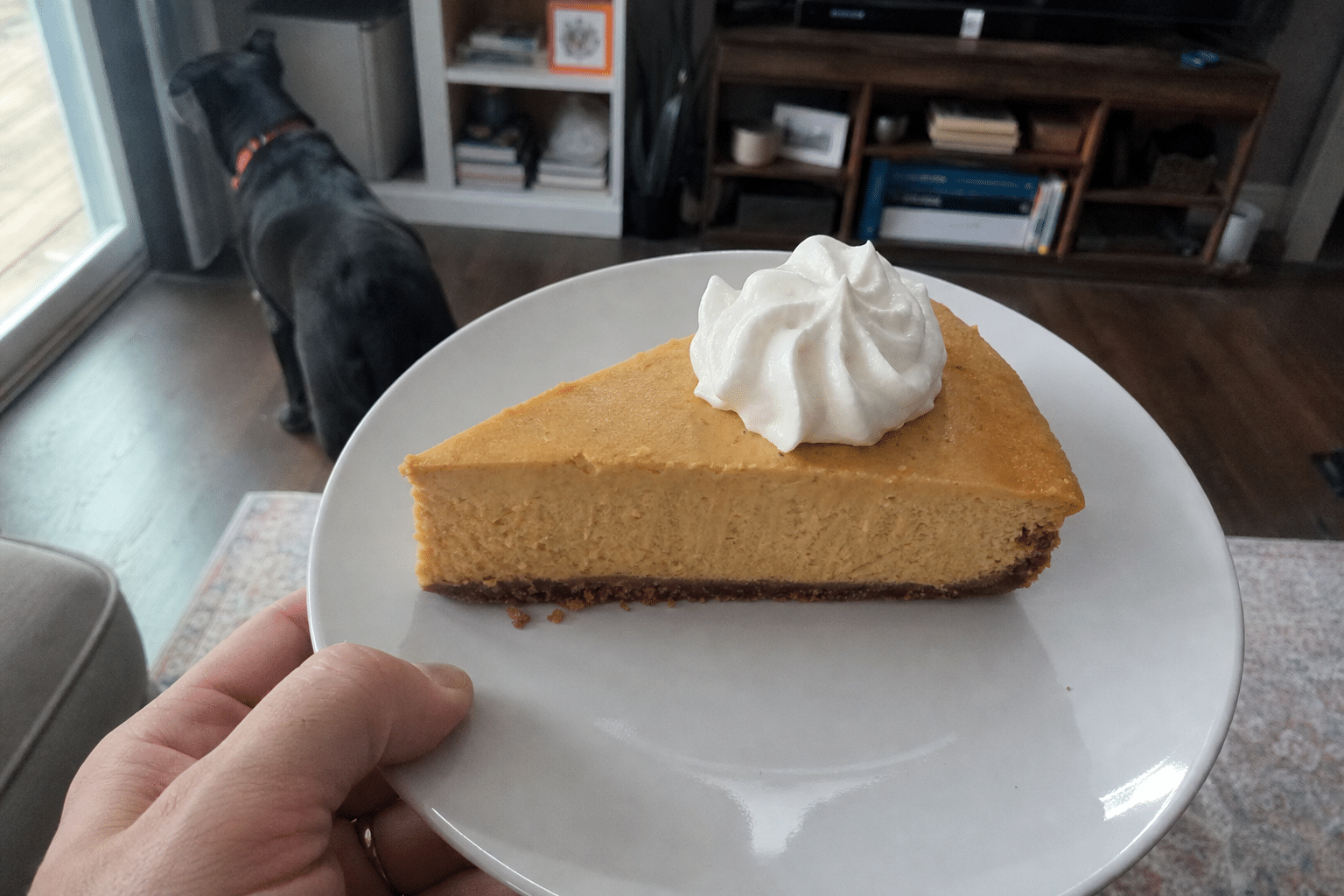

Pumpkin pie has held the holiday dessert spot for generations, but there is a strong case for its creamier cousin. This baked pumpkin cheesecake has a buttery graham cracker crust, a silky filling loaded with warm spice, and a texture that slices perfectly clean after an overnight chill. It is make-ahead by design, which means less stress on the day itself.
The technique is straightforward once you understand three things: why the cream cheese needs to be at room temperature, why you bake in a water bath, and why patience overnight is not optional. Get those right and the rest takes care of itself.
Why this recipe works
Cold cream cheese is the enemy of a smooth cheesecake. Even a powerful stand mixer cannot fully break down chilled blocks – what you get is a grainy, lumpy filling that no amount of additional beating can rescue. Two hours on the counter before you start is the single most important step in this recipe.
The water bath solves the other classic cheesecake problem: uneven heat. A direct oven bake drives the temperature up fast at the edges while the center is still raw, forcing you to choose between overcooked sides and an underdone middle. Surrounding the pan with hot water brings the heat up gently and evenly, and the added humidity keeps the top from drying and cracking.
An overnight chill is not optional. The filling continues to firm up well after it comes out of the oven. A warm or barely-chilled cheesecake slices ragged; one that has had a full night in the refrigerator cuts cleanly with a single press of the knife.
Ingredients
For the crust
- 1½ cups (150 g) graham cracker crumbs (about 12 full crackers, finely crushed)
- 3 tablespoons granulated sugar
- 6 tablespoons (85 g) unsalted butter, melted
For the filling
- 24 oz (680 g) full-fat block cream cheese, at room temperature (3 standard 8 oz blocks)
- 1 cup (200 g) granulated sugar
- 1 cup (240 g) pure pumpkin puree (not pumpkin pie filling)
- 3 large eggs, at room temperature
- ½ cup (120 ml) full-fat sour cream, at room temperature
- 2 teaspoons pumpkin pie spice
- 1 teaspoon pure vanilla extract
- ¼ teaspoon fine salt
Instructions
1. Set cream cheese, eggs, and sour cream on the counter at least 2 hours before you plan to mix. This step is non-negotiable.
2. Preheat the oven to 325°F (165°C). Wrap the outside of a 9-inch (23 cm) springform pan in two tight layers of heavy-duty aluminum foil, pressing it well up the sides – this keeps water out during the water bath step.
Read more: The corn casserole you stir together in five minutes for a soft, sweet holiday side
3. Stir together the graham cracker crumbs, sugar, and melted butter in a bowl until the mixture looks like wet sand. Press it firmly and evenly into the bottom of the prepared pan and about 1 inch (2.5 cm) up the sides. Bake for 10 minutes until lightly set, then set aside to cool while you make the filling.
4. Beat the room-temperature cream cheese in a large bowl with an electric mixer on medium speed until completely smooth and lump-free, about 3 minutes. Stop and scrape down the sides and bottom of the bowl. Add the sugar and beat on medium for 2 more minutes.
5. Add the pumpkin puree and mix on low speed until just combined. Switch to adding the eggs one at a time, mixing on low after each just until incorporated. Do not overmix once the eggs are in – extra air folded into the batter causes cracks in the finished cheesecake.
6. Add the sour cream, pumpkin pie spice, vanilla, and salt. Mix on low until the filling is smooth and even. Scrape down the bowl once more and give it a final brief mix.
7. Pour the filling over the cooled crust and smooth the top. Set the foil-wrapped springform pan inside a large roasting pan. Slide the roasting pan into the oven, then pour enough hot tap water into the roasting pan to come about 1 inch (2.5 cm) up the outside of the springform pan.
Read more: Rich turkey noodle soup: the best thing to do with Thanksgiving leftovers
8. Bake for 60 to 70 minutes. The cheesecake is done when the outer 2 inches are set and the center still has a slight jiggle when you nudge the pan gently. Use an instant-read thermometer inserted at the center to confirm the filling has reached 160°F (71°C), the USDA FSIS safe minimum internal temperature for egg dishes.
9. Turn off the oven, crack the door open about 1 inch, and leave the cheesecake inside for 1 hour. This gradual cool-down prevents the surface from contracting suddenly and cracking.
10. Carefully lift the springform pan out of the water bath and remove the foil. Run a thin knife around the perimeter of the cheesecake to free it from the pan sides – this also prevents cracking as the filling contracts further during chilling. Cool to room temperature on a wire rack.
11. Refrigerate uncovered for at least 8 hours, and ideally overnight. Before serving, remove the outer ring of the springform pan. Slice with a sharp knife, running it under hot water and wiping it clean between each cut.
Tips and variations
Make ahead. This cheesecake actually improves with time. Make it up to 2 days before Thanksgiving, refrigerate, and cover loosely with plastic wrap once it is fully chilled.
Read more: How to reheat mashed potatoes so they turn out creamy, not dry or gluey
No-crack checklist. Four things help here: (1) the foil wrap keeps water out of the crust, (2) not overmixing after the eggs go in keeps air out of the filling, (3) the oven-resting step prevents sudden temperature shock, and (4) running the knife around the edge before refrigerating lets the filling pull away from the pan cleanly as it firms.
Spice adjustments. For more complexity, replace the pumpkin pie spice with 1 teaspoon cinnamon, ½ teaspoon ground ginger, ¼ teaspoon ground nutmeg, and ¼ teaspoon ground cloves. A pinch of black pepper adds warmth without being identifiable.
Toppings. Softly whipped cream is the classic pairing. A drizzle of salted caramel sauce works well too, added just before serving so it does not soak into the top.
Storage. Refrigerate covered for up to 4 days. For longer storage, wrap individual slices tightly in plastic wrap, then foil, and freeze for up to 1 month. Thaw overnight in the refrigerator before serving.
Allergens. Contains dairy (cream cheese, butter, sour cream), gluten (graham crackers), and eggs. For a gluten-free crust, substitute certified gluten-free graham crackers in the same quantity.