
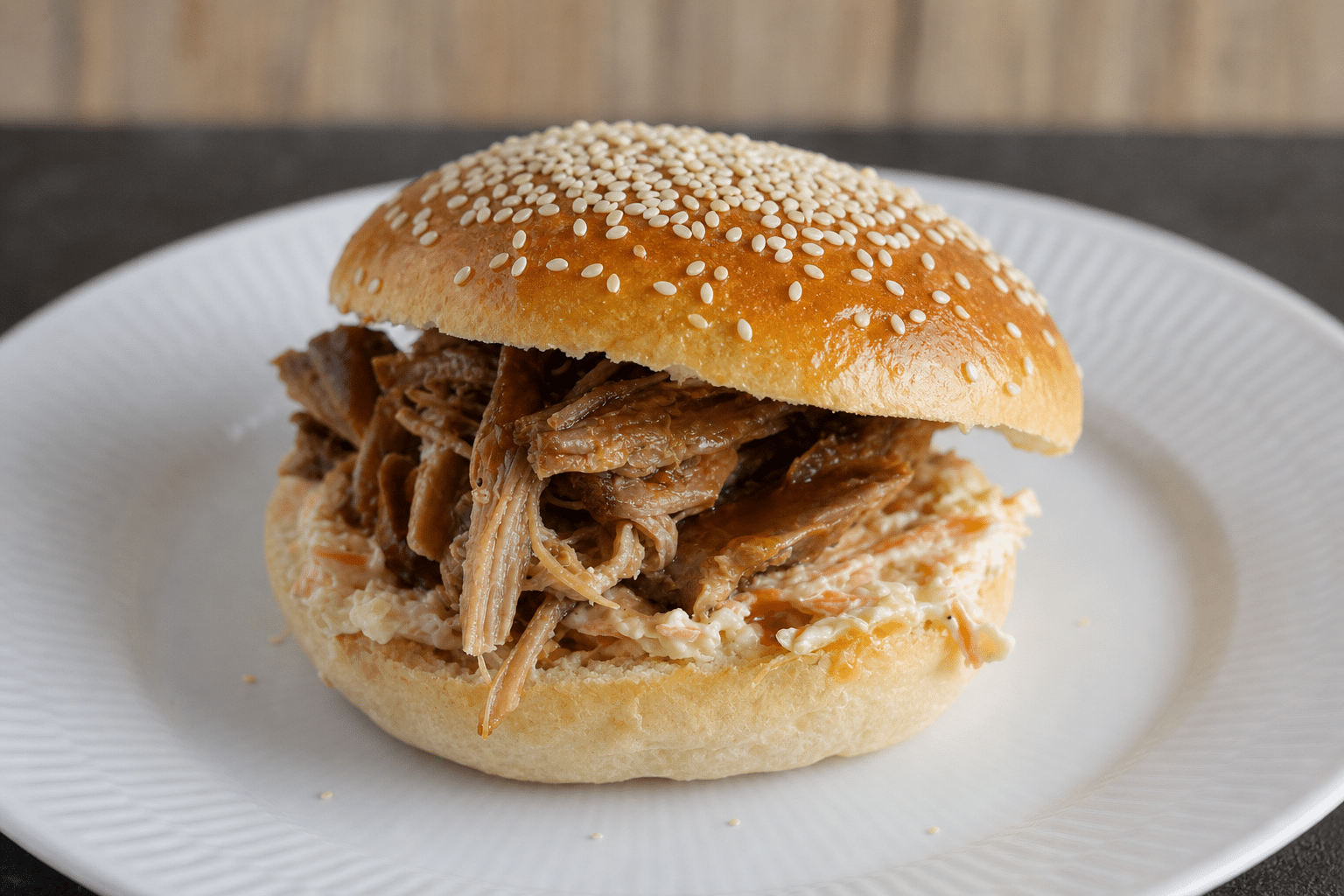

Pulled pork sounds like a weekend project for people with dedicated smokers and all-day ambitions. It really isn’t. It requires planning and patience, yes, but the technique itself is surprisingly simple. Once the pork goes into the oven, most of that time is just waiting. I love that about this recipe.
The flavor comes from building it in layers. First, a cold brine of salt, sugar, and aromatics works moisture deep into the meat. Then a paprika-cumin dry rub forms a dark, spiced crust. Then 14 hours at low heat in the oven until the pork practically falls apart on its own. Piled onto a brioche bun with coleslaw and a good BBQ sauce, it beats anything from a food truck, easily.
Why this recipe works
Pork neck fillet is the ideal cut for this. In the US the closest equivalent you’ll find is pork shoulder (Boston butt) – look for a cut with heavy fat marbling running through it, since that fat is what keeps the meat moist and tender through such a long, slow cook.
The brine is the most underrated step. Submerging the pork in a salt-sugar solution for 8 to 12 hours lets the seasoning penetrate all the way through the muscle, not just the surface. It also helps the meat hold onto moisture during the long roast. You can skip it – it’s not strictly required – but the difference is real and I’d always recommend it.
Cooking at 230°F (110°C) keeps the internal temperature climbing slowly enough that the collagen in the meat has time to break down into gelatin rather than seizing up and drying out. After 14 hours, the pork will reach an internal temperature of around 195-205°F (90-96°C) at its thickest point – far above the USDA safe minimum of 145°F (63°C) for whole pork cuts, and right in the range where pulled pork shreds cleanly off the bone.
The last 15-20 minutes at high heat is what turns the rub into a proper crust. Don’t skip it.
Read more: The one folding step that finally makes homemade white bread rise properly
Ingredients
For the brine:
- 2 quarts (2 liters) cold water
- 1/3 cup fine salt (3.5 oz / 100 g)
- 1/3 cup granulated sugar (2.5 oz / 70 g)
- 10 whole black peppercorns
- 4 bay leaves
For the dry rub:
- 4 tablespoons brown sugar
- 3 tablespoons sweet paprika
- 1 tablespoon smoked paprika
- 1 teaspoon ground cumin
- 1 teaspoon garlic powder
- 1 teaspoon onion powder
- 1 teaspoon chili powder
For the pork:
– 2.2 pounds (1 kg) pork neck fillet, Boston butt, or pork shoulder – Iberico pork if you can find it, regular pork works fine
For assembly:
- 6 brioche buns
- Coleslaw
- BBQ sauce
- A splash of apple cider vinegar (to drizzle over the shredded meat)
Instructions
1. Make the brine. Combine the water, salt, sugar, peppercorns, and bay leaves in a large pot. Stir until the salt and sugar fully dissolve. Let it cool to room temperature, then refrigerate until completely cold.
2. Brine the pork. Submerge the pork in the cold brine. Cover and refrigerate for 8 to 12 hours.
3. Apply the dry rub. Remove the pork from the brine and pat it thoroughly dry with paper towels – the drier the surface, the better the crust will form. Mix all dry rub ingredients together. Press and massage the rub across every surface of the meat, working it into any folds or crevices.
4. Start the low-and-slow roast. Place the rubbed pork on a rack set inside a roasting pan. Put it in a cold oven (do not preheat). Set the temperature to 230°F (110°C) and roast for 14 hours.
Read more: Soffritto: the Italian base that makes pasta sauces, stews, and soups taste restaurant-quality
5. Check for doneness. At the 14-hour mark, probe the thickest part of the pork with a meat thermometer. You want 195-205°F (90-96°C). At this point the collagen has fully dissolved and the meat will shred with almost no effort.
6. Blast the crust. Switch the oven to convection and crank it to 400°F (200°C). Roast for 15 to 20 minutes, until the rub is dark and slightly crispy on the outside. Watch it closely during this final stage.
7. Rest and shred. Pull the pork from the oven and let it rest for 15 minutes. Using two forks, shred the meat apart. Drizzle a small splash of apple cider vinegar over the shredded pork to cut through the richness.
8. Build the burgers. Lightly toast the brioche buns. Load the bottom bun with a generous pile of pulled pork, top with coleslaw, add BBQ sauce, and serve immediately.
Serves 6. Total cooking time: about 14 hours 30 minutes (mostly inactive). Add 8-12 hours for the brine.
Read more: The chef’s trick for oven-baked salmon with pesto herb butter, done in 30 minutes
Tips and variations
Plan your timing. The simplest schedule: brine the pork overnight, start the oven early the next morning at 230°F, and eat by dinnertime. Or brine in the morning and roast overnight for a lunchtime feast.
Add smoke if you can. If you have a grill with a lid and a handful of wood chips, cold smoking the pork for a couple of hours after brining and before the oven adds real depth to the flavor. That said, even without smoke, the result is genuinely excellent. The rub does the heavy lifting.
Is brining really necessary? Not strictly. But it adds moisture and seasons the meat through to the center. Skip it if time is short, knowing the result will be a little less juicy and evenly seasoned.
Don’t skip the cold oven start. Beginning in a cold oven lets the temperature climb gradually, giving the meat a gentler start through the critical low-temperature window. This is a small thing that makes a real difference to the texture.
Store and reheat. Pulled pork keeps well. Refrigerate leftovers in an airtight container with a spoonful of the roasting juices for up to 4 days. Reheat covered in a pan over low heat with a small splash of water until hot through.