
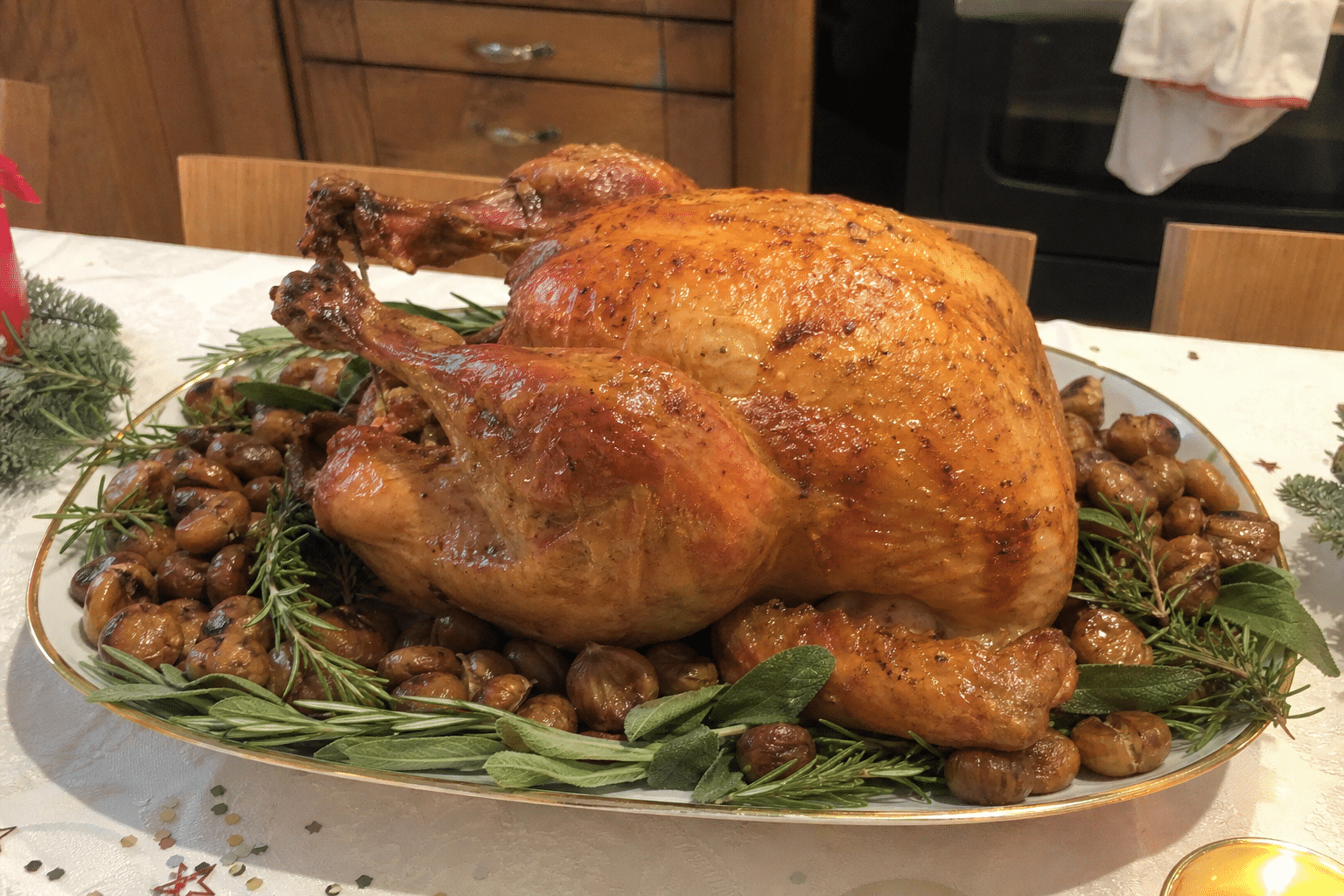

In France, the holiday bird is often dinde aux marrons, turkey with chestnuts, and it is a quietly elegant thing. Sweet, earthy chestnuts go into the stuffing and around the bird, and they give the whole dish a richness that feels special without being fussy.
It is a lovely way to dress up a Thanksgiving turkey and nudge it toward something more refined. The method is classic roasting; the chestnuts do the transforming. Here is how I make it.
What you need
- 1 whole turkey, about 12 to 14 lb (5.4 to 6.4 kg)
- 2 cups (300 g) cooked, peeled chestnuts
- 4 tablespoons (55 g) butter
- 1 onion and 2 celery stalks, diced
- Bread, a splash of stock, and chopped thyme and parsley for the stuffing
- Salt, black pepper, and herb butter for the skin
How I make it
- Soften the onion and celery in the butter, then fold in roughly chopped chestnuts, bread, herbs, and enough stock to bind a loose stuffing.
- Bake the stuffing in a dish, or cook it inside the bird only if you will measure its temperature.
- Push herb butter under the turkey skin, salt it well, and scatter a few whole chestnuts in the pan.
- Roast at 325°F (165°C) on a rack, breast-side up.
- Cook to 165°F (74°C) in the thickest part, and if the bird is stuffed, make sure the center of the stuffing also reaches 165°F (74°C).
- Rest it for 20 minutes before carving.
How to get it right every time
- Use cooked chestnuts. Vacuum-packed or jarred chestnuts save a lot of fiddly peeling.
- Bake stuffing separately. A dish crisps better and sidesteps the food-safety worry of stuffing inside the bird.
- Keep it loose. A moist, loose stuffing stays tender; a dense one bakes into a brick.
- Reach 165°F. Both the turkey and any stuffing cooked inside it must hit 165°F (74°C).