
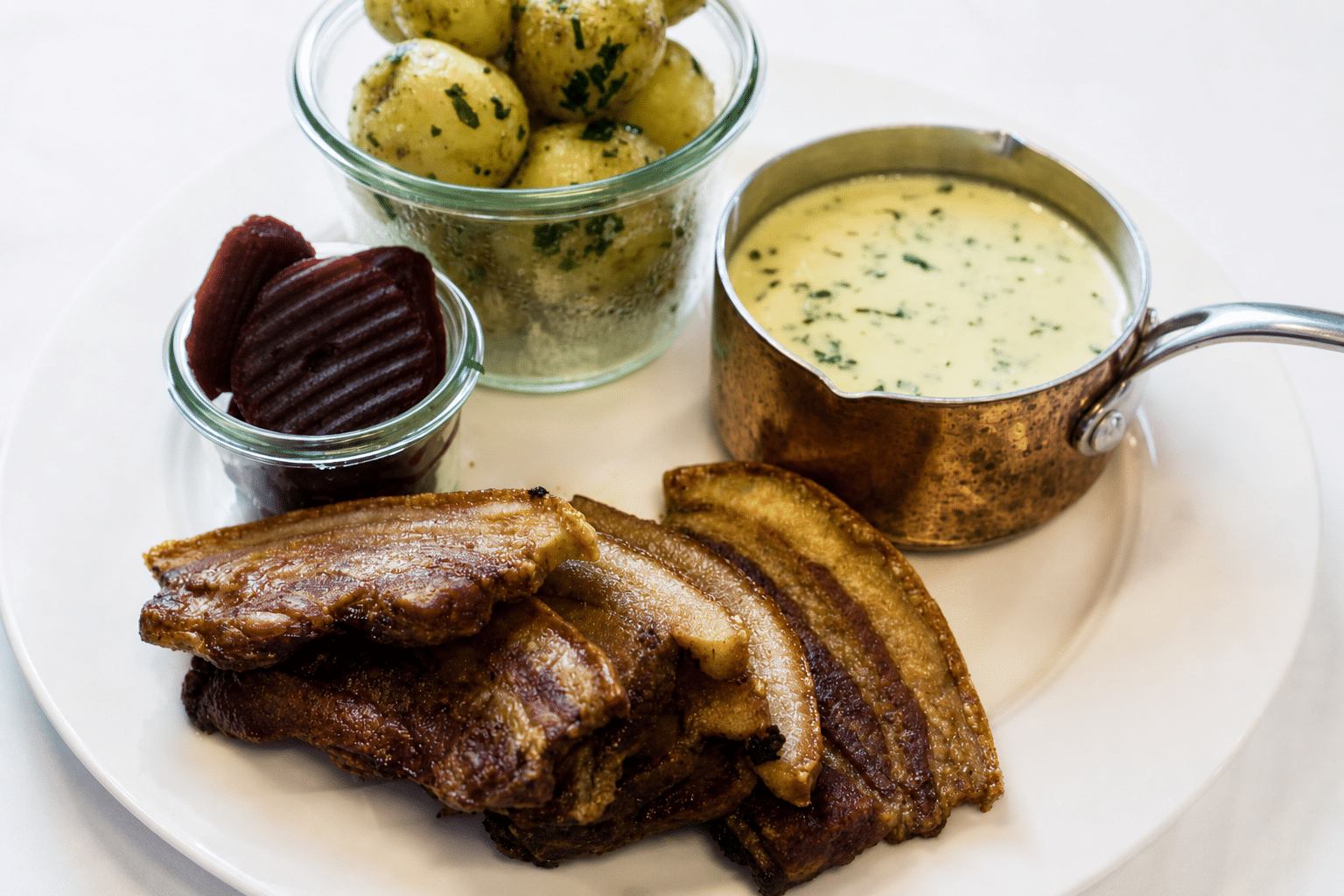

In 2014, Denmark’s then-Food and Agriculture Minister Dan Jørgensen launched a nationwide vote to find the country’s first official national dish. More than 63,000 Danes cast ballots across 24 candidates, and stegt flæsk med persillesovs – crispy fried pork belly with parsley sauce and boiled potatoes – won by a landslide, pulling in 44 percent of the total vote. Runner-up smørrebrød (the open-faced sandwich) finished well behind with 17,041 votes. The result was not really a surprise to anyone who grew up eating it.
This is not a flashy dish. It is thick-cut slabs of pork belly, fried until the fat renders and the edges shatter, served alongside floury boiled potatoes and a silky parsley sauce. It is deeply satisfying in the way that only proper comfort food can be – familiar ingredients, honest technique, nothing wasted. And pork belly has been a staple on US restaurant menus for years, so nothing here is hard to source.
A chef’s take on a classic
Chef Thomas Søndergaard Christensen of Restaurant Møllegården on Alrø island in East Jutland knows exactly how good this dish can be when it’s done right. I had the pleasure of learning his approach, and I’ll be honest – especially the parsley sauce surprised me. I had never encountered a cream-based version before, without any roux or thickening flour in sight. The result is lighter, brighter, and far more interesting than the classic.
There are small chef’s tricks throughout this recipe that genuinely make a difference. None of them are complicated, but each one matters.
Why this recipe works
The traditional parsley sauce uses a béchamel base – butter, flour, milk – which produces something thick and starchy. Thomas’s version skips the roux entirely and instead reduces heavy cream with vegetables, then finishes with lemon juice and fresh parsley. The lemon does two things at once: it brightens the flavor and naturally tightens the sauce through its acidity. No flour needed.
The pork gets a two-stage oven treatment. First, the salted slices bake together so the fat begins to render gently. Then they’re spread out on a rack, no longer touching, so each slice can release its fat without steaming against its neighbor. That second stage is where the real crispiness happens.
Read more: Homemade churros crispier than the fair stand, with the simplest dough you have ever made
And the parsley stems – most people throw them away. Here they go into the potato cooking water, quietly infusing the potatoes with a parsley note that ties the whole plate together.
Ingredients
For the pork:
- Pork belly, sliced about 5/16 inch (7-8 mm) thick (3-4 slices per person)
- Salt
For the parsley sauce:
- Heavy cream
- 1 small onion, roughly chopped
- 1 parsley root (or substitute parsnip), roughly chopped
- 1 carrot, roughly chopped
- 1-2 bay leaves
- Juice of half a lemon
- Large handful of fresh flat-leaf parsley, finely chopped
- Salt to taste
For the potatoes:
- Small waxy or new potatoes
- Parsley stems (saved from the parsley above)
- Clarified butter (or unsalted butter)
- Splash of potato cooking water
For the pickled beets (optional but recommended):
- Cooked beets, sliced
- White wine vinegar
- Dry white wine
- Sugar
- 1 cinnamon stick
- 1 star anise
- 1 bay leaf
Instructions
1. Salt the pork. Lay the pork belly slices flat and season evenly with salt on both sides. Set aside while you start the other components.
2. First bake – together. Place the salted slices side by side on a baking sheet (they can touch at this stage) and slide them into a hot oven. Bake for 10 minutes. This first phase allows the fat to begin rendering gently and evenly before the slices separate.
3. Second bake – on a rack. Transfer the slices to a rack set over a baking sheet, spacing them apart so they no longer touch. Return to the oven for another 7-10 minutes, until the pork is deeply golden and the fat has rendered fully. The pork is safe to eat when it reaches an internal temperature of 145°F (62.8°C), measured with a meat thermometer, with a 3-minute rest before serving.
Read more: Danish cream cakes from scratch: the bakery treat you can actually make at home
4. Build the sauce. Pour the cream into a saucepan and add the onion, parsley root (or parsnip), carrot, and bay leaves. Bring to a gentle simmer over medium heat and cook for about 10 minutes, stirring occasionally. The cream will reduce and absorb the flavor of the vegetables.
5. Strain and finish the sauce. Pour the reduced cream through a fine strainer, pressing on the vegetables to extract every drop; discard the solids. Return the cream to the pan and bring back to a simmer. Add the lemon juice and stir well. Fold in the fresh chopped parsley, taste for salt, and keep warm over very low heat.
6. Cook the potatoes. Bring a pot of salted water to a boil and add the parsley stems. Add the potatoes and cook until tender, about 15-20 minutes depending on size. Drain, reserving a small amount of the cooking liquid.
7. Gloss the potatoes. Melt a knob of clarified butter in a wide pan over medium heat. Add the drained potatoes and a splash of their cooking water. Toss gently until the potatoes are coated in a light gloss. You are not trying to brown them – you want a smooth, shiny surface.
Read more: Loukoumades: the Greek honey doughnuts you can fry at home in 30 minutes
8. Make the pickled beets. Combine white wine vinegar, a splash of white wine, sugar to taste, the cinnamon stick, star anise, and bay leaf in a small saucepan. Bring to a boil, stir to dissolve the sugar, then pour over the sliced beets. Set aside to cool. The beets add a sharp, spiced contrast that keeps the richness of the pork and cream in check.
9. Plate. Arrange the glossy potatoes and crispy pork on each plate. Spoon the parsley sauce generously over the potatoes. Add the pickled beets on the side.
Tips
How thick should the pork slices be? About 5/16 inch (7-8 mm), and keep them as uniform as possible. Even thickness means even rendering. Slices that are too thin will shrivel and toughen before the fat has had a chance to fully render out.
Why skip the roux in the sauce? The cream-reduction method produces a lighter, cleaner-tasting sauce. Lemon juice acts as a natural thickener through its acidity, so there is no need for flour. The result coats the potatoes beautifully without feeling heavy.
Why cook the potatoes with parsley stems? The stems carry a lot of flavor that usually gets thrown away. Dropping them into the cooking water is a simple move that gives the potatoes a subtle parsley note, linking them quietly to the sauce. Good technique with zero waste.