
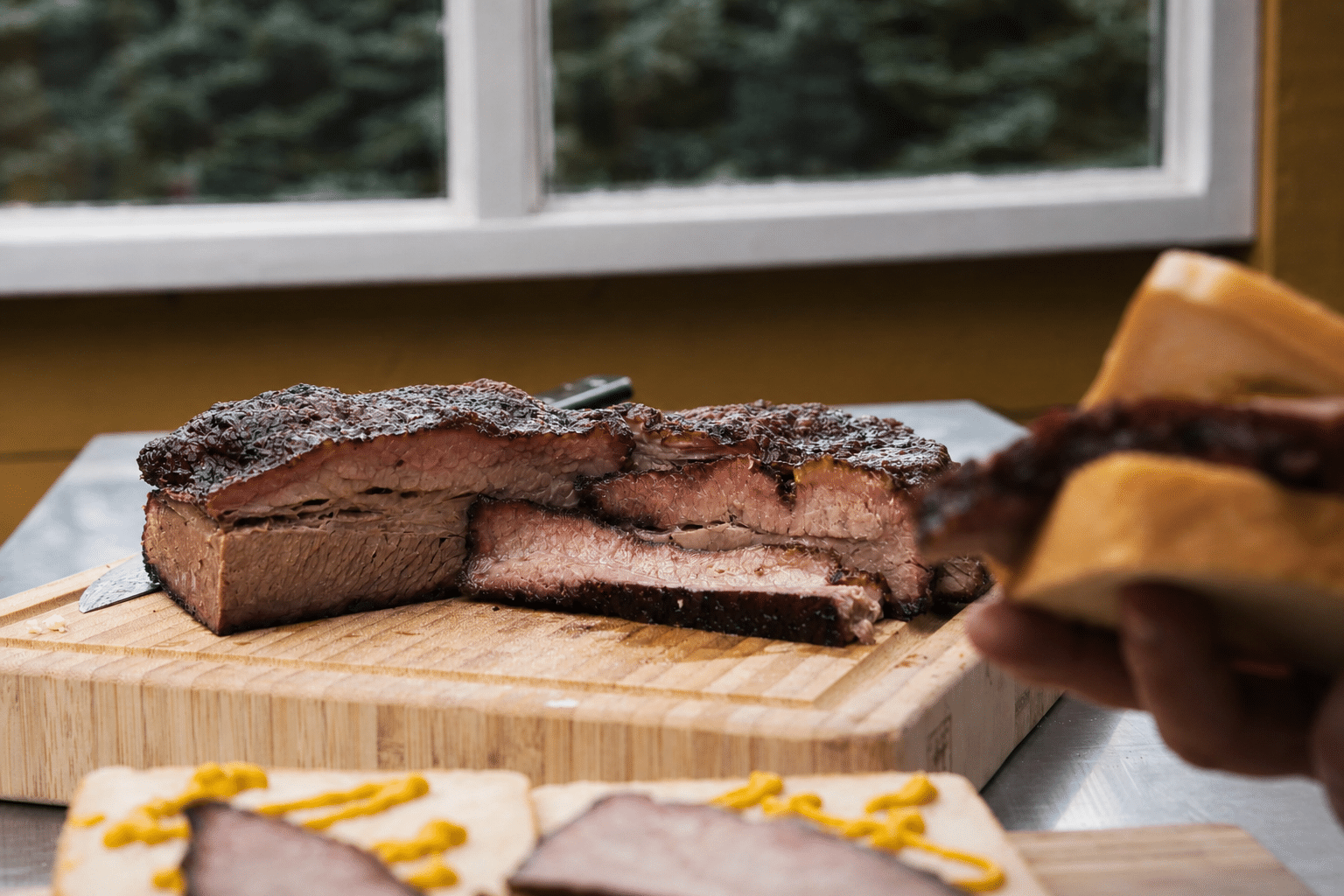

BBQ brisket is an iconic dish in American food culture and a favorite among meat lovers worldwide. The flavorful, tender, and juicy result comes from the breast of the cow and gets its very particular taste and texture through careful preparation and many hours at low temperature – what Americans call low and slow. Texas is the heartland of brisket culture, and I would argue that in Texas, BBQ – and brisket above all – is the food experience worth traveling for.
It is worth establishing from the start that brisket is not just a word for beef breast. It is a specific cut with its own particular logic. And the central point is actually simple. Time is the best ingredient.
What you’re actually buying: flat, point, and the full packer
In American BBQ, one typically talks about a full packer brisket – the whole cut, with both the flat and the point still connected. This is the version you see in Texas barbecue, in competitions, and in most classic brisket recipes.
The flat is the lean, relatively thin section. This is where you get the clean, uniform slices. It is also the part that dries out first if the preparation goes wrong.
The point is thicker, more irregular, and far more marbled with fat. This is where you get more juiciness and depth of flavor. Think of it as the part of the cut where fat and connective tissue work together as the heat slowly does its thing.
The most important thing to understand is that a full packer brisket is not one uniform chunk of meat. The structure, fat content, and shape change throughout. This is why it does not behave like an ordinary roast.
A whole packer brisket is widely available at Costco, restaurant supply stores, and specialty butchers. When you buy one, look for flat and point still connected – the full packer, designed for low-and-slow cooking.
The BBQ vocabulary: low and slow, rub, and bark
When you read about brisket, you run into the same handful of words almost immediately: low and slow, smoker, bark, rub. This can sound like a whole private language. The thinking behind it is straightforward.
Barbecue is fundamentally about taking a hard-working cut and giving it what quick cooking cannot: time. Not high heat, not fuss – just enough time for fat and connective tissue to slowly change character.
The key terms:
- Low and slow: Low temperature over a long time. This is the entire idea. You give the meat the time it needs for fat and connective tissue to break down.
- Smoker: The grill or smoke oven you use to cook the meat with indirect heat and smoke.
- Rub: A dry spice blend you apply to the meat before cooking. It also functions as a dry brine, especially when salt is a primary ingredient. The Texas tradition leans minimalist – coarse salt and cracked black pepper is a classic foundation.
- Bark: The dark, concentrated surface that forms as smoke, spice, fat, and time work together. It provides real contrast to the soft interior.
- Full packer brisket: The whole cut, flat and point still connected.
Here is the key point: brisket only makes sense as barbecue, not as a roast that simply needs more time.
Read more: No-bake blueberry cheesecake with a tangy compote topping and no gelatin
Why brisket demands so much time
Brisket requires a different approach than most beef because the cut is loaded with connective tissue and comes from a part of the animal that works constantly. If you treat it like a regular roast, you will almost always be disappointed.
This does not mean brisket is complicated. It means you need to treat it on its own terms.
Give it too little time and it comes out dry, compact, and tough. Give it enough time and patience, and the connective tissue and fat start working with you instead of against you. The collagen – the protein that makes the cut chewy when cooked too quickly – converts to gelatin. That gelatin, together with melted fat, lubricates the meat and creates the tender, juicy bite that makes brisket worth the effort.
The practical targets: a smoker or oven temperature of 225-250°F (107-121°C) and an internal meat temperature of around 200-205°F (93-96°C) for the collagen to fully break down. Start checking with a probe around 195°F (90°C) – you are looking for feel as much as number. When a probe slides into the thickest part of the flat with almost no resistance, the brisket is done.
For food safety, the USDA minimum internal temperature for beef steaks and roasts is 145°F (63°C) with a three-minute rest. For genuine BBQ brisket, you will always cook well past that point.
This is also why brisket has such a central place in BBQ culture. Not because it is fancy, but because you can taste exactly what time does. A cut that starts coarse and tough ends up tender, juicy, and sliceable – all because you gave it what it needed.
Trimming: the step that shapes the whole cook
Before you start cooking, brisket is typically trimmed. This does not mean cutting away all the fat – quite the opposite.
What you want is control over the very thick fat deposits, loose flaps, and irregular patches that would otherwise make the cooking uneven. The goal is a more uniform cut that responds more predictably to heat. You do not need to get obsessive about it, but it is one of those details that consistently makes a noticeable difference in the final result.
Read more: Cilbir: the Turkish brunch dish with poached eggs on cold garlic yogurt and warm chili oil
Three ways to cook brisket at home
On a smoker or kettle grill
The classic BBQ route is brisket cooked over low, indirect heat in a smoker or kettle grill. This is where you get the smoke flavor, the bark, and the character most people associate with real BBQ brisket. It is also the method closest to the Texas tradition.
It requires more attention. Temperature, airflow, and time all have to work together, and it is not the easiest starting point if you have not done much long-cook grilling. But if you already have a handle on indirect heat and temperature control on your grill, this is the method that delivers the most authentic result. Set your grill or smoker to 225-250°F (107-121°C) and use wood chunks or chips alongside your charcoal – oak is the traditional Texas choice.
In the oven
If you do not have a smoker, the oven is a practical and honest way to get to know the cut. You will not get the same bark or smoke profile, and you will not get the same BBQ result. That trade-off is real and worth acknowledging. But you can still learn a great deal from working with brisket this way – and the oven gives you one significant advantage: it is consistent and easy to control.
This is not the same as classic BBQ. But it is a sensible entry point.
Sous vide with a grill finish
Sous vide is the most controlled and technical route. You use precise temperature control to work on tenderness, then finish the brisket over high heat on a grill or under a broiler to build surface color and character. It can be a useful method if you want to minimize uncertainty, but brisket also needs character – not just tenderness.
Which method should you start with?
If you already have a grip on your grill and indirect heat, it makes good sense to start with the smoker or kettle grill. That is where you get the most authentic BBQ expression.
If you do not have that yet, the oven is a more manageable way to get acquainted with the cut. Not because it gives the same result as a smoker, but because you can focus on the process and learn how the meat behaves over time without managing fire at the same time.
The most important thing is not starting with the most advanced setup. It is starting with a method you can actually control.
Read more: Carnitas at home in about an hour, using a pressure cooker and orange-chipotle marinade
What you’re aiming for
A good brisket should not just be tender. It should also have structure. When you slice it, the slices should hold together but still give way. Too little time and it seems tight and dry. Too much and it loses firmness and starts to fall apart.
You are aiming for juicy without being soft. Deep flavor without just tasting fat. And in the smoked version, you are aiming for the bark – that dark, concentrated exterior that provides real contrast to the soft interior.
A good brisket cuts clean, gives way, and still feels like meat. Not like pulled beef that has gone slack.
Having had the chance to judge brisket at a national grilling competition, what I noticed is that the difference between good and great brisket was almost always time and temperature, not technique. The teams with the best results understood the meat on its own terms.
How to serve brisket the Texas way
Brisket is sliced across the grain – this is not a minor detail but something that actually matters a great deal for how the meat feels on the plate. Even a perfectly cooked brisket can seem tougher than it is if you cut with the grain instead of against it.
In Texas, brisket is often served very simply: in slices on butcher paper with white bread, pickles, and raw onion on the side, or as a sandwich where the meat is still the main event. This is part of the point in classic Texas barbecue. When brisket is made properly, it does not need much else.
That does not mean you cannot serve it with coleslaw, pinto beans, potato salad, or other classic BBQ sides. You certainly can. But it is worth understanding that in its most classic form, brisket is served plainly – so the bark, the smoke, and the meat itself are what comes through.
After pulling the brisket from heat, rest it wrapped before you slice. That rest is part of the cook – skip it and the juices you spent hours building simply run out when the knife goes in.