


Squid cooked sous vide. Here with an experimental guide in different times and temperatures.
The Experiment:
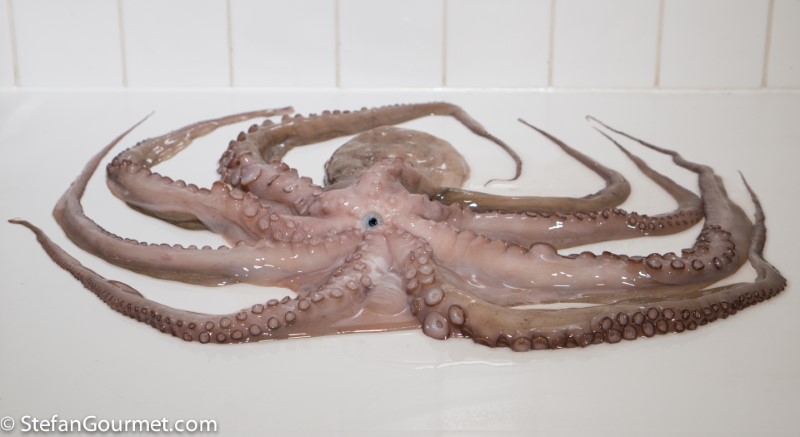
Squid can be tough and tasteless, but when cooked with the sous vide technique, it will be tender and delicious with the right combination of time and temperature. Until now, I have always used 4-5 hours at 77 degrees Celsius or 3-4 hours at 85 degrees Celsius and obtained good results. But because the squid loses so much liquid during cooking and I’ve seen that Italians recommend 8 hours at 72 degrees Celsius, I thought it was interesting to try lower temperatures. Since the squid has 8 tentacles, I tried 8 different combinations of time and temperature.
In this experiment, I used the above squid, which was frozen and weighed 1.7 kg after thawing. Freezing is known to have a tenderizing effect on squid, so if you use fresh squid, you may need to increase the time or temperature. Size also matters: the larger it is, the higher the temperature and time you need to use.
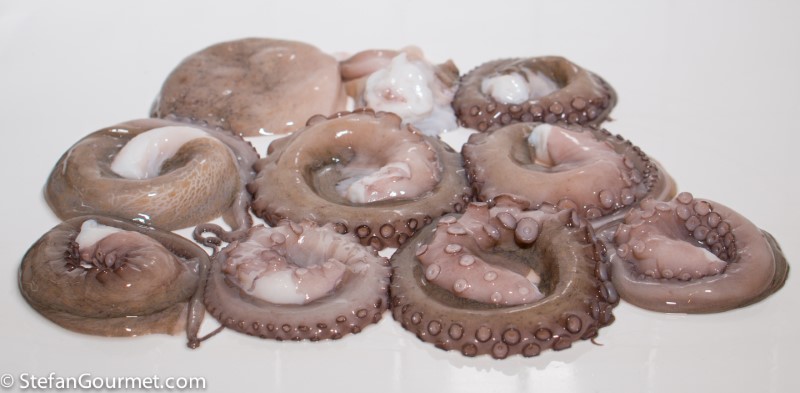
I cleaned my squid and cut it into different pieces; 8 tentacles, 1 head, and the elements in between.
For the experiment, I used only the 8 tentacles. There was a significant difference in their weight, the lightest weighed 121 grams and the heaviest weighed (almost double) 221 grams.
Nevertheless, I experienced no pattern in the loss of liquid or tenderness that could be attributed to the weight difference.
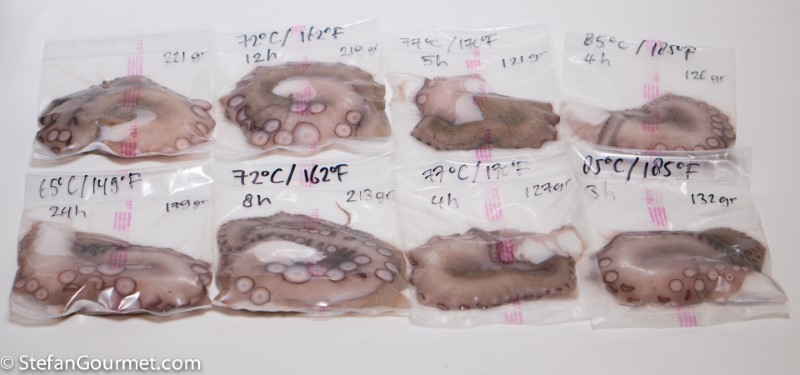
They were vacuum-packed without adding anything.
I wrote the weight/time/temperature on each individual bag.
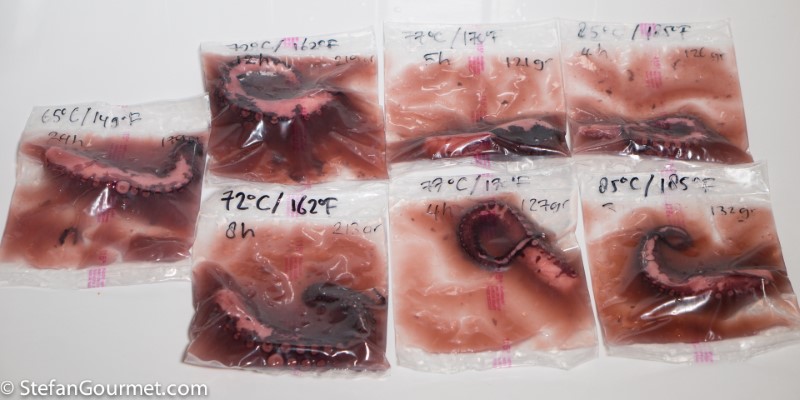
Initially, I only cooked the 7, as the last one was to be cooked based on the results of the first 7.
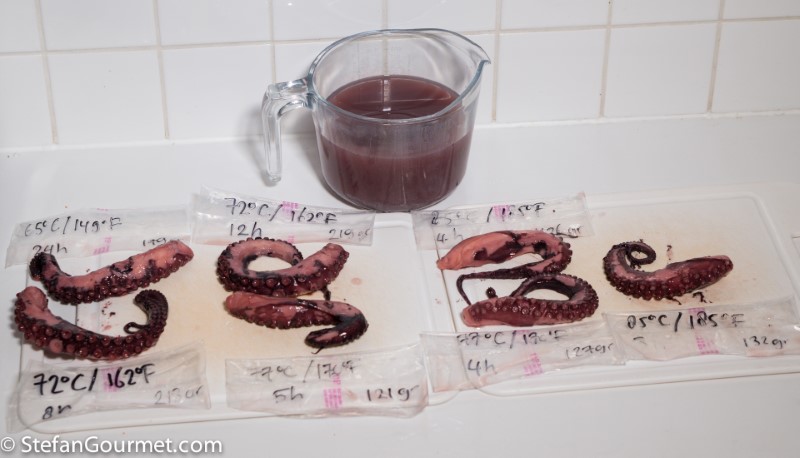
I collected all the liquid from the bags and used it for a risotto. Then all the squid tentacles were weighed and tasted.
Based on the results, I decided to cook the last one for 24 hours at 60 degrees Celsius.
The result of all 8 is described in the table below:

The Result:
- The difference in tenderness is very small. I used my subjective judgment and gave them a number from 1-10, where 1 = “very tough”, 10 = “very tender”, and 6 = “tender enough but still has some bite left”. All tasted fine, and I had to taste them again and again to assess the differences. That is why all are placed in the 7-8 scale, even though the scale goes from 1-10.
- Squids lose a lot of liquid when cooked, and in my experiment, they all lost about 2/3 of their starting weight. Although there are differences in weight, I couldn’t taste a difference in the tenderness of the squids. The one that got 3 hours at 85 degrees Celsius appears to be abnormal in liquid loss compared to the others, but I am not sure what happened there. Generally, it seems that the longer they cook, the more liquid they lose.
- When you lower the temperature by about 7 degrees Celsius, the cooking time approximately doubles to achieve the same tenderness. It is somewhat similar to when you boil a squid, for example, at 100 degrees for 1 hour. It becomes just as tender as if you cooked it at 85 degrees for 4 hours.
Conclusion:
My main conclusion is that if you adjust the time correctly, any temperature over 60 degrees Celsius will work for cooking your squid sous vide. The result will be very similar, no matter which temperature you choose. So you can choose the temperature you want, perhaps based on what suits you best, if you are cooking something else simultaneously in your sous vide/water bath.
This surprising conclusion shows that squid is very different from meat, as the difference in cooking meat at 60 degrees Celsius for 24 hours or 85 degrees Celsius for 3 hours will be very noticeable.
Some people have said that it is difficult to cook squid sous vide. If that happens to you using my above time/temperature combination, then you should simply increase the time or temperature when you cook squid next time (if you cook a squid at a lower temperature than 60 degrees Celsius, I recommend you cook it for a very long time, which can give a bad smell. So I do not recommend that. Trust me, I’ve tried. At 55 degrees Celsius, the liquid loss was about the same, so there is no reason to do it).
This article is translated from English and written by the Dutch blogger Stefan.