
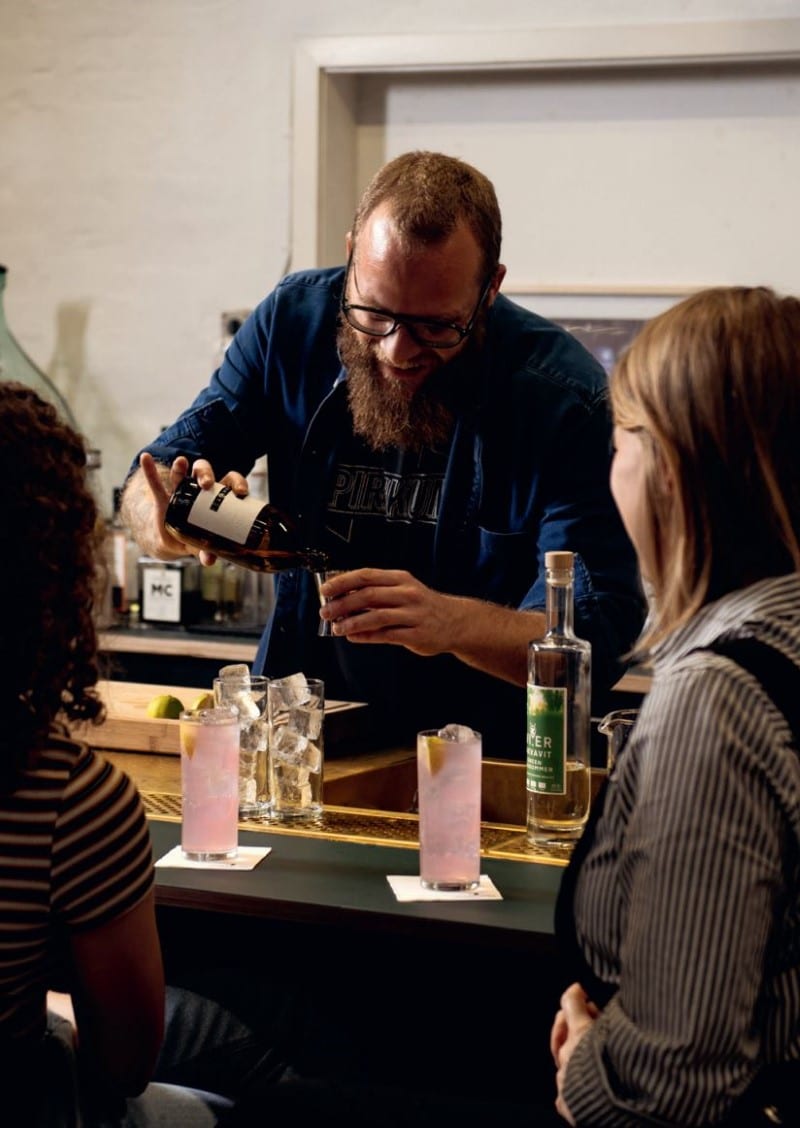

Who better to answer that question than the authors Rasmus Poulsgaard and Sune Risum-Urth, who have written the book: AKVAVIT – Myths, Food, and Cocktails“:
No, it is not.
Here is a brief explanation of the differences based on EU rules and definitions. Let’s lay down the rules before we begin.
Akvavit is schnapps, but schnapps is not necessarily akvavit. Gin is technically, in Danish terms, a juniper-flavored schnapps, while akvavit is a schnapps flavored with a distillate of dill seeds and/or caraway.
We’ll outline it in bullet points.
● Schnapps: A spirit flavored with whatever one finds amusing.
● Gin: A spirit flavored with juniper berries.
● Akvavit: A spirit flavored with a distillate of dill or caraway seeds.
That’s the basic premise, and here come some interesting details from the legislation.
If, for example, you put a handful of juniper berries in a bottle of vodka and let them steep for a while, well, you have a basic gin. But if you do the
same with a handful of dill or caraway seeds, well, you get a dill schnapps and a caraway schnapps, respectively.
You see, an akvavit must be flavored with a distillate of dill seeds and/or caraway, so you need a distillation apparatus to make it. You can of course have that at home, but keep it quiet and call it schnapps, or else the excise police might come knocking. However, very few people have distillation apparatuses in today’s Denmark, so in practice, akvavit is made at distilleries. That’s really all there is to that story.
Specifically, this means that akvavit is made by taking what’s known as agricultural ethanol – let’s just call it a very strong vodka for now,
and we’ll get back to that later – which is flavored with a caraway and/or dill distillate as well as any other distillates and extracts.
Ehhhxtract-what, you might be thinking.
Extracts are flavor extractions made by immersing a substance in alcohol. Sound familiar? That’s because it is. That’s what you call schnapps,
so you can actually flavor your akvavit with schnapps, as long as the most dominant flavor comes from a distillate of either caraway or dill seeds.
In the case of gins, it should be noted that most are made as ‘distilled gin’ or London gin, and for these classifications, the same rules apply as for akvavit, namely that they must be distilled.
To understand what akvavit is and how it differs from schnapps, it is important to note that until 1988 there was no actual legislation in the area – and thus no regulating body. In other words, akvavit was made based on traditions that arose from boozy mists over centuries. We’ll get back to that, but in the EU, they’ve always liked putting things in boxes, and akvavit had to be put in one too. Or rather, a box had to be made for akvavit, because in practice it really just meant that representatives from the spirits industry in Scandinavia wrote down what had been done for the better part of a century and a half and asked the EU to include it in the legislation.
The reason the industry came together to create a set of rules was also to avoid the category “akvavit” from becoming diluted. Too high a degree of pluralism would make the category meaningless. Instead, they wanted to have a common narrative that could be used abroad to convey what akvavit was and is. Have they then been good enough at communicating this? That must be for the reader to judge. We will at least give it a try.
The legislation is as follows:
● Akvavit is a flavor-neutral spirit (agricultural ethanol) flavored with a distillate of dill seeds and/or caraway seeds
● Akvavit must not be bitter in a way that defines the taste
● Akvavit must contain a maximum of 15 grams of dry matter per liter added after distillation (this can be sugar, fruit, or old belts)
● Akvavit must contain at least 37.5% alcohol.
“Table Akvavit” is not a legally defined classification or a protected trademark, but traditionally a clear, unaged akvavit flavored exclusively, or
at least overwhelmingly, with caraway.

The book can be purchased here: “AKVAVIT – Myths, Food, and Cocktails“.