
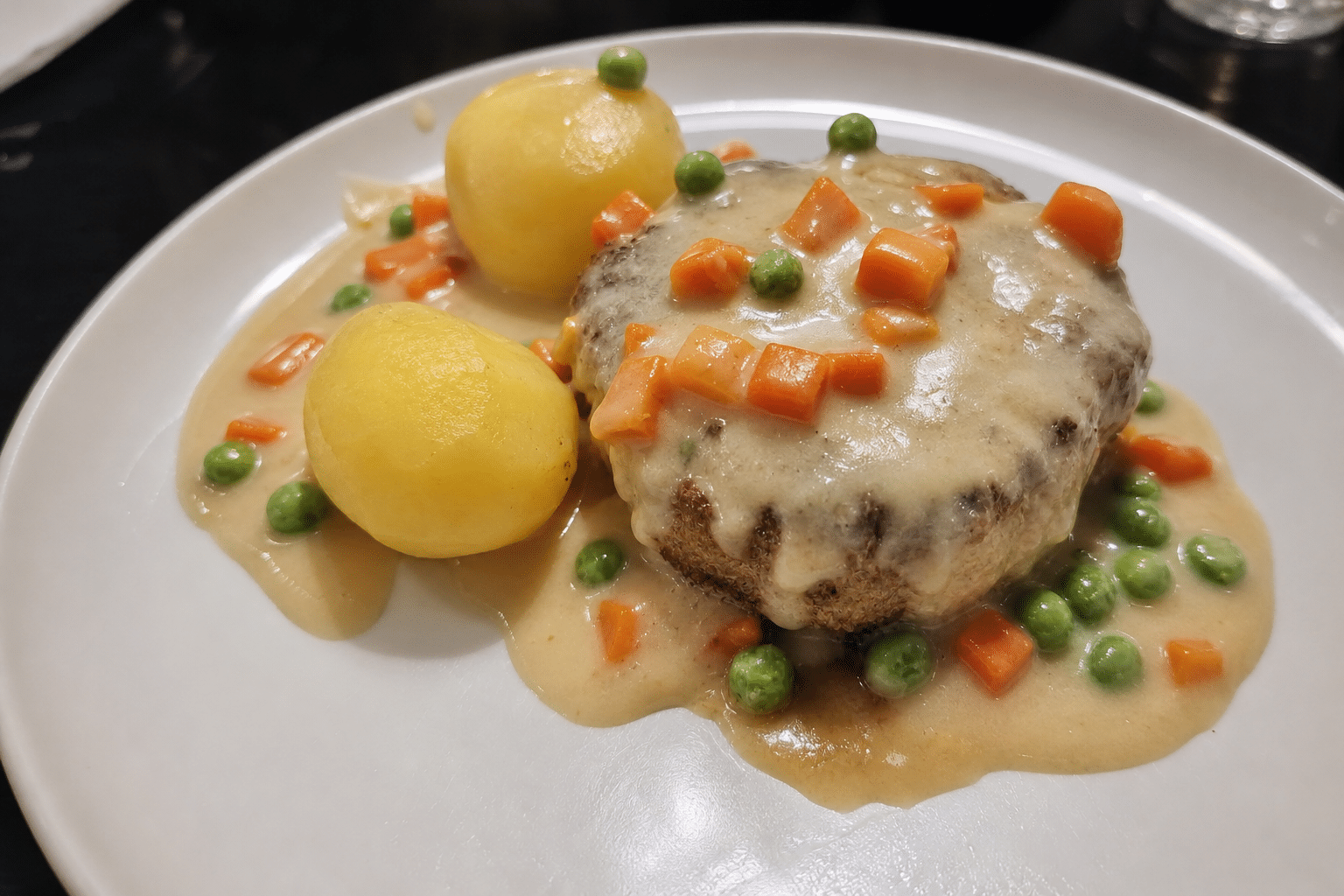

This is Denmark’s everyman weeknight dinner: seasoned ground pork shaped into thick patties, double-dipped in egg and breadcrumbs, then fried in real butter until the crust turns deep gold and crackles at the edges. Alongside it, a velvety roux-based sauce loaded with peas and carrots, and a pile of boiled potatoes. Simple, satisfying, and genuinely delicious.
The dish is completely accessible – ground pork, egg, breadcrumbs, butter, frozen vegetables. Nothing obscure, nothing fancy. What makes it work is technique, not ingredients.
What karbonader are
Karbonader (pronounced roughly kar-bo-NAH-der) are breaded ground pork patties, pan-fried in butter. If you’ve come across a similar-sounding dish called krebinetter in Danish recipes, that’s essentially the same thing. In practice the two names are often used interchangeably in Danish kitchens: both are made from ground pork shaped into patties, breaded in egg and breadcrumbs, and fried in a pan.
The creamed peas and carrots that go with them – called stuvede grøntsager in Danish – is a classic Scandinavian technique: a butter-and-flour roux thinned with stock and milk, finished with frozen vegetables until they’re heated through. It is a comfort-food sauce, and it coats the potatoes and patties together perfectly.
Read more: Chimichurri chipotle smash burgers with two homemade sauces and crispy bacon
Why this recipe works
This is a simple dish where technique matters enormously for the result. Two things make or break a karbonade.
First, thickness. Form each patty to an even 3/4 inch (2 cm) all the way across. That uniformity means the pork cooks through at the same time the crust turns golden – uneven patties mean some dry, some underdone.
Second, double-breading. After the first coat of egg and breadcrumbs, you go back in for a second round: egg again, then breadcrumbs again. That doubled crust holds its crunch all the way through dinner and doesn’t soften the moment it touches the sauce.
Read more: Cook fish like a French chef: the meuniere technique that takes just 6 minutes
Fry in real butter over medium heat. Butter gives the crust a nutty, toasted depth that oil can’t replicate here. Medium heat is not negotiable: too hot and the crust burns before the pork cooks through; too low and you lose the crunch.
Ingredients
For the karbonader (serves 4):
- 1 pound (500 g) ground pork
- 1 1/2 teaspoons fine salt
- 1/2 teaspoon black pepper
- 2 large eggs
- 1 3/4 cups (200 g) plain dry breadcrumbs
- 9 tablespoons (125 g) unsalted butter, for frying
For the creamed peas and carrots:
- 7 tablespoons (100 g) unsalted butter
- 2/3 cup (80 g) all-purpose flour
- 2 cups (500 ml) chicken stock
- scant 1 cup (200 ml) whole milk
- 3 cups (500 g) frozen peas and carrots
- 1 teaspoon fine salt
- 1 teaspoon sugar
- 1/4 teaspoon black pepper
To serve: boiled potatoes
Instructions
Make the karbonader:
- Combine the ground pork with the salt and pepper in a bowl and mix until evenly seasoned.
- Divide into 4 equal portions and shape each into a patty about 3/4 inch (2 cm) thick. Keep the thickness even all the way across so they cook uniformly.
- Beat the eggs in a shallow bowl. Spread the breadcrumbs on a separate shallow plate.
- Dip a patty in the egg and let the excess drip off, then press it firmly into the breadcrumbs to coat all sides. Dip it back into the egg, let the excess drip off again, and press into the breadcrumbs a second time. Repeat with the remaining patties.
- Melt the butter in a large skillet over medium heat. When it foams and starts to smell nutty, add the karbonader.
- Cook for 6 to 8 minutes per side, until the crust is deep golden brown. The internal temperature at the center should reach 160°F (71°C) – use a meat thermometer to confirm.
Make the creamed peas and carrots:
- Melt the butter in a saucepan over medium heat.
- Add the flour and stir constantly until the mixture comes together into a smooth, pale paste, about 1 minute.
- Add the chicken stock a little at a time, whisking constantly so the paste dissolves smoothly into the liquid. Keep adding and whisking until all the stock is incorporated.
- Add the milk in the same way, a splash at a time, whisking until the sauce is smooth.
- Let the sauce simmer gently, stirring often, for 2 to 3 minutes until it thickens.
- Add the frozen peas and carrots and cook for 2 to 3 minutes more, until heated through and tender.
- Season with the salt, sugar, and pepper, then taste and adjust.
Serve the karbonader alongside the creamed peas and carrots and boiled potatoes.
Tips and variations
Use a meat thermometer. Because these are made from ground pork, the USDA recommends a safe internal temperature of 160°F (71°C). Press the thermometer into the center of the thickest patty to confirm.
Read more: The moist yogurt cake with orange and coconut, no butter, no stand mixer
Make the sauce ahead. The karbonader are best eaten fresh from the pan – the crust softens as they sit. The creamed peas and carrots, on the other hand, reheat well. Make the sauce earlier in the day, refrigerate it, and warm it gently on the stove before you fry the patties.
Other meats. The classic version uses ground pork, but you can make a similar dish with ground veal, or a mix of veal and pork.
Storing leftovers. Keep any leftover karbonader in an airtight container in the fridge for up to 3 days. Reheat in a dry skillet over medium heat to bring some crunch back to the crust.