
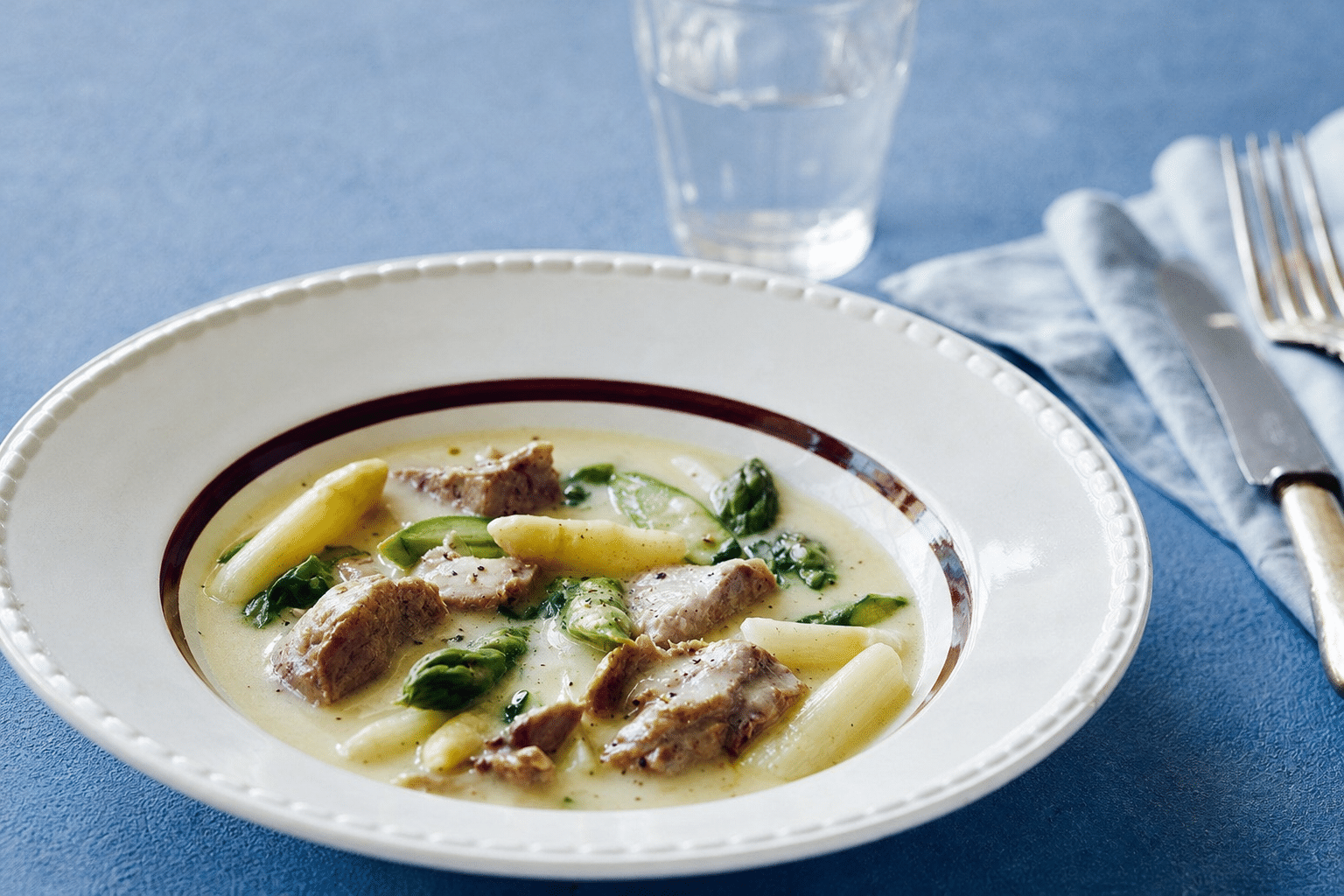

Kalvefrikasse is what Danes make when they want to show someone real care. The name is simply Danish for veal fricassee, and the dish is exactly that: a large piece of veal simmered low and slow in aromatic stock, cut into chunks, and folded back into a glossy cream sauce made from the reduced cooking liquid. It lands somewhere between a French braise and a comforting stew, mild, deeply savory, and far more approachable than the cook time suggests.
The veal needs close to two hours of gentle simmering, and you will want time for the stock to reduce before you build the sauce. But almost all of that time is hands-off. And once you know the trick, this dish gets even better if you make it the day before and reheat it. The flavors develop overnight in a way that makes the extra planning entirely worth it.
The recipe serves 8 and works with seasonal vegetables. In winter, that means carrots, leeks, celeriac, and parsley roots. In summer, asparagus or a mix of peas, beans, and new carrots. Either way, the technique is the same.
Why this recipe works
The first move is a quick blanch of the veal in boiling water. This pulls out proteins and impurities that would otherwise cloud the stock and muddy the flavor. You discard that water, start fresh, and what you get is a clean, clear broth that will carry the entire sauce.
From there, the meat simmers very gently, barely a bubble, for up to two and a half hours. Low and slow is the whole game. Rush it, and the veal seizes instead of turning tender.
Once the meat is done, you reduce the braising liquid over high heat down to about 6 cups (1.5 liters). That concentrated stock becomes the foundation of the sauce, built the classic way: a roux of butter and flour cooked until smooth, the hot broth whisked in gradually, then heavy cream stirred in at the end. A small amount of curry powder goes in with the cream. It does not make the sauce taste like curry, it just adds a quiet warmth that rounds out the richness.
The vegetables are blanched separately and folded in at the end, which keeps them bright and slightly crisp rather than soft and gray.
Read more: In Puerto Rico, Thanksgiving turkey gets a roasted-pork makeover, and it is called pavochon
Ingredients
For the veal and stock
- 2½ lbs (1.2 kg) veal chuck, breast, or brisket, in one piece
- About 3 quarts (3 liters) cold water, plus more as needed
- 1½ to 2 tablespoons salt
- 10 to 15 whole peppercorns
- ½ to ¾ cup (100-200 ml) dry white wine
Aromatics (bouquet garni)
- 1 onion
- 1 carrot
- ¼ small celeriac (or 1 celery stalk)
- ½ bunch flat-leaf parsley
- 1 garlic clove, unpeeled
- 1 sprig fresh thyme
- 1 bay leaf
Winter vegetables
- 3 to 4 carrots, peeled and cut into bite-sized pieces
- 2 to 3 leeks, cleaned and sliced
- ¼ small celeriac, cut into chunks
- 2 to 3 parsley roots, peeled (parsnips work well as a substitute)
Summer vegetables (use instead of winter)
- 2¼ lbs (1 kg) green or white asparagus, or a mix
- OR about 2¾ lbs (1.2 kg) mixed new-season vegetables: peas, young carrots, green beans, pointed cabbage, small new onions
For the sauce
- 5 tablespoons (70 g) unsalted butter
- A generous ½ cup (75 g) all-purpose flour
- 1¼ cups (300 ml) heavy cream
- ¼ to ½ teaspoon curry powder
- Fresh lemon juice, to taste
- Salt, pepper, and a pinch of sugar if needed
Instructions
1. Peel and rinse the bouquet garni vegetables (onion, carrot, celeriac). Rinse the parsley and thyme, then tie them together with the bay leaf into a bundle using kitchen twine.
2. Bring a large, heavy-bottomed pot with about 3 quarts (3 liters) of water to a boil. Add the veal and blanch for 3 to 4 minutes. Lift the meat out, discard the blanching water, and rinse the pot.
3. Place the bouquet garni vegetables, herb bundle, and unpeeled garlic in the bottom of the clean pot. Set the veal on top. Pour in fresh cold water until the meat is covered by about 2 inches (4-5 cm). Add the salt, peppercorns, and white wine.
4. Bring slowly to a boil, then reduce to a very gentle simmer, barely a bubble. Cover and cook for 1¾ to 2½ hours, skimming the surface frequently, until the meat is completely tender and a knife passes through easily.
5. While the veal simmers, prepare the vegetables: clean, peel, and cut them into bite-sized pieces. Blanch in a separate pot of lightly salted boiling water for about 1 minute. Remove with a slotted spoon and set aside in a bowl.
6. When the veal is done, lift it out onto a platter. Cover loosely with parchment paper and set aside. Remove and discard the herb bundle and aromatics.
Read more: Braising meatballs directly in a creamy mushroom sauce is better than keeping them separate
7. Increase the heat to high and reduce the broth, uncovered, until you have about 6 cups (1.5 liters). Strain through a fine-mesh strainer into a bowl and discard the solids.
8. Cut the cooked veal into medium bite-sized cubes, trimming off any loose fat.
9. Make the sauce: in the same pot over medium heat, melt the butter. Add the flour and stir constantly for 1 to 2 minutes until the roux is smooth and barely beginning to color.
10. Add the warm broth a ladleful at a time, whisking constantly and bringing the sauce back to a simmer between each addition. Continue until all the broth is incorporated.
11. Stir in the cream and curry powder. Simmer on low heat for 7 to 10 minutes, stirring occasionally, until the sauce is silky and coats the back of a spoon.
12. Add the blanched vegetables and return to a boil. Simmer 2 to 3 minutes, then add the veal pieces and bring the fricassee back to a full boil.
Read more: You don’t need yeast: 7 breads that rise without it and still taste great
13. Season with lemon juice, salt, pepper, and a pinch of sugar if the sauce needs it. Serve immediately with boiled potatoes or fresh bread to soak up the sauce.
Tips and variations
Make it the night before. Kalvefrikasse genuinely tastes better the next day. Make the whole dish, let it cool to room temperature, refrigerate overnight, and reheat gently on the stovetop over medium-low. The flavors come together and the sauce thickens slightly in a way that is entirely welcome.
Can’t find veal? Bone-in chicken thighs or pork shoulder both work. The flavor will be a little different, richer with the pork, milder and quicker-cooking with the chicken, but the technique is identical. Veal gives the dish its signature mild sweetness, which is worth seeking out at a good butcher.
Parsley roots are hard to find in many US grocery stores. Parsnips are the natural substitute and work very well.
Sauce too thick? Add a splash of reserved broth or a little more cream and stir over low heat. Too thin? Simmer uncovered for a few more minutes until it tightens up.
On the curry powder: half a teaspoon across a full batch adds just a quiet warmth. It won’t make the dish taste spiced. Don’t skip it.