
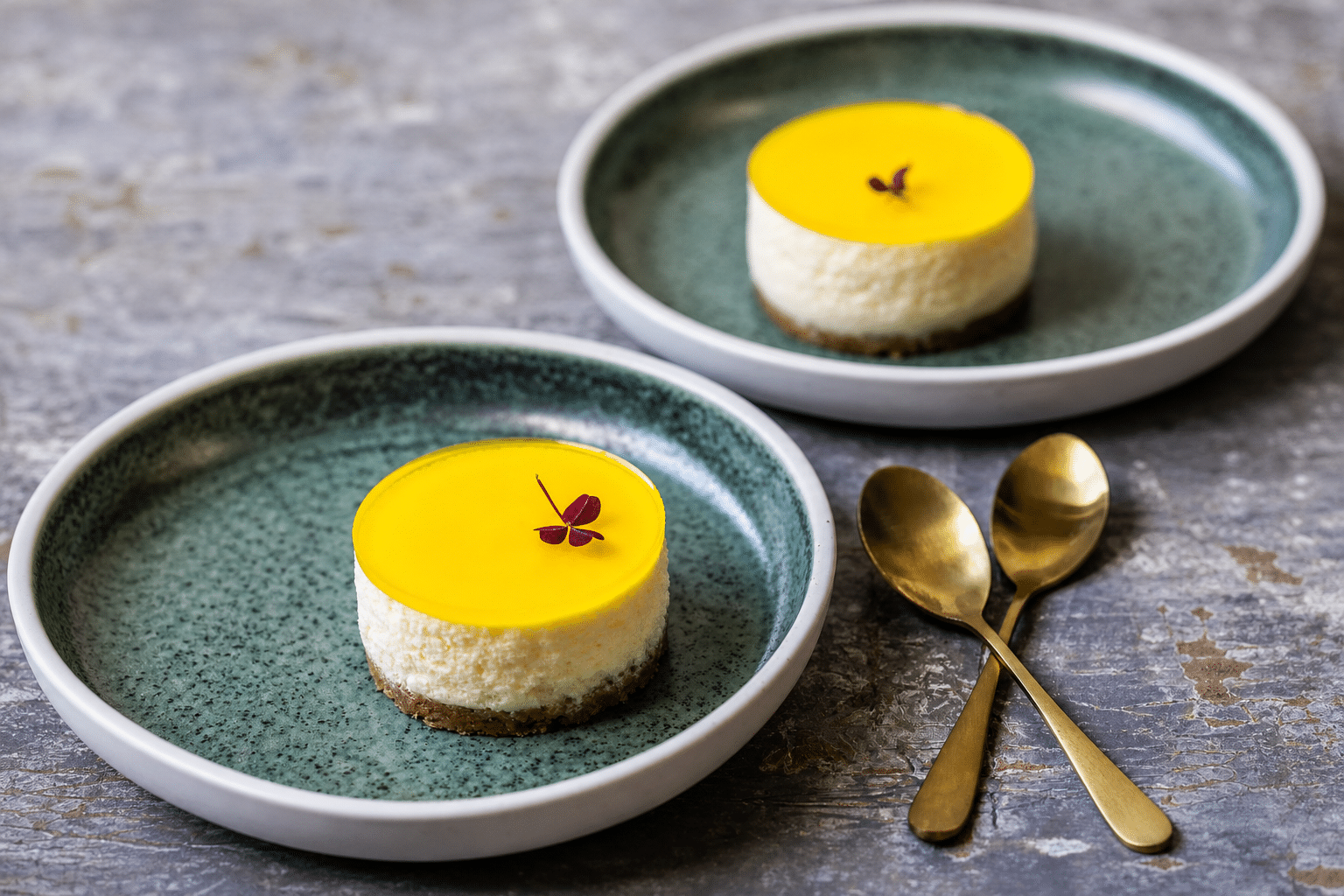

If you have never come across a Danish fromage before, a quick note: it is not a cheese course. In Danish baking, fromage is a light, gelatin-set mousse – airy and creamy, somewhere between a classic mousse and a chilled cheesecake, and genuinely one of the most elegant things you can make for a dinner party. This version comes individually portioned in glasses: a buttery Graham cracker base, a silky lemon mousse, a thin bright-yellow lemon gelee on top, and a finish of fresh zest and mint.
The recipe is from the cookbook Gæstemad (Guest Food), and author Thomas Tranegaard Nielsen describes it as “a dessert that rounds off the meal without weighing it down.” That is exactly what it does. The lemon keeps everything bright and clean-tasting even after a full dinner.
Best of all, the whole thing is built ahead. The base, the mousse, and the gelee all need fridge time, and they all hold beautifully overnight. By the time guests arrive, your dessert is already done.
Why this recipe works
Three separate layers, each doing a specific job: the Graham cracker base gives crunch and richness; the mousse is tart, airy, and just rich enough; the gelee adds a glassy lemon finish that looks like it came from a patisserie window.
Read more: Denmark’s iconic cowboy toast gets the smashburger treatment, and it is better than ever
Setting the mousse with gelatin rather than baking it means it holds its shape perfectly in the fridge and never weeps or collapses. Building everything in individual glasses means there is nothing to cut, slice, or plate at the last minute. This is a dessert that is genuinely easier to make for ten people than for two.
Ingredients
Makes 8 individual servings
Graham cracker base:
- 2½ cups (250g) Graham crackers, finely crushed
- 7 tablespoons (100g) unsalted butter
Lemon mousse:
- 2 sheets leaf gelatin (or approximately 1½ teaspoons / 5g powdered gelatin, bloomed in 2 tablespoons cold water)
- 2 eggs, separated
- ⅓ cup (65g) sugar
- ½ cup (125ml) heavy cream
- 1 lemon (zest and juice)
Lemon gelee:
- 1 sheet leaf gelatin (or approximately ¾ teaspoon / 2.5g powdered gelatin, bloomed in 1 tablespoon cold water)
- 1½ tablespoons (25ml) fresh lemon juice
- 1½ tablespoons (25ml) water
- 2 tablespoons (25g) sugar
- A few drops of yellow food coloring (optional; the original uses 2g)
To finish:
- About 2 tablespoons (20g) finely grated lemon zest
- A small handful of fresh mint leaves (about 5g)
Instructions
Make the base:
- Melt the butter.
- Seal the Graham crackers in a zip-lock bag and crush with a rolling pin until you have fine, sandy crumbs.
- Stir the crumbs into the melted butter until evenly coated.
- Divide the mixture between 8 small glasses or short ramekins, pressing it firmly and evenly into the bottom. Refrigerate while you make the mousse.
Make the lemon mousse:
- Soak the gelatin sheets in cold water for 5 minutes to soften. If using powdered gelatin, sprinkle it over 2 tablespoons cold water and let it bloom for the same time.
- Beat the egg whites in a clean bowl to stiff peaks.
- In a separate bowl, whisk the egg yolks and sugar together until the mixture turns pale and noticeably thicker, about 2 minutes with an electric whisk.
- Lightly whip the heavy cream to soft peaks, then fold it into the yolk mixture.
- Finely zest the lemon, taking only the yellow part. Juice it.
- Warm the lemon juice in a small pan or microwave for about 30 seconds, until hot but not boiling.
- Lift the softened gelatin sheets out of the water, squeeze out the excess, and stir them into the warm juice until fully dissolved. (If using bloomed powder, stir the entire bloomed mixture in.)
- Stir the dissolved gelatin, lemon juice, and lemon zest into the cream-and-yolk mixture.
- Gently fold in the stiff egg whites, keeping as much air as possible.
- Spoon the mousse over the chilled bases, dividing it evenly. Refrigerate for at least 3 hours, or overnight.
Make the lemon gelee:
- Soak the gelatin sheet in cold water for 5 minutes. (Or bloom the powdered gelatin in 1 tablespoon cold water.)
- Combine the lemon juice, water, and sugar in a small saucepan and heat over medium heat, stirring, until the sugar dissolves completely.
- Remove from the heat. Squeeze out the gelatin sheet and stir it in until dissolved. (Or add the entire bloomed powder mixture.)
- Stir in a few drops of yellow food coloring if using.
- Let the mixture cool until it is just barely warm but still completely liquid. This step is important: too hot and it will melt the mousse underneath; too cold and it will begin to set before it levels out. Test it by holding the back of a spoon against the liquid – it should feel just above room temperature and flow freely.
- Pour a thin layer, about ⅛ inch (2-3mm) deep, over each set mousse. Return to the fridge for at least 1 hour.
To serve:
Take the glasses straight from the fridge. Finely grate fresh lemon zest over each one and add a few mint leaves.
Tips and variations
Leaf gelatin vs. powdered: Leaf gelatin gives a slightly cleaner, more transparent set and is worth finding at specialty grocery stores or online. If you use powdered gelatin, the amounts above are a close approximation – bloom the powder in cold water first, and never stir it directly into boiling liquid.
Read more: Boeuf bourguignon at home: the French braised beef that tastes like a Parisian bistro
The gelee temperature is the one tricky moment: This is the step most likely to go wrong if you rush it. If the gelee is still too warm when poured, it will soften the mousse surface and the layers will blend. If it has cooled too far, it will pour unevenly or set solid before it levels. Give it a full 10-15 minutes to cool after removing from the heat, then check it.
Raw eggs: This mousse uses uncooked eggs. If you are serving people who are pregnant, elderly, or immunocompromised, use pasteurized eggs, which are available at most large grocery stores.
Read more: Warm apple-pear crumble with a crispy oat topping and vanilla cream
Make-ahead window: The base and mousse can be made up to 24 hours ahead. Add the gelee on the day of serving, at least 1 hour before guests arrive.
Glasses: Small rocks glasses, old-fashioned dessert glasses, or short wide ramekins all work well. Anything with straight sides gives the clearest view of the layers.
Food coloring: The yellow tint is entirely for looks. Leave it out for a naturally pale, almost white gelee – the flavor is identical.