

Most of us have gotten pretty good at saving leftovers, and that is genuinely a good thing: it cuts waste and saves money. The problem comes the next day, when the steak goes into the microwave, the vegetables get halfheartedly warmed through, and everyone eats out of duty rather than hunger.
Leftovers do not have to work that way. The real shift is simple: stop thinking of a leftover steak as a finished meal that needs to be resurrected, and start treating it as one ingredient among many, raw material you can build something entirely new from.
The reframe that makes it work
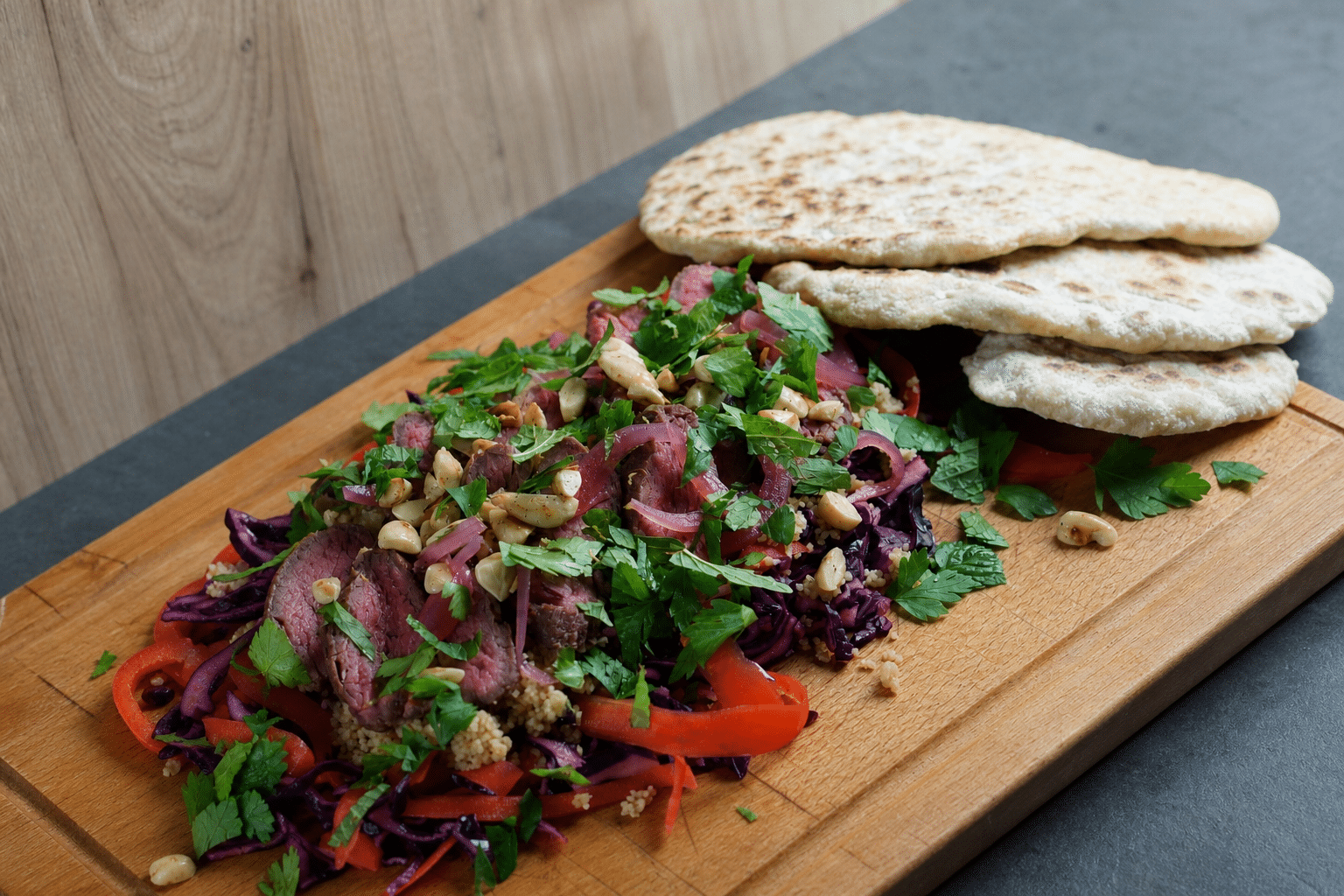
This couscous salad is what that reframe looks like in practice. It uses leftover beef and leftover red cabbage – mine came from a roast dinner earlier in the week – but by the time those two pieces meet spiced couscous, shredded carrots, toasted almonds, pickled red onions, and a pile of fresh mint and parsley, there is nothing about it that feels like clearing out the refrigerator.
Honestly, you could serve this to guests without mentioning that the idea started with leftovers.
Cook extra steak on purpose
Not everyone has a steak sitting in the fridge on any given Tuesday. So here is the other half of the idea: plan for it.
If you are making steak anyway, make two. I often cook mine sous vide – teres major (sometimes sold as shoulder tender at butcher counters) at 131°F (55°C) for one hour, then finished with a hard sear in a screaming-hot pan – and if the circulator is already running, adding an extra piece costs nothing. It goes in the fridge, and two or three days later I have a fast, genuinely satisfying dinner ready to build on.
Read more: The cheesy lasagna soup that gives you everything you love about lasagna, without layering a thing
You do not need sous vide. Ribeye, flank steak, sirloin – any steak works here. The point is the mindset shift: a steak in the refrigerator is not yesterday’s dinner waiting to be warmed up. It is the protein anchor for tomorrow’s meal.
The key: new textures, new flavors
If there is one thing that makes the biggest difference when cooking with leftovers, it is bringing in elements that change both the texture and the flavor entirely – so the old meal disappears and something new takes its place.
Here, the couscous is cooked with softened onion, garlic, cumin, and cinnamon. Those warm, earthy notes have nothing to do with how the steak tasted the first time around. The red cabbage and carrots get a squeeze of lemon and become bright and crunchy rather than soft reheated sides. Toasted almonds add snap. Fresh mint and flat-leaf parsley cut right through the richness of the beef.
And then there are the flatbreads. A small portion of steak and leftover cabbage is not always enough to feed a family on its own. Add a stack of quick pan-fried flatbreads, and suddenly it is.
Recipe: leftover steak couscous salad with flatbread
Serves 3. Takes about 30 minutes if the steak is already cooked.
Read more: The creamy loaded baked potato soup that tastes like restaurant comfort food, made in one pot
Ingredients
Couscous:
- Generous 3/4 cup (150g) dry couscous
- 2/3 cup (150ml) water
- 1 small onion, minced
- 1 garlic clove, minced
- 1/2 tsp ground cumin
- 1/2 tsp ground cinnamon
- Lemon juice, to taste
Salad:
- 1/3 small red cabbage, thinly sliced
- 2 large carrots, grated or julienned
- Lemon juice
- 3 tablespoons (20g) almonds
- Handful of fresh mint
- Handful of fresh flat-leaf parsley
Flatbreads:
- 2 1/4 cups (275g) all-purpose flour
- 3 tablespoons (25g) rye flour
- 1 1/4 tsp baking powder
- 1/2 tsp coarse salt
- 1 pinch sugar
- Scant 1/2 cup (100ml) milk
- 3 1/2 tablespoons (50ml) olive oil
To finish:
- 1 leftover cooked steak
- Pickled red onions
- Flaky sea salt
Instructions
1. Start the couscous: Soften the onion and garlic in a small pan with a little oil over medium heat. Add the water, cumin, and cinnamon and bring to a boil. Pour over the dry couscous in a heatproof bowl, cover, and let it steam for 5 minutes. Fluff with a fork and set aside to cool. Add lemon juice to taste.
2. Prep the vegetables: Thinly slice the red cabbage and grate or julienne the carrots. Toss with a good squeeze of lemon juice and a pinch of salt.
3. Toast the almonds: Add the almonds to a dry skillet over medium heat and cook, shaking the pan often, until golden, about 3 to 4 minutes. Let cool slightly, then chop finely.
4. Make the flatbreads: Stir together both flours, the baking powder, salt, and sugar in a bowl. Add the milk and olive oil and work into a smooth dough. Divide into 3 equal portions and roll each one thin, about the thickness of a corn tortilla. Cook in a dry, very hot pan for about 2 minutes per side until golden and charred in spots. Wrap in a clean kitchen towel immediately to keep them soft.
5. Assemble: Toss the cooled couscous with the cabbage and carrots and spread across a large plate or platter. Slice the steak thin and against the grain and lay it over the top. Finish with flaky sea salt, chopped toasted almonds, fresh mint, parsley, and pickled red onions.
Read more: Chili crisp, harissa, and gochujang: 9 spicy fixes for flat Thanksgiving sides
Serve the warm flatbreads alongside. A small bowl of yogurt with lime juice and fresh mint, or a scoop of baba ganoush, makes a genuinely great addition if you want to push it further.
Tips and swaps
Red cabbage: Mine was left over from a roast dinner, but raw red cabbage from the store works just as well. No red cabbage? Any firm cabbage, radicchio, or sturdy romaine can step in. Leftover cooking works best when you are not locked into a specific ingredient list – look at what you already have and build from there.
Pickled red onions: You can quick-pickle sliced red onions in white vinegar, sugar, and a pinch of salt in about 15 minutes, or use a jar from the store. They add a sharp, bright note that balances the richness of the beef and the nuttiness of the couscous.
The steak: Teres major responds beautifully to both sous vide and a hard sear. Flank steak and ribeye are easy alternatives. Slice cold steak thin and against the grain – it makes a real difference to the texture.
Making ahead: The couscous salad keeps in the fridge for up to two days. Flatbreads are best fresh off the pan but can be revived in a dry skillet for about a minute on each side.