
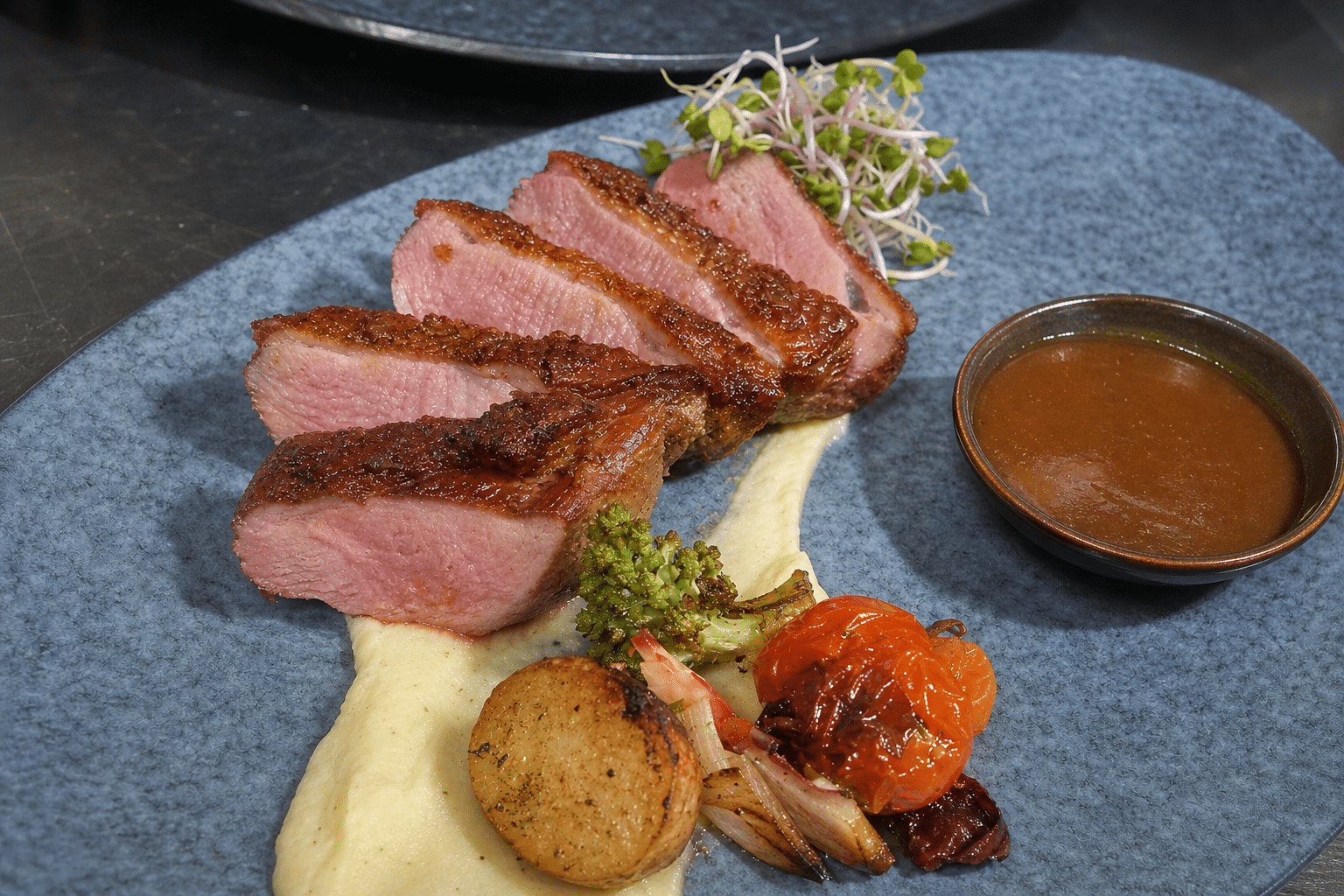

Duck breast has a way of going wrong in one of two directions: either the skin stays pale and flabby, or you crank up the heat to fix it and the meat overcooks before the fat has had a chance to render. I have done both.
Chef Jacob Jørgsholm has a better answer. He is a self-taught cook and owner of Feed Bistro in Copenhagen’s Nørrebro neighborhood, and his approach is built on one counterintuitive move: start the breast in a cool pan. “Salt, pepper, and the right treatment of the fat will take you incredibly far,” he says. Everything else follows from there.
Duck breast is a great choice for fall and holiday entertaining. It is faster than a whole roast bird, more striking on the plate than chicken, and once you understand the technique, it is not as complicated as it looks.
Score the skin, but not too deep
Before the breast goes anywhere near heat, score the skin. Use a sharp knife to cut a crosshatch pattern across the entire surface, with cuts roughly 1/2 inch (about 1 cm) apart. The rule is firm: the knife goes through the skin and the fat layer beneath it only. It does not go down into the meat.
Cutting too deep opens the flesh, which dries the meat out and can make it tough. Getting the depth right gives you the most surface area for fat to escape from and for the skin to crisp against.
Take a minute to trim the back of the breast as well, removing any loose tendons or excess fat from the underside.
Start skin-side down in a cold-ish pan
Season the breast well on both sides with salt and pepper. Place a dry skillet over low heat and let it warm for 3 to 4 minutes. You barely need any added fat – duck releases so much of its own that you are really just getting the pan ready.
Set the breast skin-side down and press it gently for the first few seconds so the full surface makes contact with the pan. Then leave it alone. Let it cook on low, steady heat for 5 to 7 minutes without turning the heat up.
This is where the whole thing lives or dies. The slow heat gives the thick fat layer beneath the skin time to render out gradually. By the time the skin begins to crisp, most of that fat is gone – and what you end up with underneath is a dry, crackly shell rather than a greasy one.
Read more: Brunsviger: the sticky-sweet Danish yeast cake that is basically a caramel roll in sheet-cake form
After a few minutes, add a sprig of rosemary and a halved garlic clove directly to the pan. The fat already pooling around the breast will carry those flavors up into the scored skin as it cooks.
A quick flip, then baste
When the skin is visibly golden and starting to firm up, flip the breast and cook the meat side for 30 to 60 seconds. Then turn up the heat briefly, tilt the pan, and spoon that hot, aromatic fat generously over the skin side. Work it into the score marks so the flavor reaches every groove.
Finish in a 392°F oven
Transfer the breast to an oven-safe pan or baking dish, skin-side up. Place it in a preheated 392°F (200°C) oven for 3 to 4 minutes. This finishes the interior without the risk of overcooking that comes from leaving it on a hot burner.
Rest on the cutting board, not in the dish
Pull the breast from the oven and immediately move it to a cutting board. Do not leave it sitting in the hot pan or baking dish – the residual heat will keep the meat cooking past where you want it. Let it rest for 6 to 8 minutes before slicing.
Slice it thin. The combination of rendered skin, the brief oven stint, and a proper rest means the interior will be rosy and moist while the skin crackles when the knife goes through it.
Two easy flavor additions
Jørgsholm suggests stirring freshly grated orange zest or a whole star anise into the seasoning before the breast goes into the pan. Both work beautifully against the richness of duck and add something interesting without overcomplicating the dish.
Save the fat from the pan
The fat left behind in the skillet is excellent. It is well-seasoned and aromatic from the rosemary and garlic, making it a natural starting point for a quick pan sauce to serve alongside the duck. If you do not use it right away, it keeps well in the refrigerator and is superb for roasting potatoes.