
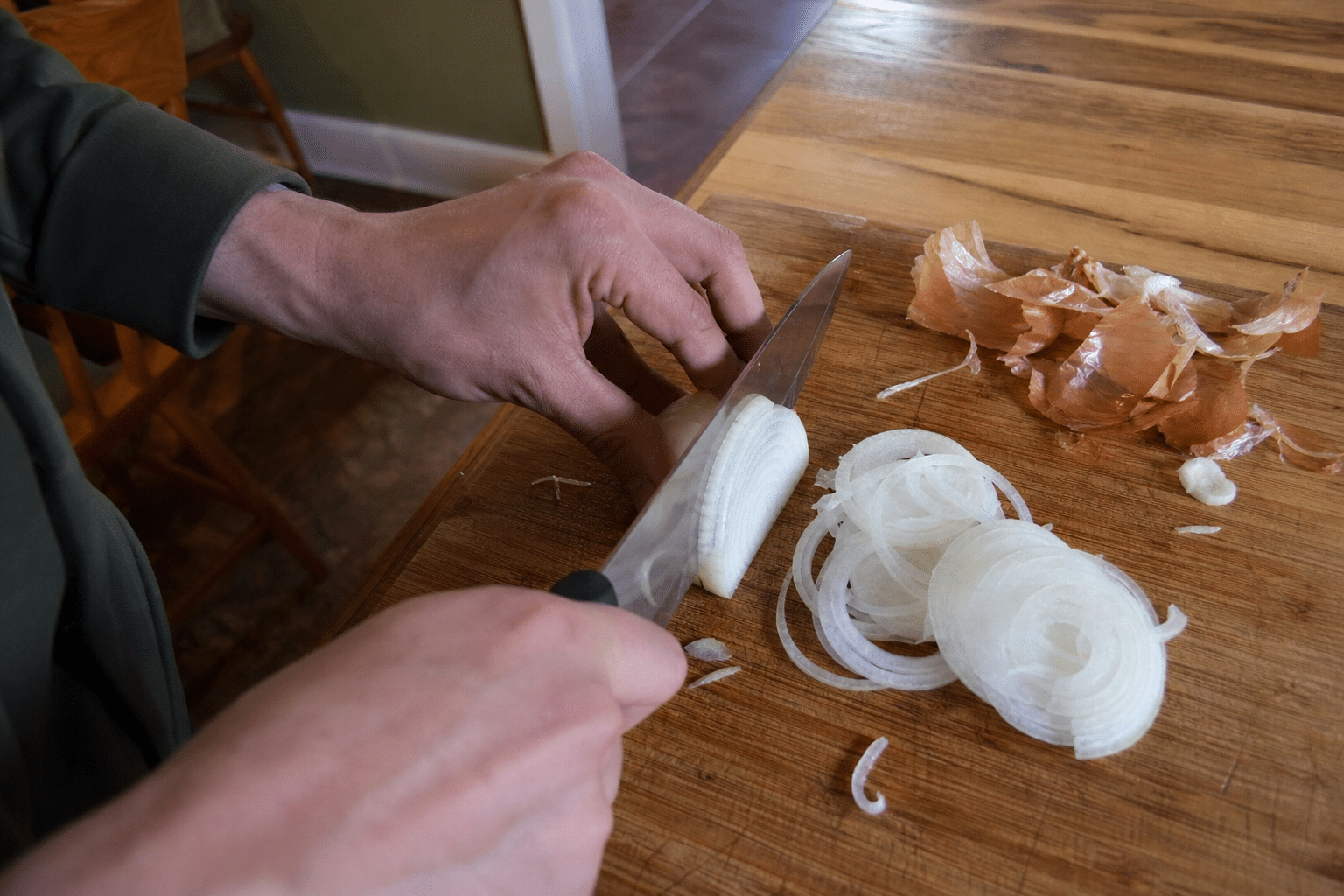

That reaction is no accident. When you cut an onion, it launches a two-step enzyme sequence designed to repel predators, ending with a volatile irritant evaporating toward your face. Food scientists have known the outline for decades, but a 2017 study in ACS Chemical Biology mapped the precise crystal structure of the key enzyme for the first time, clarifying how the attack works and, more usefully, which common fixes actually interrupt it.
The two-enzyme chain
Onion cells keep their chemical defenses separated. When your knife ruptures those cells, two enzymes that were previously isolated suddenly meet. The first, alliinase, reacts with a sulfur compound called 1-propenyl-L-cysteine sulphoxide, releasing ammonia and a short-lived intermediate: 1-propenylsulphenic acid.
LFS (lachrymatory-factor synthase), a second enzyme, then takes that intermediate and converts it into propanethial S-oxide, the actual irritant, as Duane Mellor explains in The Conversation. Propanethial S-oxide is volatile: it evaporates quickly, drifts toward your face, and dissolves in the moisture on your eyes, forming sulphenic acid. The sting that follows triggers the lacrimal glands to flush the irritant out, which is exactly what the tears are doing.
The 2017 breakthrough
The enzyme sequence had been known in outline, but LFS itself had never been fully visualized. In 2017, Marcin Golczak and colleagues published the first crystal structure of LFS in ACS Chemical Biology, revealing the enzyme’s exact three-dimensional shape and showing how it drives propanethial S-oxide production through a process described as “sequential proton transfer accompanied by formation of a carbanion intermediate,” according to phys.org, reporting on the ACS study.
Read more: Baking soda browns your baked goods; baking powder doesn’t, food scientists explain the chemistry
That structural map opens a path to blocking LFS at the molecular level. It is the same approach that produced tearless onions already sold in Japan, where LFS enzyme production has been suppressed entirely in the plant, as reported by phys.org.
Why the onion bothers
The sulfurous chemistry is an evolved defense. It functions as “chemical warfare against microbes and animals,” according to the ACS research as reported by phys.org, discouraging soil insects and other pests from eating into the bulb. The irritant works because it is volatile: it escapes the wound site and spreads to anything nearby.
Sweeter varieties contain lower concentrations of the sulfur compounds that lead to propanethial S-oxide, Mellor notes in The Conversation. That is why a mild sweet onion stings considerably less than a standard yellow onion when cut.
Read more: The classic French onion soup that actually tastes like the restaurant version, made at home
Four fixes that hold up
1. Use a sharp knife. Every cell you crush rather than slice releases more alliinase and more substrate, amplifying the reaction. A sharp knife cuts cleanly through cell walls; a dull blade crushes them, increasing enzyme contact with every stroke. Sharpening your knife is the highest-return fix here.
2. Chill the onion. Propanethial S-oxide is volatile, so temperature directly controls how fast it evaporates and spreads. A cold onion, straight from the refrigerator, produces the irritant at a much slower release rate. Mellor lists refrigeration as one of the practical options in his Conversation explainer.
3. Cut near running water. Propanethial S-oxide is water-soluble. Cutting next to a running tap, or directly under it, intercepts the vapor before it can rise toward your eyes, washing it away before it converts into sulphenic acid at the eye surface. Awkward but chemically sound.
Read more: Osso buco with saffron risotto and gremolata: the Italian braise that is easier than it looks
4. Wear goggles. Sealed swim goggles or purpose-made onion goggles work by physical exclusion: if the vapor cannot reach your eyes, it cannot trigger tears. When the seal holds, they are fully effective.
Two fixes without evidence
Bread in the mouth. The claim is that a piece of bread between the teeth absorbs propanethial S-oxide vapor. There is no published evidence that bread held in the mouth captures enough vapor to protect eyes that are several inches away and exposed to open air.
A lit candle nearby. The theory is that the flame burns off the volatile compound. For that to work, the candle would need to be positioned directly in the vapor path between the onion and your eyes, covering the full exposure area. No kitchen candle can do that, and no controlled evidence supports this as an effective fix.