
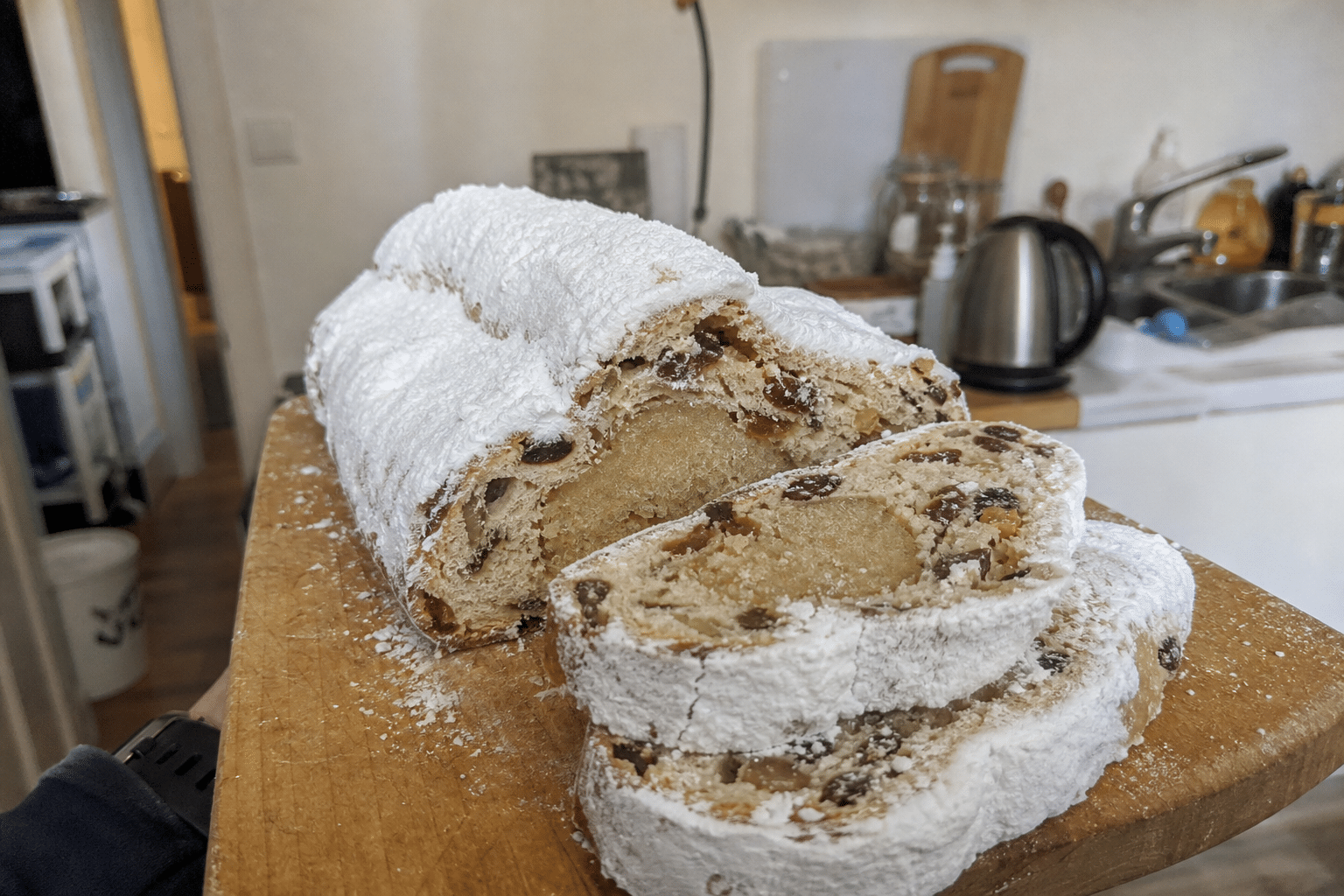

Stollen is the enriched German Christmas bread that rewards patience more than any other holiday bake. Under its thick powdered-sugar crust sits a dense, buttery loaf packed with rum-soaked dried fruit, slivered almonds, and a hidden log of marzipan that runs the full length of every slice. The flavors deepen and meld as the loaf rests, so a stollen made in mid-November is a genuinely different, and better, thing than one made the day before Christmas.
This recipe produces one standard loaf, enough to serve 10 to 12 people. The dough is an enriched yeast dough, similar in character to brioche but drier and more loaded with fruit. No advanced bread experience required; the method is forgiving.
Why stollen gets better with age
The butter in stollen does double duty: it enriches the crumb and acts as a preservative. As the loaf sits, the butter seeps more deeply into the dried fruit, the rum aroma rounds out, and the spices, cardamom, nutmeg, mace, integrate from distinct sharp notes into something warmer and more unified. The powdered-sugar crust, applied thick while the loaf is still hot, sets into a firm shell that seals moisture in and keeps the crumb from drying out. After 1 to 2 weeks, the layers read as one thing rather than several.
Why this recipe works
Three things drive the result.
Overnight fruit soak. Rum-soaked fruit that sits 8 to 12 hours absorbs the liquid completely. Fruit that is still wet when it goes into the dough makes the crumb soggy and gummy; fruit that has fully absorbed the rum carries the flavor without the moisture.
Cold overnight rise. Refrigerating the dough after mixing builds more complex flavor in the enriched crumb than a fast room-temperature rise. The cold also firms the butter, making the dough easier to handle and shape without sticking.
Hot butter and powdered sugar, immediately. The coating is what makes stollen stollen. Brushing generously with melted butter the moment the loaf comes out of the oven, then burying it in sifted powdered sugar while still hot, creates a thick, opaque crust that hardens as it cools. This is not a light dusting; it is a shell.
Ingredients
Fruit soak (start the night before):
- 1 cup (145g) raisins, golden or dark, or a mix
- 1/2 cup (70g) dried cranberries or currants
- 1/3 cup (55g) diced candied orange peel or mixed citrus peel
- 3 tbsp (45ml) dark rum
Dough:
- 3 1/4 cups (410g) all-purpose flour, plus more for dusting
- 1/4 cup (50g) granulated sugar
- 2 1/4 tsp (7g, one standard packet) active dry yeast
- 1/2 cup (120ml) whole milk, warmed to 110°F (43°C)
- 2 large eggs, room temperature
- 1 tsp fine salt
- 1/2 tsp ground cardamom
- 1/4 tsp ground nutmeg
- 1/4 tsp ground mace (or an extra pinch of nutmeg)
- Zest of 1 lemon and 1 small orange
- 1/2 cup (115g) unsalted butter, softened, cut into small cubes
- 1/2 cup (55g) slivered blanched almonds
Marzipan center:
- 7 oz (200g) marzipan
Finish:
- 4 tbsp (55g) unsalted butter, melted
- 1 1/2 cups (175g) powdered sugar, sifted
Instructions
1. Soak the fruit. Combine raisins, cranberries, and candied peel in a bowl. Add rum and stir. Cover and leave at room temperature overnight, or for at least 2 hours. Before using, drain off any unabsorbed liquid; wet fruit ruins the crumb.
Read more: How to make scrambled eggs the Jamie Oliver way: soft, creamy, and never rubbery
2. Proof the yeast. In the bowl of a stand mixer, combine warm milk, yeast, and 1 tsp of the measured sugar. Let sit 5 to 10 minutes until foamy and smelling of bread. If nothing happens, your yeast is dead – start with a fresh packet before going further.
3. Build the dough. Add the remaining sugar, eggs, salt, cardamom, nutmeg, mace, and both citrus zests to the yeast mixture. Add the flour and mix on low speed with the dough hook until a shaggy dough forms, about 2 minutes.
4. Work in the butter. With the mixer on medium-low, add the softened butter cubes a few at a time, letting each addition disappear before adding the next, about 5 minutes total. The dough will look rough and greasy before it comes together; this is normal. Once all butter is in, increase to medium and knead 5 more minutes until smooth and slightly tacky.
5. Add fruit and almonds. Add the drained fruit and slivered almonds. Mix on low until evenly distributed, about 2 minutes. Some of the fruit will tear slightly; that is fine.
6. Cold rise. Transfer to a lightly oiled bowl, cover tightly with plastic wrap, and refrigerate overnight (8 to 12 hours). If you need to bake the same day, let the covered bowl rise at room temperature for 1 1/2 to 2 hours until roughly doubled, but the flavor will be noticeably thinner.
Read more: The 12 best hot chicken spots in Nashville
7. Warm and shape. Remove the dough from the refrigerator and let it sit, still covered, at room temperature for 30 minutes. Turn it onto a lightly floured surface and roll or press into an oval about 10 x 8 inches (25 x 20 cm). Roll the marzipan into a log about 8 inches (20 cm) long. Place it along the center of the oval. Fold one long side over the marzipan, then fold the other side to overlap by about 1 inch (2.5 cm), the fold sits slightly off-center, giving stollen its traditional asymmetric hump. Press gently to seal.
8. Second rise. Set the shaped loaf on a parchment-lined baking sheet. Cover loosely with plastic wrap and let rise at room temperature for 1 to 1 1/2 hours until visibly puffed. Enriched doughs don’t double the way lean doughs do; look for a loaf that has relaxed and grown by roughly half.
9. Bake. Preheat the oven to 350°F (175°C). Bake 45 to 55 minutes until a deep, even golden brown. An instant-read thermometer inserted into the center of the loaf (avoid the marzipan) should read 190 to 200°F (88 to 93°C). If the surface colors too quickly, tent loosely with foil after 30 minutes.
10. Coat immediately. The moment the stollen comes out of the oven, brush it all over with the melted butter, use the full 4 tablespoons. While still hot, sift powdered sugar over the top and sides in a generous layer, flip carefully with two spatulas, and coat the bottom too. Once it has cooled enough to handle, apply a second heavy coat of powdered sugar. The finished surface should be thick, fully opaque, and white, not a dusting.
11. Cool and wrap. Let cool completely on a wire rack, at least 2 hours. Wrap tightly in plastic wrap, then in foil. Store at cool room temperature.
Tips and variations
Skip the rum? Replace it with fresh orange juice or apple juice. The fruit won’t absorb quite as deeply, but the result is still good.
Marzipan choice. European-style marzipan with a high almond content (look for 50% almonds or more on the label) gives the cleanest almond flavor. The log should be firm enough to hold its shape; if yours is very soft, chill it for 20 minutes before rolling.
Nuts. Slivered almonds are traditional. A mix of almonds and roughly chopped dried apricots (added with the fruit) works well for a richer variation; skip the marzipan if you go this route.
Allergens. Stollen contains gluten, dairy, eggs, and almonds (tree nuts). Candied peel is sometimes produced in facilities that also process peanuts; check the label if that is relevant for your household.
Storage and aging
Wrapped tightly at room temperature, stollen keeps for up to 3 weeks. The sweet spot is 1 to 2 weeks after baking. At that point the spices have softened into the crumb, the dried fruit tastes more concentrated, and each slice holds together cleanly without crumbling.
If you want to bake further ahead, say, Thanksgiving weekend for Christmas, freeze the uncoated loaf before adding any butter or powdered sugar, wrapped in a double layer of plastic wrap and foil. It keeps in the freezer for up to 3 months. Thaw overnight at room temperature, then apply the full butter and powdered sugar coating after thawing. The loaf still benefits from 3 to 5 days of resting after the coating is applied before you cut into it.