
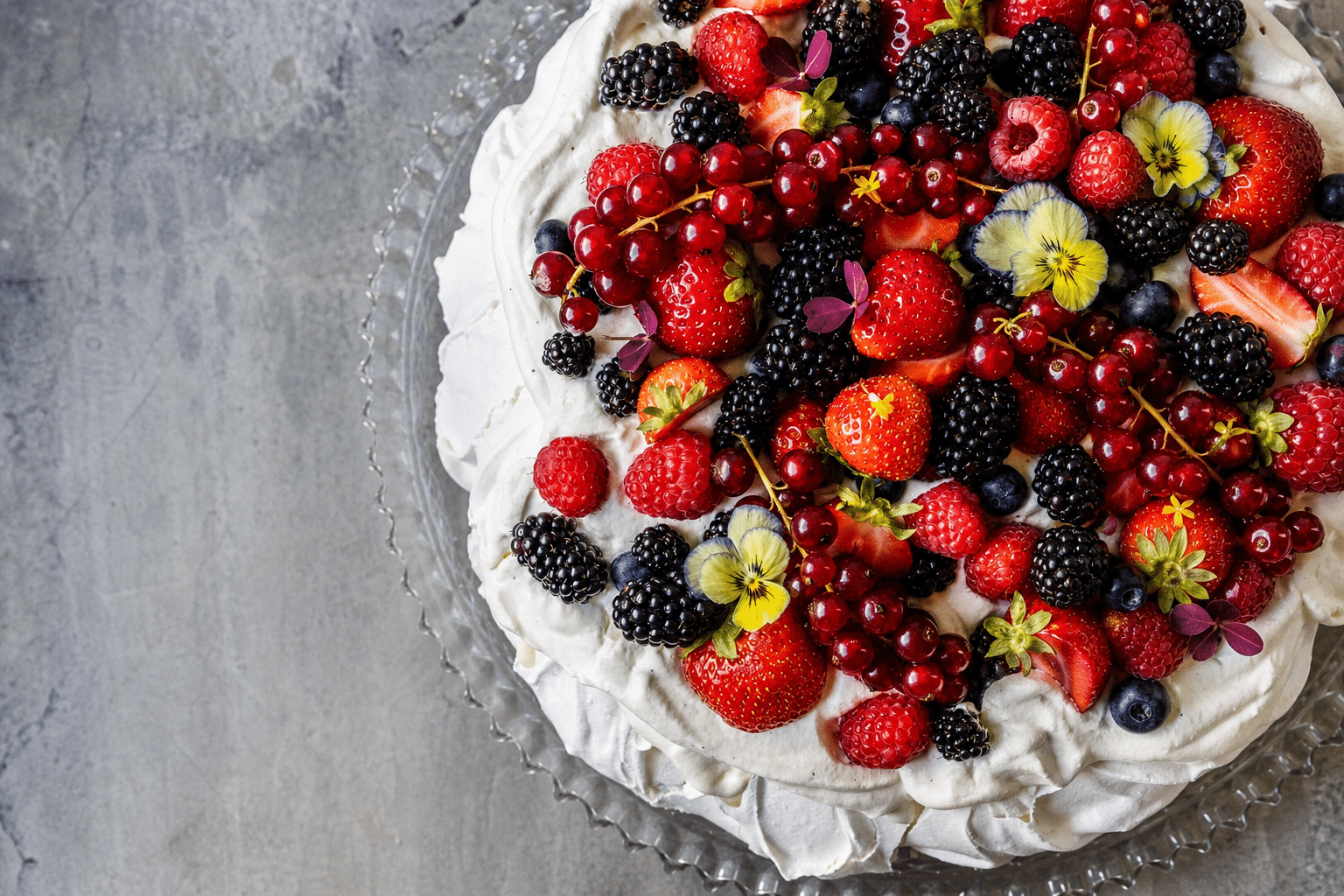

Pavlova looks like a showstopper, but the method is surprisingly straightforward. The base is just whipped egg whites, sugar, a splash of vinegar, and a little cornstarch – four ingredients that bake into a meringue with a shattering shell and a yielding, almost fudgy center.
Top it with vanilla whipped cream and a pile of fresh berries, and you have a dessert that is both impressive and completely make-ahead-friendly. The base bakes for an hour and a half, then sits in the switched-off oven overnight. The next morning it is set, dry, and ready to store until you need it.
For holiday cooking, that is the real selling point: bake the base up to four days ahead, then whip the cream and add the berries right before you serve.
Why this recipe works
Two ingredients do most of the heavy lifting. Vinegar stabilizes the egg white foam and gives the outer shell its characteristic snap. Cornstarch keeps the interior dense and sticky rather than drying it all the way through – that is what creates the two-texture contrast pavlova is famous for.
The low oven temperature – 230°F (110°C) – is just as important. Too hot, and the meringue dries out completely, losing the soft center. Low and slow gives you a dry, crisp shell with a marshmallow core.
Ingredients
Serves 8
Meringue base:
- 6 large egg whites, at room temperature (about ¾ cup / 180g)
- 1 teaspoon white vinegar (5g)
- 1¾ cups granulated sugar (350g)
- 1 tablespoon + 1 teaspoon cornstarch (10g)
Vanilla whipped cream:
- 1 cup heavy cream (250g)
- 2½ tablespoons powdered sugar (20g)
- 1 teaspoon vanilla extract
Garnish:
- 1 cup fresh strawberries, hulled and halved (125g)
- ¾ cup fresh blueberries (125g)
- 1 cup fresh raspberries (125g)
- Powdered sugar, for dusting
- A few sprigs of fresh mint
Instructions
1. Pull the eggs out of the refrigerator at least 30 minutes before you start – room-temperature whites whip higher and hold their shape better. Preheat your oven to 230°F (110°C), conventional setting (not convection).
Read more: The pulled pork burger recipe that actually works in a regular home oven
2. Line a rimmed baking sheet with parchment paper. Use a pencil and a 9½-inch (24 cm) plate or bowl to draw a circle on the paper, then flip it pencil-side down so the graphite does not touch the meringue.
3. In a large, spotlessly clean and grease-free bowl, beat the egg whites with the vinegar on medium-high speed until they just hold soft peaks. With the mixer still running, add the sugar one tablespoon at a time. Keep going until the mixture is very thick, glossy, and holds stiff, firm peaks – this takes 8 to 10 minutes. Rub a little between your fingers; it should feel completely smooth, not gritty. Add the cornstarch and beat for 30 seconds more.
4. Spoon the meringue onto the parchment inside your drawn circle. Use an offset spatula to shape it: push the sides up slightly so the center dips a little, creating a natural well for the cream later.
5. Bake for 1 hour 30 minutes. The outside should be dry, matte, and pale cream in color. Turn off the oven, leave the door completely closed, and let the pavlova cool inside the oven for at least 2 hours – overnight is ideal.
Read more: The one folding step that finally makes homemade white bread rise properly
6. For the whipped cream: combine the heavy cream, powdered sugar, and vanilla extract in a bowl. Whip with a hand whisk or on low speed with a stand mixer until softly thickened. Stop when it holds a soft, billowy shape – stiff cream is harder to spread and tastes heavy against the light meringue. Using a whisk by hand gives you better control at this stage.
7. When ready to serve, carefully transfer the pavlova base to a serving plate or board. Spoon the whipped cream into the center and spread it gently with the offset spatula, leaving a 1-inch border of bare meringue around the edge. Pile on the strawberries, blueberries, and raspberries, tuck in a few mint sprigs, and dust lightly with powdered sugar. Serve right away.
Tips and make-ahead notes
Bake days ahead. The finished, cooled meringue base keeps for 3 to 4 days at room temperature in an airtight container or under a cake dome. Do not refrigerate it – humidity softens the shell. Add the cream and berries no more than 1 to 2 hours before serving.
Getting the texture right. If the pavlova comes out sticky all the way through with no crisp shell, the oven temperature was likely too high or the bake was cut short. If it cracks dramatically and collapses, it cooled too fast in a drafty room – always let it cool inside the switched-off oven with the door closed.
Read more: Soffritto: the Italian base that makes pasta sauces, stews, and soups taste restaurant-quality
Clean equipment is non-negotiable. Even a trace of fat – including a speck of egg yolk – will prevent the whites from whipping to full volume. Wipe the bowl and beaters with a little white vinegar before you start if you are unsure.
Berry swaps. Any mix of fresh berries works. Sliced peaches, pitted cherries, or fresh mango are all excellent alternatives or additions depending on the season.
Vinegar. White wine vinegar or plain distilled white vinegar both work. Avoid balsamic or any strongly colored vinegar.
Serving with ice cream. The pavlova is excellent alongside a scoop of vanilla ice cream and an extra handful of berries.