
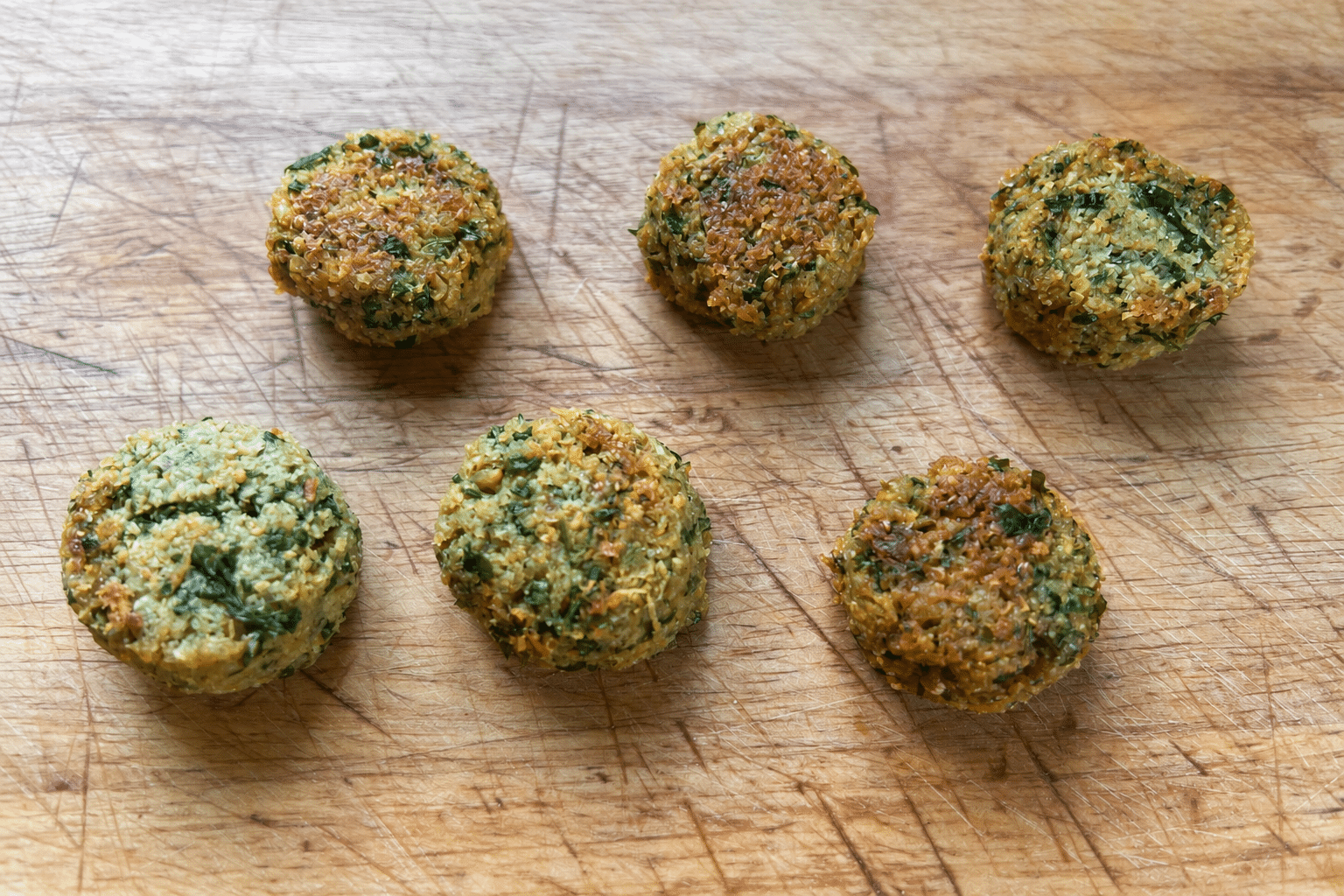

Falafel is one of the great street foods of the Middle East: crispy, golden balls of spiced chickpea paste tucked into soft pita with tahina sauce, chopped vegetables, and a drizzle of zhoug, a fiery cilantro hot sauce. Making them at home is entirely possible, but there is one thing most home recipes get wrong, and it costs them everything.
The secret is raw, overnight-soaked dried chickpeas, not cooked or canned ones. If you have tried falafel at home and been disappointed by a dense, gluey interior, cooked chickpeas are almost certainly why. This recipe fixes that.
Why this recipe works
The falafel you get from a good street stall has a light, almost fluffy crumb inside a shatteringly crisp shell. That texture comes entirely from starting with raw, soaked chickpeas. When you grind raw chickpeas that have been soaked overnight, you get a paste with enough internal structure to hold together in hot oil while still opening up as it cooks.
Cooked chickpeas are already soft all the way through. They blend into a dense, wet paste that fries up heavy and moist inside rather than tender and open. Even canned chickpeas, drained and dried as much as you like, give you the same problem. Skip them entirely.
The spice mix is a traditional one: cumin, coriander, cardamom, and a pinch of cayenne, backed up by plenty of fresh parsley and cilantro. The cardamom is subtle but important; it gives falafel a faintly floral warmth that you notice immediately at a good falafel stand and can never quite identify.
Ingredients
Makes 4 servings
For the falafel:
Ingredient | US measure | Metric |
|---|---|---|
Dried chickpeas | 1¼ cups | 250g |
Red onion, finely chopped | ½ medium (about ⅓ cup) | ~80g |
Garlic clove, crushed | 1 | 1 |
Flat-leaf parsley, finely chopped | ½ cup loosely packed | 15g |
Fresh cilantro, finely chopped | 1 cup loosely packed | 30g |
Cayenne pepper | ½ tsp | 3g |
Ground cumin | 1½ tsp | 5g |
Ground coriander | 1½ tsp | 5g |
Ground cardamom | ½ tsp | 3g |
Baking powder | 1¼ tsp | 5g |
All-purpose flour | 2½ tbsp | 20g |
Water | 3½ tbsp | 50ml |
Sesame seeds, for finishing | 2 tsp | 5g |
Salt | to taste |
For frying:
– About 3 cups (750ml) neutral oil (canola or vegetable), or enough to fill a deep pot to a 2¾-inch (7cm) depth
Instructions
1. The night before, place the dried chickpeas in a large bowl and cover with twice their volume of cold water. Leave them to soak overnight, at least 12 hours. They will roughly double in size.
2. Drain the soaked chickpeas thoroughly. Combine them in a food processor with the chopped onion, crushed garlic, parsley, and cilantro. Blend until the mixture forms a coarse paste. For the best texture, run it through the processor twice so everything is fine and uniform.
3. Transfer the mixture to a large bowl. Add the cayenne, cumin, coriander, cardamom, baking powder, flour, water, and a generous pinch of salt. Mix by hand until smooth and evenly combined. The paste should hold together when pressed but not feel wet or sticky.
4. Cover and let the mixture rest for at least 1 hour. This rest lets the baking powder activate and allows the texture to firm up so the falafels hold their shape when they hit the oil.
Read more: Roast beef rump cap with green asparagus and curry mayo potato salad: a stress-free spring dinner
5. Pour the oil into a deep, heavy pot to a depth of about 2¾ inches (7cm) and heat to 350°F (180°C). Use a thermometer if you have one; a few degrees too cool and the falafels absorb oil, too hot and they color before cooking through.
6. Wet your hands lightly with water. Scoop out walnut-sized portions of the mixture and roll them into firm, dense balls, then press each one slightly flat. Sprinkle or press sesame seeds onto each one.
7. Working in batches of 4 to 6, carefully lower the falafels into the hot oil. Fry for about 4 minutes, turning once or twice, until deep golden brown all the way around. The interior should be cooked through and no longer moist.
8. Lift the falafels out with a slotted spoon and drain on a strainer lined with paper towels. Serve immediately while the crust is at its crispiest.
Tips and serving
How to serve. Tuck the warm falafels into pita with Israeli salad (finely diced fresh tomato and cucumber), a generous drizzle of tahina sauce, pickled vegetables, and zhoug if you have it. For the tahina sauce, there is a separate recipe on gastrofun.dk that takes about five minutes to put together.
Don’t skip the rest. The one-hour rest before frying is not optional. Mixture that hasn’t rested will fall apart in the oil.
Fry in batches. Adding too many falafels at once drops the oil temperature sharply. Keep batches small and let the oil climb back to 350°F (180°C) between rounds.
Check the mixture before you fry. Squeeze a small amount in your palm; it should form a compact ball without crumbling and without leaving wet residue. If it crumbles, add water a teaspoon at a time. If it feels wet, work in a little more flour.
Reheating. Cooked falafels reheat well in a 400°F (200°C) oven for 8 to 10 minutes, placed directly on the rack so air circulates around them. A microwave only steams the crust soft.