
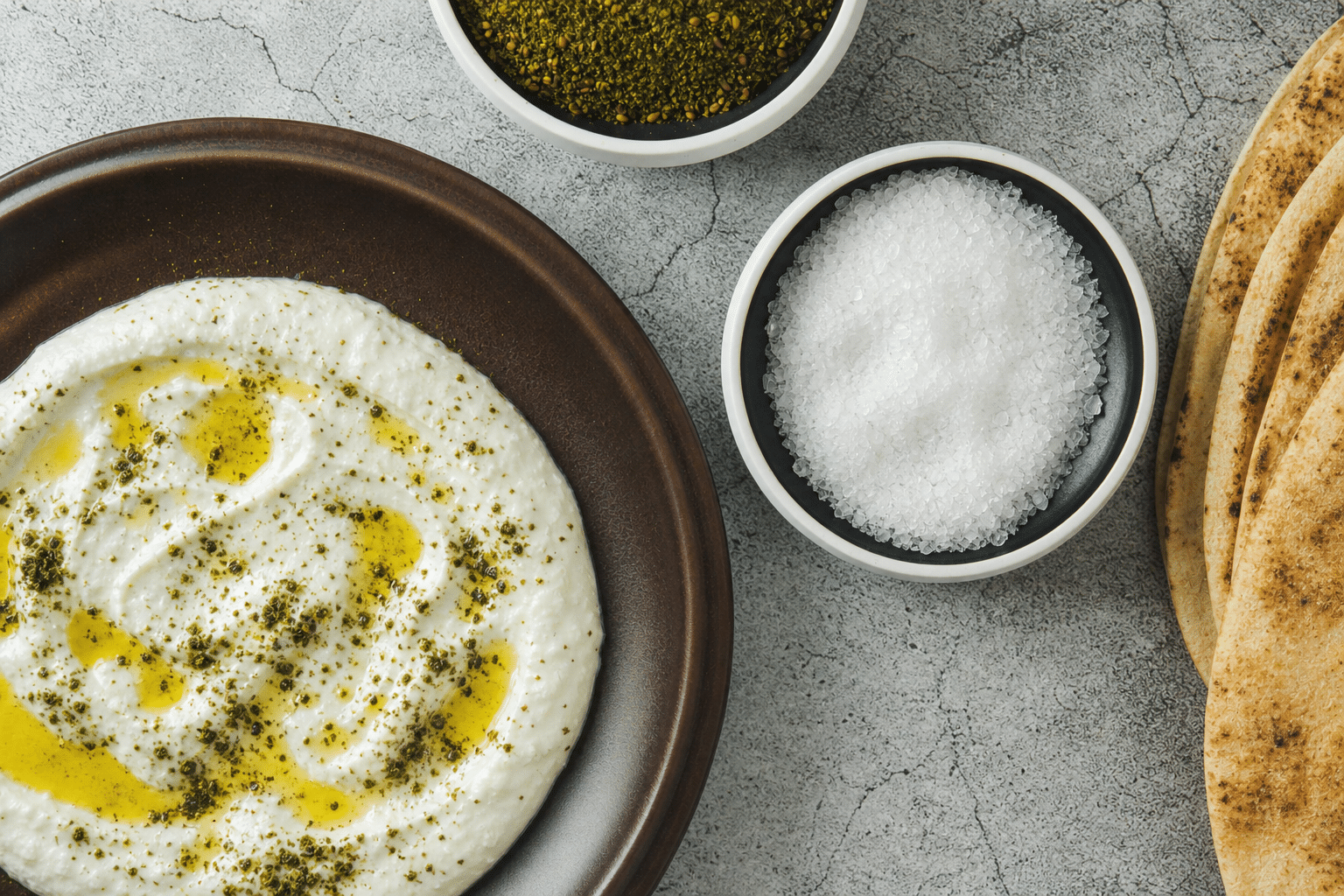

That is genuinely all there is to it. Two ingredients, a sieve, and a square of cheesecloth. What comes out the other end is a thick, tangy, spreadable cheese that has been eaten across Lebanon, Syria, Jordan, and Palestine for thousands of years, and is now firmly on the menu at any Middle Eastern restaurant worth going to.
I keep a batch going in my fridge on a near-permanent rotation. Once you understand what draining does to yogurt, you will too.
What labneh actually is
Labneh is what you get when you salt yogurt and let gravity pull the liquid out of it. The whey drains away through the cheesecloth, leaving behind a dense, creamy mass with a clean, sharp tang. The more you drain it, the firmer it gets: 12 hours gives you something that spreads like soft cream cheese, while a full 24 hours pushes it toward a scoopable, almost clay-like consistency you can roll into balls.
The original labneh was made from goat’s milk, but today cow’s milk Greek yogurt is the standard. Use full-fat, at least 10% fat. Low-fat yogurt drains down to something grainy and sad.
How it compares to cream cheese and mascarpone
The texture is similar to cream cheese, but labneh is noticeably tangier and contains roughly half the fat. That makes it a genuinely useful substitute in both sweet and savory recipes anywhere you would reach for cream cheese or mascarpone. I have used it as a base for cheesecake, stirred it through pasta, and spread it under roasted vegetables. It holds up in all of them.
Read more: Roast beef rump cap with green asparagus and curry mayo potato salad: a stress-free spring dinner
It also sits close to thick Greek yogurt or skyr in texture, but with the flavor turned up. The draining concentrates everything: the richness, the dairy sharpness, the slight sourness.
Ingredients
For the labneh:
- 4 cups (1 kg) full-fat Greek yogurt, 10% fat
- 1 tsp (5g) fine sea salt
For serving:
- 2 tbsp (30g) good olive oil
- 1 tbsp (10g) za’atar
- 1/2 tsp coarse sea salt
Equipment: cheesecloth, a fine-mesh sieve or colander, and a bowl deep enough to collect the whey beneath it.
Za’atar is a dried herb and sesame seed blend from the Middle East. You will find it at most well-stocked grocery stores, Whole Foods, Trader Joe’s, or any Middle Eastern market.
Instructions
- Add the fine sea salt to the yogurt and stir well until fully combined.
- Drape a double layer of cheesecloth over your sieve and set the sieve over a bowl. Make sure the bottom of the sieve does not touch the bowl’s base, so the whey can collect freely below.
- Pour the salted yogurt into the cheesecloth and smooth it level.
- Gather the four corners of the cheesecloth and tie them together into a pouch. For even cleaner results, you can hang the pouch from a wooden spoon set across the top of a tall pot.
- Refrigerate for 12 to 24 hours. At 12 hours you will have a soft, spreadable labneh. At 24 hours it will be firmer and dense enough to shape into balls.
- Discard the collected whey (or save it for bread dough or smoothies) and spoon the labneh into a shallow serving bowl.
- Make a shallow well in the center with the back of a spoon, pour the olive oil over the top, scatter the za’atar, and finish with the coarse salt.
- Serve with warm pita bread or raw vegetables for dipping.
Tips and variations
Start with the right yogurt. Full-fat Greek yogurt at 10% fat is the target. Regular stirred yogurt will drain down to almost nothing. The closer to 10% fat you can get, the richer and more satisfying the result.
Don’t skip the salt. Salting before draining does two things: it draws moisture out faster, and it seasons the labneh evenly all the way through. Salt added only at serving sits on the surface.
Check the texture before you unwrap it. At the 12-hour mark, press the outside of the cheesecloth gently. If it feels soft and yielding, give it a few more hours. If it holds its shape against light pressure, you are there.
Serve it at room temperature. Cold labneh straight from the fridge tastes flat. Pull it out 20 minutes before serving and the tang comes alive.
As a cream cheese substitute. Use labneh one-for-one anywhere a recipe calls for cream cheese or mascarpone. It is especially good in cheesecakes, dips, and pasta sauces where you want a little brightness alongside the richness.
Storage. Labneh keeps well in the fridge in a sealed container for up to a week. For longer storage, roll it into balls, pack them into a jar, and cover completely with olive oil. Stored this way it will last several weeks.
Can’t find cheesecloth? A clean, unscented cotton dish towel or several layers of paper towels work. The draining takes a little longer with paper towels, but it gets there.
Quick shortcut. If you need labneh today and cannot wait for the draining, Turkish strained yogurt (sometimes labeled “süzme”) or very thick skyr are the closest ready-made stand-ins. You can also buy labneh directly at Middle Eastern grocery stores or the deli counter at many specialty food shops.