
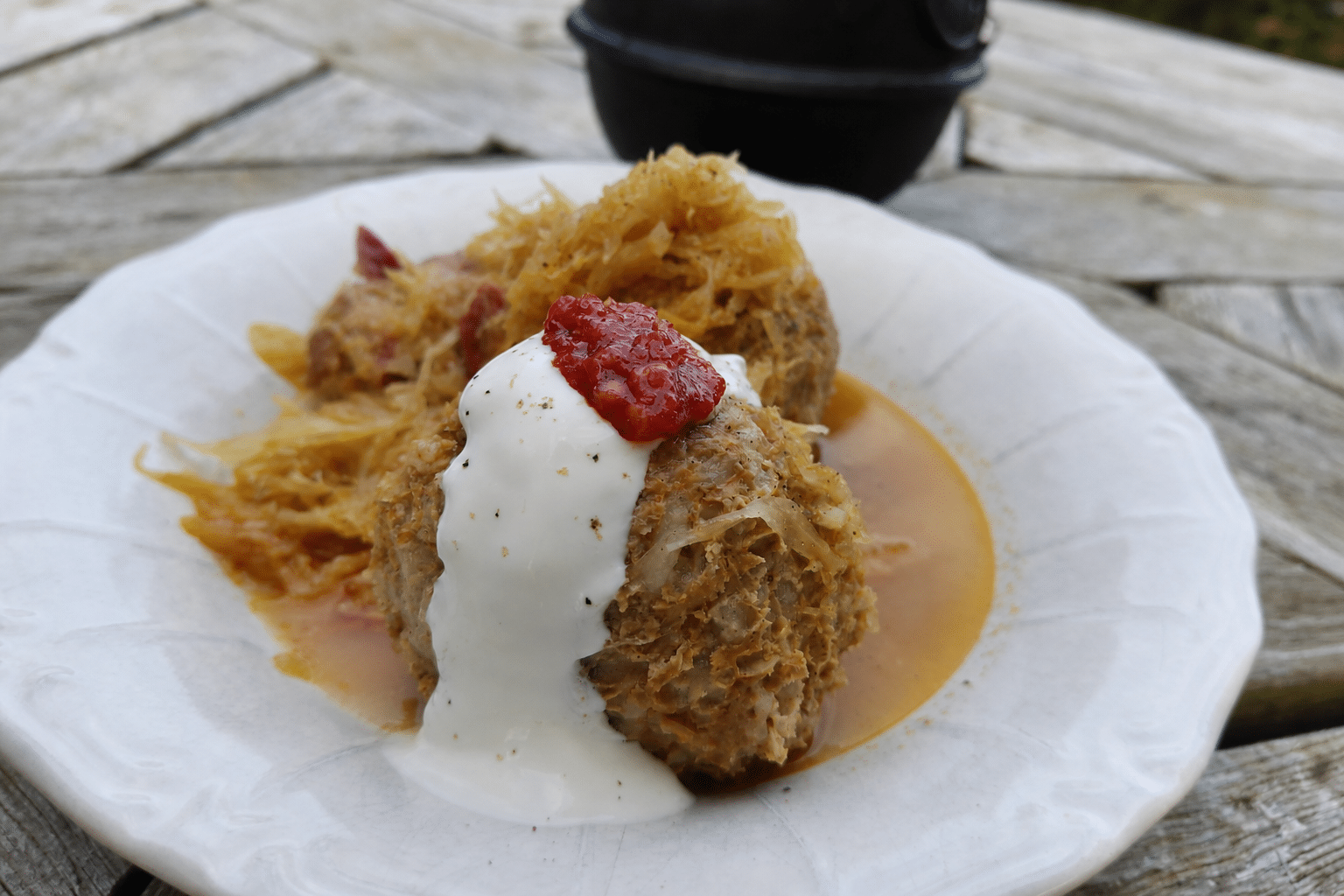

Töltött káposzta (say it roughly: “TULL-tutt KAH-poh-stah”) is Hungary’s celebration version of stuffed cabbage, and it is a serious step up from any generic version you may have encountered before. Seasoned ground pork and par-cooked rice get wrapped in softened cabbage leaves, then the whole pot simmers for two hours over a base of sauerkraut and smoked pork ribs. The sauerkraut is not a garnish here – it is the cooking medium, and it changes everything.
This is traditional Christmas food across Hungary and much of Central Europe. It shows up at family gatherings, holiday tables, and cold-weather Sunday dinners. If you have made Polish golabki or a plain tomato-sauce stuffed cabbage, the Hungarian approach will surprise you. The layering, the smoked meat, the caraway, the two full hours – this is a bigger, bolder dish.
It is also a great make-ahead. Töltött káposzta reheats beautifully, and many people will tell you it is even better on day two.
Why this recipe works
The sauerkraut does two things simultaneously. The rolls sit sandwiched between layers of kraut and braise for two hours, the acidity slowly working into the meat while the smoked ribs perfume the entire pot. By the end, the filling tastes as though it had been marinated overnight.
Starting the rice only half-done is what keeps the filling light and cohesive. Par-boil it for 7-8 minutes – still firm at the center – then let it finish absorbing liquid during the long braise. Use fully cooked rice and the filling turns heavy and gluey.
Sweet paprika and dried marjoram are the two flavor signals that place this firmly in Hungarian territory. They give warmth and fragrance with very few ingredients, and together with garlic they create a filling that is far more complex than it looks.
Ingredients
For the sauerkraut base:
- 1 lb (450g) smoked pork ribs; substitute smoked ham hock or thick-cut smoked bacon
- About 2.2 lbs (1 kg) sauerkraut, drained
For the filling:
- 1 1/3 lbs (600g) ground pork
- 3/4 cup (150g) white rice, uncooked
- 2 eggs
- 1 large onion (about 1 cup / 150-200g), finely chopped
- 6-8 garlic cloves (about 2 tablespoons / 20-30g), minced
- 2 tablespoons (14g) sweet paprika
- 1 teaspoon (6g) fine salt
- 1/2 teaspoon (2g) ground black pepper
- 1 teaspoon (2g) dried marjoram
- Oil or lard for sautéing
For assembly:
- About 1.1 lbs (500g) large cabbage leaves from 1 medium head (12-14 leaves)
- 1/2 teaspoon (2g) ground caraway seeds
To serve:
- Sour cream and fresh dill
Instructions
1. Sauté the onion. Heat a little oil or lard in a large, heavy pot over medium heat. Cook the finely chopped onion until soft and lightly golden, about 8-10 minutes.
Read more: Homemade rhubarb jam with vanilla: 20 minutes, four ingredients, better than any jar
2. Build the base. Remove the pot from the heat. Stir in the paprika and minced garlic. Add the smoked ribs and half the drained sauerkraut. Set aside.
3. Par-cook the rice. Bring a pot of salted water to a boil, add the rice, and cook for 7-8 minutes. The grains should still be firm at the center – half-done, not soft. Drain and let cool slightly.
4. Mix the filling. In a large bowl, combine the ground pork, par-cooked rice, eggs, salt, pepper, and marjoram. Mix until evenly combined.
5. Prep the cabbage leaves. Bring a large pot of water to a boil and submerge the whole cabbage head for a few minutes until the outer leaves soften. Peel them away one by one, returning the head to the boiling water to loosen the next layer. You need about 12-14 large, pliable leaves. Trim the thick rib at the base of each leaf flat so it rolls easily.
6. Roll. Place about 2 tablespoons of filling near the base of each leaf. Fold the sides in over the filling, then roll up away from you, tucking the ends underneath to seal. You want a firm, compact roll – snug but not so tight it will split.
Read more: Giouvetsi: the Greek one-pot where orzo pasta absorbs a rich braised meat sauce and comes out creamy
7. Layer the pot. Arrange the rolls tightly in a single layer over the sauerkraut base. Pack them close together so they support each other and stay put during the simmer. Cover with the remaining sauerkraut and sprinkle the ground caraway seeds over the top.
8. Simmer for 2 hours. Pour in enough water to come about halfway up the contents. Cover with a lid and cook over low heat for about 2 hours, until the cabbage is completely tender and the filling is cooked through. Check occasionally – the bottom should stay moist. Add a splash of water if the pot looks dry.
9. Check doneness. Ground pork must reach an internal temperature of 160°F (71°C) to be safe to eat. After 2 hours of covered simmering the rolls will be well past this, but a probe thermometer in the center of a roll will confirm it.
10. Serve hot with a generous spoonful of sour cream and a handful of fresh dill scattered over the top.
Tips and variations
Make it ahead. This is an ideal weekend dish that actively improves overnight. Reheat covered over low heat, adding a splash of water if the pot has dried out, and serve the next day.
Read more: Tortilla de patatas: the Spanish potato omelet that is just as good cold as it is warm
Smoked meat options. Smoked ribs give the deepest, most meaty base. A smoked ham hock is a solid substitute and will also release collagen that makes the braising liquid slightly richer. Thick-cut smoked bacon cut into chunks is the easiest option to find at any grocery store and works well.
Fermented cabbage leaves. Eastern European specialty stores sometimes carry whole fermented cabbage leaves packed in brine – not shredded kraut, but large leaves ready to roll with. If you can find them, use them in place of the blanched fresh leaves. They add a sharper, more authentic sour flavor and require no blanching.
How much to rinse the sauerkraut. The recipe calls for draining, not rinsing. For a sharper, more pronounced sour flavor in the finished dish, skip rinsing entirely. For a milder result, give the kraut a quick rinse under cold water before using.
Don’t skip the caraway. It is a small amount, but ground caraway sprinkled over the top before the lid goes on perfumes the entire dish during the long simmer. It is what makes this taste unmistakably Hungarian rather than generic stuffed cabbage.
This recipe makes 6 generous servings.